

The French Strategy of the Saarland. A German Federal State on the Way to a Living European Multilingualism
With the France Strategy, Saarland set out in 2014 to become an efficient multilingual German-French region within a generation.
French is to join German as a lingua franca and be complemented by English and other foreign languages.
With the motto “More languages - more opportunities”, the state, which is particularly marked by the Franco-German reconciliation, began to further deepen its European orientation. It is thus becoming the only multilingual state in the Federal Republic of Germany and a reference region for living European multilingualism.
How can such a fundamental process of change succeed for an entire region? How will it be possible for a proposal by the state government to ultimately become a project for society as a whole that is supported and driven forward by the population, the economy, local authorities, institutions and organizations? What progress is being made on the path to multilingualism and how is it being achieved? What remains to be done and in which areas do efforts need to be intensified? What further perspectives are emerging?
The text provides answers to these questions and shows how, through the proposal of a strong vision for the future and continuous participatory processes, movement and change ultimately emerge throughout the country and all social groups in great breadth jointly shape a concrete development and future goal for the region from the vision - with political and economic success not only in the local, regional and cross-border context, but also at the national, European level and beyond.
Christine Klos works as Head of the Department for Europe, International Cooperation, France and France Strategy in the Saarland State Administration since 2012.
Karl Terrollion is Head of the Saarland Liaison Office in Paris since 2019, responsible for regional partnerships and Franco-German cooperation (“France Strategy”) within the Saarland Department for European Affairs.
This publication is available the following languages (pdf):
- FRENCH: "La « Stratégie France » de la Sarre : un Land sur la voie d’un plurilinguisme européen en action".
- GERMAN: "Die Frankreichstrategie des Saarlandes. Ein deutsches Bundesland auf dem Weg zu einer gelebten europäischen Mehrsprachigkeit".

Author(s)
Related centers and programs
Discover our other research centers and programs
The Study Committee on Franco-German Relations (Cerfa)
The Study Committee on Franco-German Relations (Cerfa) was created in 1954 by an inter-governmental agreement between the Federal Republic of Germany and France, in order to raise awareness of Germany in France and analyze Franco-German relations, including in their European and international dimensions. In its conferences and seminars, which bring together experts, political leaders, senior decision-makers and representatives of civil society from both countries, Cerfa develops the Franco-German debate and stimulates political proposals. It regularly publishes studies through two collections: Cerfa notes and studies as well as Franco-German visions.
Cerfa maintains close relations with the network of German foundations and think tanks. In addition to its research and debate activities, Cerfa promotes the emergence of a new Franco-German generation through original cooperation programs. This is how in 2021-2022, Cerfa led a program on multilateralism with the Konrad Adenauer Foundation in Paris. This program is aimed at young professionals from both countries interested in the issues of multilateralism in the context of their activities. It covered a wide range of themes relating to multilateralism, such as international trade, health, human rights and migration, non-proliferation and disarmament. Previously, Cerfa had participated in the Franco-German future dialogue, co-led with the DGAP from 2007 to 2020, and supported by the Robert Bosch Foundation and the Daniel Vernet group (formerly the Franco-German Reflection Group) which was founded in 2014 upon the initiative of the Genshagen Foundation.
Find out more
Discover all our analyses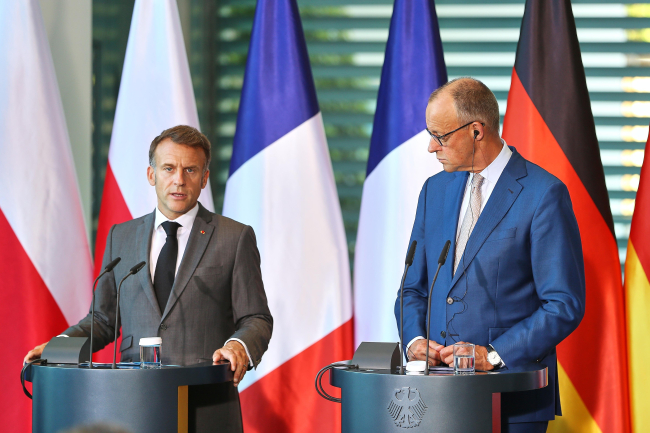
France-Germany: Overcoming Differences to Strengthen European Sovereignty
The Franco-German “reset” launched with Friedrich Merz’s appointment as Chancellor in May 2025 and given concrete form at the Franco-German Council of Ministers (FGCM) in Toulon in August 2025 was intended to address the structural challenges affecting the bilateral relationship. Yet it is clear that these ambitions have only been partially translated into concrete action. Since the beginning of 2026, Franco-German relations have entered a phase in which short-term challenges have combined with deeper divergences over priorities, policy approaches, and strategic culture.
Under construction: Europe’s economic repositioning in a fragmented international order
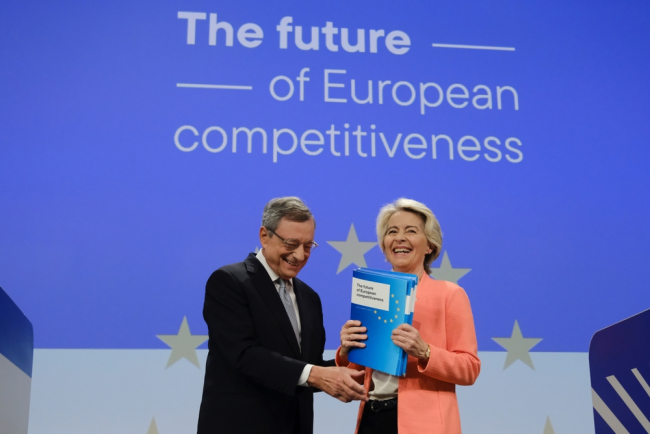
„Under Destruction“– this was this year’s motto at the Munich Security Conference. A motto that applies both to security and economy in an increasingly fragile international system. In 2024, Mario Draghi’s report on the EU’s competitiveness rang the alarm bell: Europe is slipping behind the US and China, European companies struggle with Brussels' bureaucracy, and the internal market is too fragmented. However, two years later only about 15 % of his recommendations were implemented: the wake-up call was not heard.
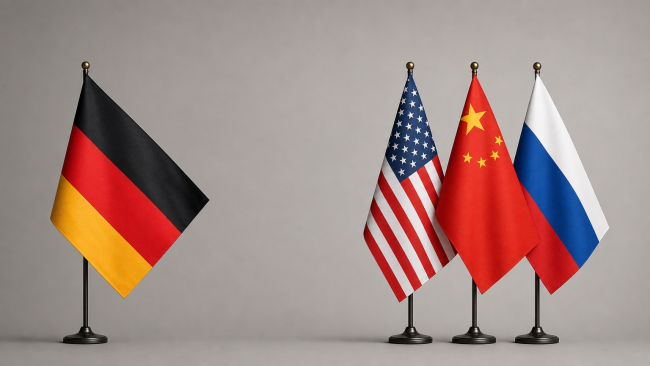
Germany in the Shadow of the United States, Russia, and China – Systemic Paradigm Shifts
Since reunification, Germany has built its prosperity on an international order based on free trade, multilateralism, and geopolitical stability. This model relied on three relationships considered complementary: U.S. military protection, Russian energy supplies, and economic integration with China. For several decades, Berlin viewed these interdependencies as factors contributing to peace, growth, and security.
France and EU Enlargement: From Strategic Hesitation to a Geopolitical Shift
Paris has come a long way in its approach to enlarging the European Union. However, French support remains fragile, due in part to a lack of public support.