



Practical information
Themes and regions
Related centers and programs

In the wake of Donald Trump's re-election in the United States, Europeans face a crucial imperative: rethinking their sovereignty, especially in the technological realm. What will be the strategic priorities and action levers of the new European Commission on this issue? What assessment can we make of the previous Commission’s achievements and challenges in navigating Sino-American technological competition, transatlantic dependencies, and emerging global partnerships?
The conference will address the need for Europe to assert its technological sovereignty by reducing reliance on external powers, fostering homegrown innovation, and forming strategic alliances. By reflecting on past policies and outlining future prospects, the objective is to provide a comprehensive roadmap for Europe to secure its place as a global technology leader amidst shifting geopolitical dynamics.
Keynote (13:45-14:15 CEST)
Gilles Babinet, Co-chairman of the National Digital Council
Bruno Sportisse, Chairman and CEO at Inria
Panel 1: Navigating Sino-American Competition (14:15-15:30)
The competition between China and the United States is reshaping the global technological landscape. From advancements in artificial intelligence to 6G networks, the race for technological supremacy has far-reaching implications for Europe. How can Europe position itself in this “tech cold war”?
Speakers:
Peter Sandler, Director, Directorate General for Trade and Economic Security, European Commission
Tobias Gehrke, Senior Policy Fellow, European Council on Foreign Relations
Agatha Kratz, Director, Rhodium Group
Moderator: Mathilde Velliet, Research Fellow, Geopolitics of Technology Center, Ifri
Panel 2: Mitigating Europe’s Dependence on the Other Side of the Atlantic (15:45-17:00)
Europe’s technological sector has long been intertwined with that of the United States. While this relationship has fostered growth and innovation, it also raises concerns about dependence. How can Europe become more strategically autonomous?
Speakers:
Pierre Chastanet, Head of Unit C3 – Microelectronics and Photonics, CNECT, European Commission
Sarah Guillou, Economist, OFCE Sciences Po
Mark Scott, Senior Resident Fellow, Atlantic Council
Moderator: Julien Nocetti, Associate Fellow, Geopolitics of Technology Center, Ifri
Panel 3: Embracing New Partnerships (17:15-18:30)
As the geopolitical landscape evolves, Europe must forge new partnerships to bolster its technological standing. At the same time, a global debate on risks is underway in various forums. Can we hope for a Brussels effect in these emerging partnerships?
Speakers:
Diana-Paula Gherasim, Research Fellow, Head of European Energy and Climate Policies, Energy and Climate Center, Ifri
Sanho Lim, Senior Specialist, Center for Economic Security and Foreign Affairs, Ministry of Foreign Affairs, Republic of Korea
Trisha Ray, Associate Director and Resident Fellow, GeoTech Center, Atlantic Council
Moderator: Laure de Roucy-Rochegonde, Head of the Geopolitics of Technology Center, Ifri
This event is public and will be held in English in a hybrid format (online and at Ifri).
Related Subjects
Other events
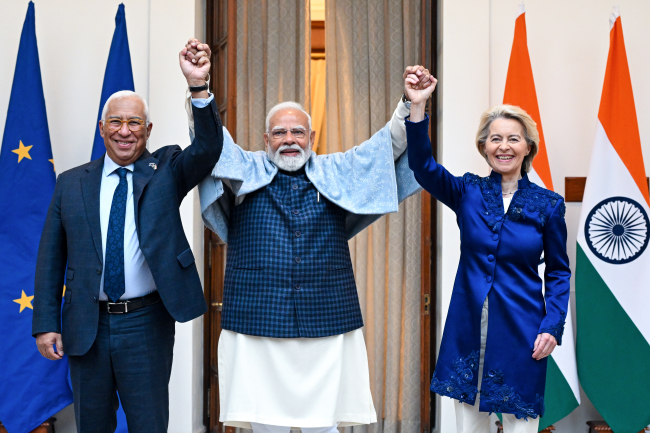
From Ambition to Action: Exploring Technological Partnerships with India
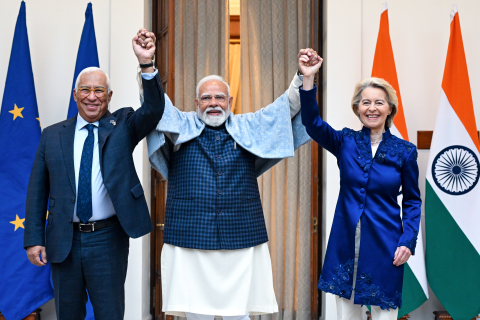
The 16th EU-India Summit, held on January 27th in New Delhi with European leaders António Costa, Ursula von der Leyen, and Prime Minister Narendra Modi, marks a significant milestone in deepening EU-India relations. At the same time, official bilateral visits from EU member states are on the rise, including that of the French President, who visited India in February to participate in the Artificial Intelligence Summit. As India asserts its technological ambitions and seeks to reduce its dependence on China, Europe is stepping up its efforts to diversify its strategic partnerships.
China’s New Five-Year Plan: Accelerated Electrification and Global Clean Tech Export Expansion?
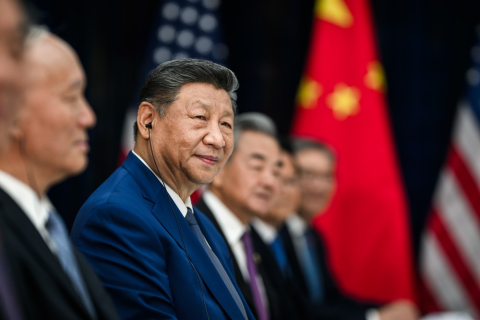
China's energy and clean tech sector developments are continuing to decisively impact the global energy system on the one hand, and to steer the country's economy towards rapid electrification on the other hand.
The Enlargement of the European Union: A Strategic Choice? France, the Western Balkans and the EU in an Uncertain Geopolitical Context
Russia’s war against Ukraine has brought the enlargement of the European Union back to the centre of European strategic debates. In this context, the Western Balkans have regained heightened visibility in discussions on the continent’s security, at a time when the international environment is marked by a growing number of destabilising factors.