


Toward a New European Security Order? Foreign Policy Shifts in Response to Russia’s War on Ukraine

Practical information
Russia’s war on Ukraine has shaken the foundations of Western foreign policy and the multilateral rules-based order. Institutions built to preserve this order – like NATO, the G7, and the EU – have had to rethink their threat assessments and postures. France, Germany, Italy, and the UK have been working hard to project unity. While it is now up to these large European countries to take up leadership for security on the continent and act in solidarity with those under attack, their foreign policies have come under growing scrutiny at home and abroad.

France’s President Emmanuel Macron, who had previously attempted to set the West’s relations to Russia on a new strategic footing and pushed for fundamental NATO reform, now finds himself acting as a crisis manager while facing legislative elections. Germany’s coalition government announced a paradigm shift in national security and defense policy but has yet to clarify what this sea change (“Zeitenwende”) entails. And Italy, like Germany, has been forced to face up to its close economic and energy ties with Russia. The war has also encouraged rapprochement between the EU and UK and revived the thorny question of how to best coordinate on security matters.
In this online discussion, we will take stock of how Russia’s invasion of Ukraine has changed national foreign and security policies and how these shifts affect Europe’s security architecture. Last year, a group of experts recommended ways of strengthening Europe’s and Germany’s capacity to act in the “Smart Sovereignty” report published by DGAP, which we will revisit and assess in the current context.
Speakers:
Dr. Thomas Gomart, Director, Ifri
Dr. Robin Niblett, Director and Chief Executive, Chatham House
Prof. Dr. Daniela Schwarzer, Executive Director Europe and Eurasia, Open Society Foundations
Prof. Dr. Nathalie Tocci, Director, Istituto Affari Internazionali
Moderator:
Sylvie Kauffmann, Editorial Director & Columnist, Le Monde; Fellow, Robert Bosch Academy Berlin
Related Subjects
Other events
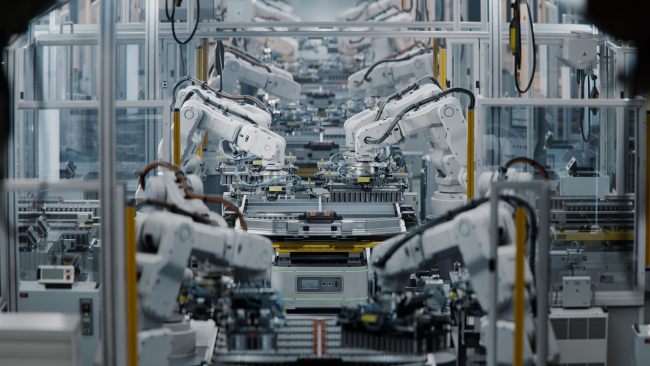
EV Supply Chains for Japan and Europe: Strengthening Economic Security
Economic security aims to ensure the resilience of supply chains for key industries: the case of electric vehicle production in Japan and Europe will be discussed.
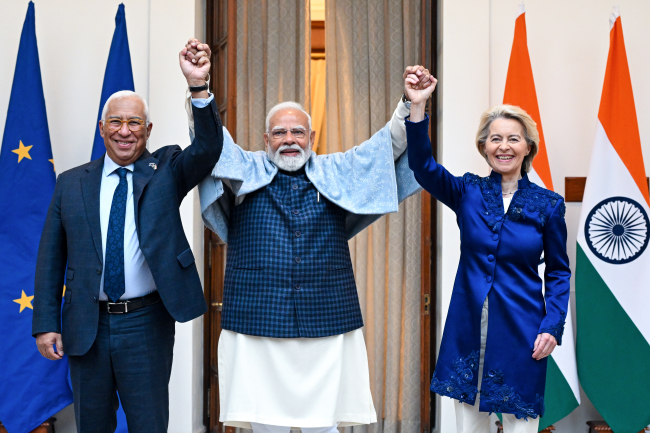
From Ambition to Action: Exploring Technological Partnerships with India
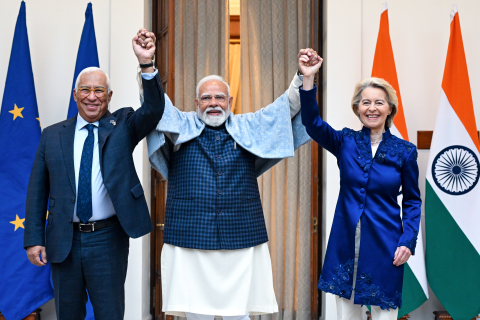
The 16th EU-India Summit, held on January 27th in New Delhi with European leaders António Costa, Ursula von der Leyen, and Prime Minister Narendra Modi, marks a significant milestone in deepening EU-India relations. At the same time, official bilateral visits from EU member states are on the rise, including that of the French President, who visited India in February to participate in the Artificial Intelligence Summit. As India asserts its technological ambitions and seeks to reduce its dependence on China, Europe is stepping up its efforts to diversify its strategic partnerships.