

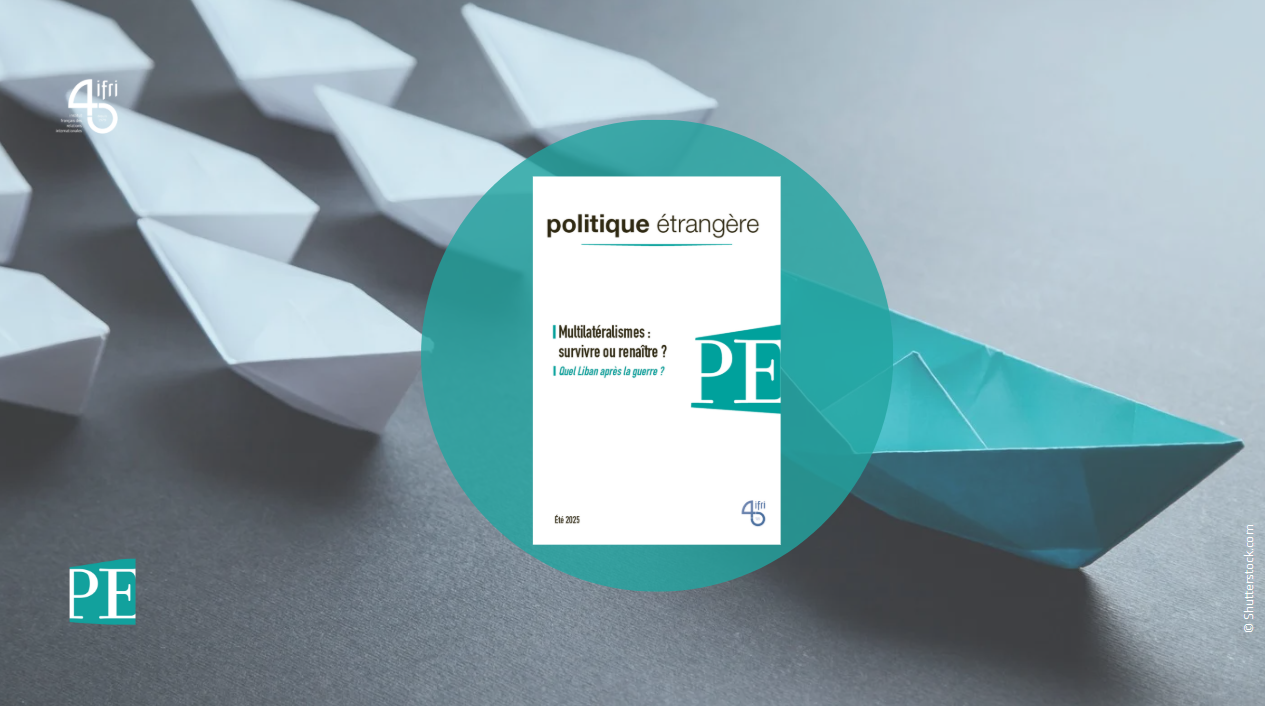
Navigating the Multilateral Seas: Lost in Decomposition? - Politique étrangère, Vol. 90, No. 2, Summer 2025
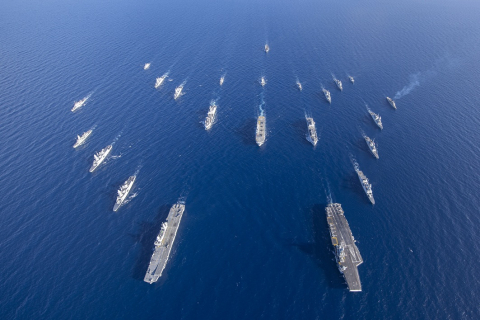
Institutionalized multilateralism seems to be under threat from power politics, especially within the UN system. There are continuing demands for the UN to be reformed. And flexible forms of consultation are being developed, such as club diplomacy and minilateralism. The reshaping of multilateralism is thus taking place mainly outside the institutional system, and its distance from the liberal international order and the multipolar order makes it less likely that the earth's habitability will be placed at the top of the multilateral agenda.
Frédéric Ramel is Professor of Political Science at Sciences Po Paris. As researcher at the Centre de recherches internationales (CERI), he co-directed the ANR DATAWAR program (2019-2023) and coordinates the Groupe de recherche sur l'action multilatérale (GRAM) at CNRS. He has just published Espace mondial (Paris, Presses de Sciences Po, 2024).
Article available in French only, published in Politique étrangère, Vol. 90, No. 2, Summer 2025.

Available in:
Themes and regions
Share
Download the full analysis
This page contains only a summary of our work. If you would like to have access to all the information from our research on the subject, you can download the full version in PDF format.
Navigating the Multilateral Seas: Lost in Decomposition? - Politique étrangère, Vol. 90, No. 2, Summer 2025
Author(s)
Find out more
Discover all our analyses
2029, the Great Asian Renaissance
Asians were dominated and sometimes humiliated by Westerners during the last two centuries. Today, they look to the future with confidence. In 2050, the world’s two leading powers are likely to be China and India. The great Asian Renaissance will lead to geopolitical upheavals. China-US tensions are already visible and conflicts may emerge between Asian powers. Yet the clash of civilizations is not inevitable.
Between the Lines of Questionable Battles
This article was published in Politique étrangère in 1979, the year the French Institute of International Relations (Ifri) was founded. In it, Raymond Aron reviews important events of the previous decade, such as the Vietnam War. He particularly reflects on the place of law, morality, force and national interest in international relations. Related topics, like the right to intervene and the responsibility to protect, are implicitly included in this article.
A Vibrant and Flexible Alliance
NATO has proved its renewed usefulness and is today fully engaged, well beyond its former frontiers, wherever its interests and those of its members are threatened.
NATO: From Washington (1949) to Strasbourg/Kehl (2009)
The Alliance cannot avoid a strategic debate about its role, missions and resources. This may be painful, but it will ensure clarity and prepare the Alliance for future challenges.