


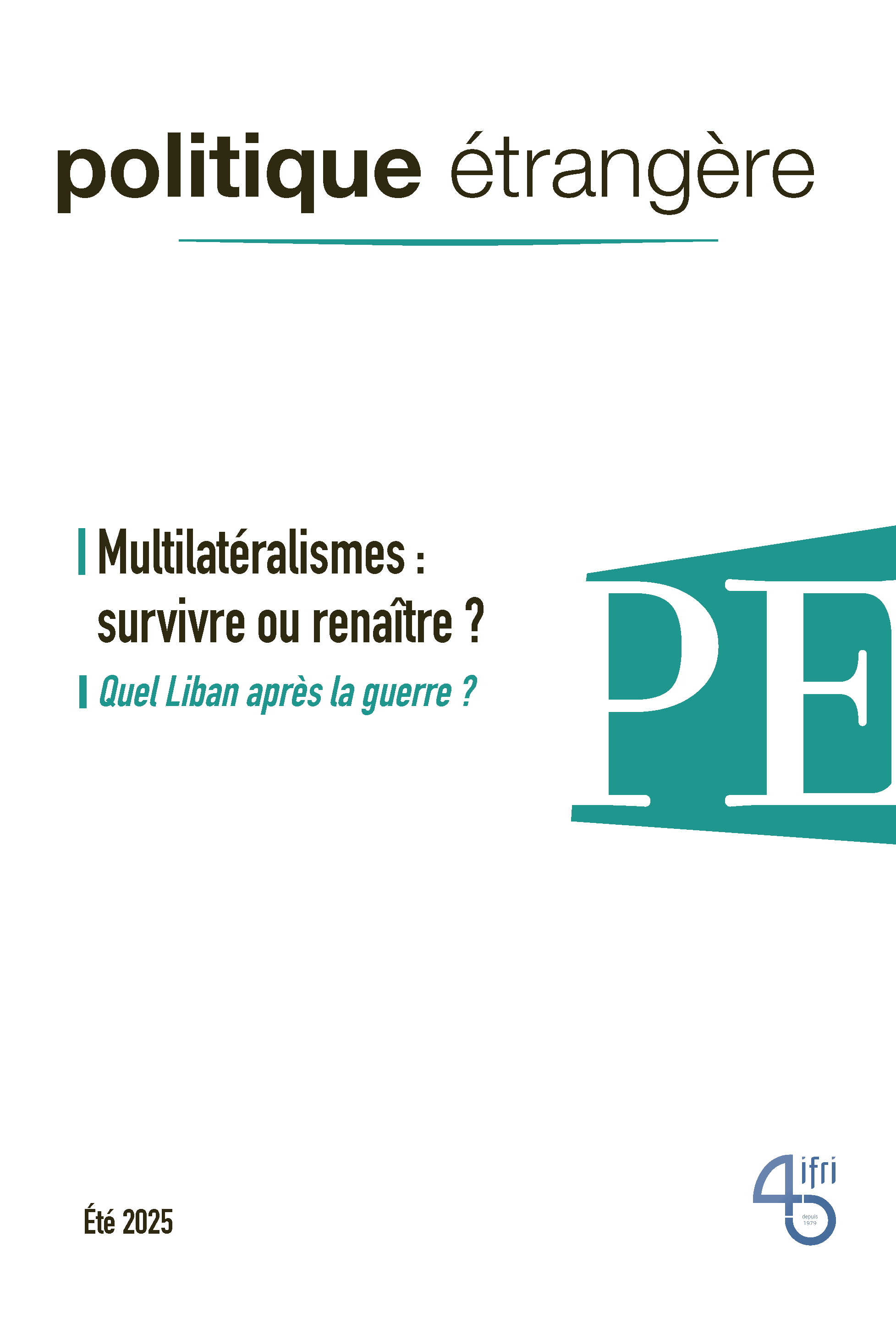
Multilateralisms: Survival or Revival?
The organized multilateralism born out of the Second World War and the Cold War, and revived in the 1990s with the dream of a world of peaceful “global governance,” has fizzled out. The erosion of the large universal frameworks (United Nations, World Trade Organization, arms control and disarmament, international criminal justice, and so on) did not give way to a void but to an excess: a multitude of agreements and schemes that bore witness to the accelerated rebuilding of international relationships. Will institutional anarchy and the open competition of interests visible in uninhibited struggles for power be able to organize themselves around common fundamental interests in the future?
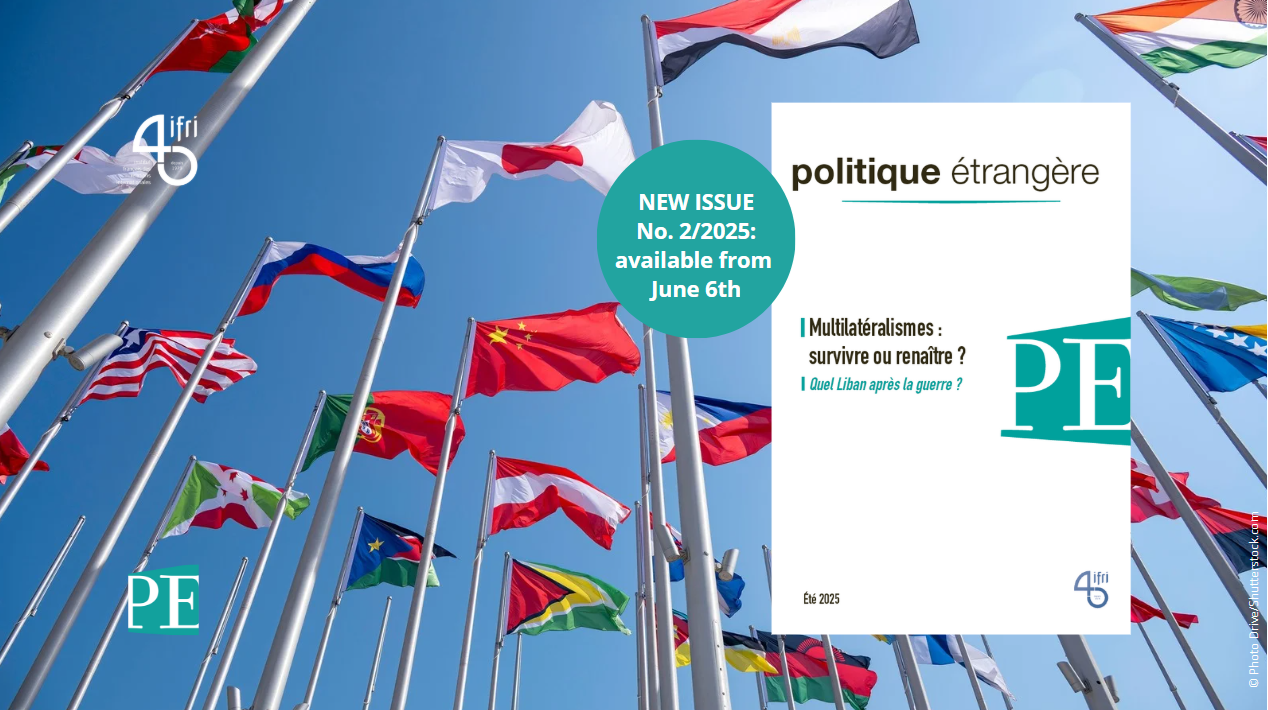
Today, Lebanon symbolizes all the ambiguity resulting from almost two years of war in Gaza. Once again, the question relates to political and institutional recomposition, the reconstitution of a Lebanese army in charge of guarding its borders. But it is common knowledge that beyond its internal complexity, Lebanon’s future depends on the general fate of the region: Will Israel accept a political solution to Gaza, downgrading the aggressiveness of Hezbollah? Can Syria and Jordan retain a degree of stability? Can relations with Iran be normalized to an extent through a nuclear agreement?
Whether we focus on the complex issues of the Middle East or choose to observe the international system as a whole, the era has all the hallmarks of a time of change, with no certainty on what lies ahead.
MULTILATERALISMS: SURVIVAL OU REVIVAL?
Saving the UN, Saving Multilateralism, by Bernard Miyet
Navigating the Multilateral Seas: Lost in Decomposition?, by Frédéric Ramel
Preparing for and Responding to Pandemics, by Michel Kazatchkine
The Faces of Multilateralism: Arms Control and Disarmament, by Serge Sur
Digital Challenges: Fragmented Governance, by Benjamin Pajot
WHAT WILL POSTWAR LEBANON LOOK LIKE?
Lebanon 2025: Where Wars Intersect, by Joseph Maïla
Lebanon: How Much has Changed?, by Nabil el Khoury
CURRENT AFFAIRS
Syria: Post Assad, the Trap of Permanent Conflict, by Fabrice Balanche
The Baltic Sea and the War in Ukraine, by Philippe Perchoc
BAROMETERS
The “Europe of Internal Security”: An Unknown Quantity, by Jean Mafart
France and Chad: One Crisis after Another, by Nathaniel Powell
South Caucasus: History, Europeanness and Geostrategy, by Pierre Andrieu
REFLECTIONS
The IMEC: Trade Routes in a Multipolar World, by Simon Savary
224 pages. 23 euros.
June 6th, 2025.
Diffusion : Pollen/Dif'Pop.
Subscription: Armand Colin.
To buy an issue: leslibraires.fr.
To buy the Epub (in French): Immatériel.fr.
Have a look on Politique étrangère's blog: Politique étrangère.

Available in:
Themes and regions
ISBN / ISSN
Share
Download the full analysis
This page contains only a summary of our work. If you would like to have access to all the information from our research on the subject, you can download the full version in PDF format.
Multilateralisms: Survival or Revival?

Author(s)
Find out more
Discover all our analyses
New Global Challenges and European Security
In this special issue of Politique étrangère devoted to the proceedings of the conference organized by Ifri on April 10, 2019, in the Grand Amphitheater of the Sorbonne, on the occasion of its fortieth anniversary, discover the debate moderated by Nicole Gnesotto between Julian King, Jean-Marie Guéhenno, Wolfgang Ischinger, Nathalie Tocci, Hubert Védrine.
Industry Response to New Protectionism
In this special issue of Politique étrangère devoted to the proceedings of the conference organized by Ifri on April 10, 2019, in the Grand Amphitheater of the Sorbonne, on the occasion of its fortieth anniversary, discover the debate moderated by Thierry de Montbrial between Jean-Paul Agon and Patrick Pouyané.
What Can Europe Hope to Achieve in Tomorrow's World?
In this special issue of Politique étrangère devoted to the proceedings of the conference organized by Ifri on April 10, 2019, at the Grand Amphitheater of the Sorbonne, on the occasion of its fortieth anniversary, discover the debate moderated by Christine Ockrent between Franziska Brantner, Jean-Louis Boulanges, Bernardino Leon, and Igor Yurgens.
The Future of Think Tanks
In this special issue of Foreign Policy devoted to the proceedings of the conference organized by Ifri on April 10, 2019, in the Grand Amphitheater of the Sorbonne, on the occasion of its fortieth anniversary, discover the debate moderated by Bassma Kodmani between Thomas Bagger, Thomas Gomart, Robin Niblett, and Daniela Schwarzer.