





Practical information
Despite the political tensions that oppose Japan, China and South Korea, recent months have seen a certain rapprochement between Tokyo, Seoul and Beijing. The first trilateral summit in three years was held in November 2015.
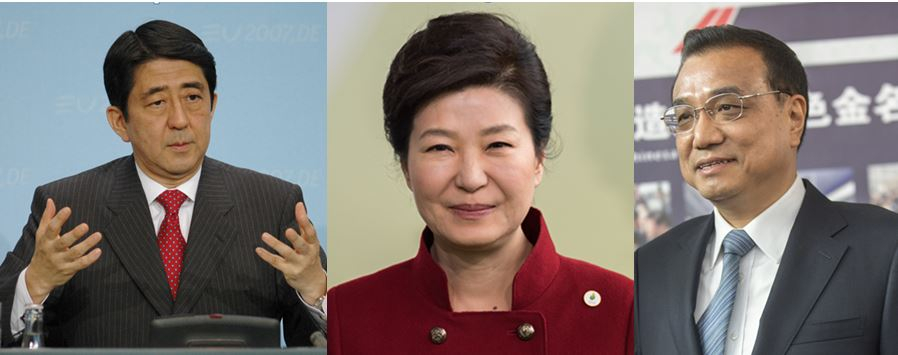
The neighbors indeed share strong interests that push them to cooperate in a pragmatic way, be it on economic and trade issues, or on strategic matters, such as towards North Korea.
This seminar will gather a researcher from each of these three countries to explain and discuss the possibilities for trilateral cooperation despite the undercurrent political friction. The seminar will take the form of a debate moderated by Marc Epstein, Foreign News Editor at the weekly magazine L’Express.
Speakers:
· CHUN Chaesung, Professor, Seoul National University
· HUANG Renwei, Vice-President, Shanghai Academy of Social Science
· TERADA Takashi, Professor, Doshisha University, Kyoto
Moderator: Marc EPSTEIN, Foreign News Editor, L’Express
Discussant: Alice EKMAN, Research fellow, Head of China research, Center for Asian Studies, Ifri
Chair and discussant: Françoise NICOLAS, Director, Center for Asian Studies, Ifri
The seminar will be held in English.
Replay
Find out more
Nationalism in China and Japan and Implications for Bilateral Relations
Nationalism appears to be an important part of the growing frictions between China and Japan.
In Japan, the return to power of Shinzo Abe as prime minister, and the historic breakthrough of an extreme right-wing party onto the political scene reinforce the view that there has been a clear shift to the right. Public opinion is today also more realistic about direct security threats to Japan.