Watch and listen
Our research fellows intervene in the public debate and bring their light to the French and international media. Find all their media interventions.
U.S. Foreign Policy in the Age of Trump
Despite a very particular style, the Trump administration's foreign policy continues on many points the American withdrawal from World affairs which had started under Barack Obama. The main trends of thought of American foreign policy show this evolution, with the resurgence of non-interventionist and even nationalist ideas amongs DC think-tankers.
The 2020 Campaign and the Impeachment Process. Conference video
The Democratic Party primary campaign is in full swing and the Impeachment inquiry against Donald Trump proceeds speedily. What is the state of American public opinion less than a year before the elections? How are conservative and progressive media lining up to cover the event?
The Changing Political Agenda and Role of Think Tanks in the Next Decade. Video
A debate in the framework of the 12th regional conference of Council of Councils (CoC) in Paris between Thierry de Montbrial, Executive Chairman of Ifri and Richard N. Haass, President of Council on Foreign Relations (CFR). Moderator: Sophie Pedder, Paris Bureau Chief, The Economist.
What is the state of democracy in Africa?
An interview with Olusegun Obasanjo, former President of Nigeria.
Strategic stability: what future in the context of confrontation between Moscow and Washington?
An interview with Andrey KORTUNOV, Director General of the Russian International Affairs Council (RIAC).
Marc-Antoine Eyl-Mazzega on Global Energy, Valdai Discussion Club
Marc-Antoine Eyl-Mazzega, director of Ifri’s Centre for Energy, discusses various issues related to the energy market, from the strategic move of Russia towards Saudi Arabia and the role of the United States to the recent prices collapses and gas crises.
How will Middle America vote in 2020? (Henry Olsen)
An interview with Henry Olsen, Senior Fellow, Ethics and Public Policy Center (EPPC).
Transatlantic relations in the age of "America First" (James Lindsay)
An interview with James Lindsay, Senior Vice President, Council on Foreign Relations.
How will Middle America vote in 2020? (Lara Putnam)
An interview with Lara Putnam, Professor and Chair, History Department, University of Pittsburgh.
Transatlantic relations in the age of "America First" (Sophia Besch)
An interview with Sophia Besch, Research Fellow, Center for European Reform.
The roots of anti-environmentalism in the U.S.
An interview with Peter Jacques, Professor of Political Science, University of Central Florida.
Jeremy SHAPIRO - Trump: One Year After The Election
Has Trump changed his views of transatlantic relations? What should Europeans do? Is Trump's Russia policy dictated by the Russia probe?
Michala MARCUSSEN - Trump: One Year After The Election
Is the American economy doing well? Will the Tax Reform change this? How could the bond markets evolve in 2018?
Jeffrey GOLDBERG - Trump: One Year After The Election
3 questions to Jeffrey GOLDBERG, Editor in Chief, The Atlantic
Karlyn BOWMAN - Trump: One Year After The Election
3 questions to Karlyn BOWMAN, Senior Fellow, American Entreprise Institute
Sanctions on African countries: what impact?
What is the role of international NGOs regarding the sanctions process?
Migration in Eastern Africa: Regional Challenge, Global Issue
An interview with Jeffrey LABOVITZ, International Organization for Migration (IOM) Nairobi Regional Director
Where is the U.S. nuclear arsenal headed?
An interview with Jon WOLFSTHAL, nonresident scholar, Nuclear Policy Program, Carnegie Endowment for International Peace
Reforming the EU electricity markets - Florian ERMACORA
Florian Ermacora, Head of the Internal Energy Market Unit in DG Energy, explains how the Clean Energy Package will improve the functioning of the internal electricity market, and how the new market design will help integrating larger shares of renewables.
ENTSO-E's views on the Clean Energy Package - An Interview with Laurent SCHMITT
Laurent Schmitt, Secretary General, ENTSO-E, explains how to improve cooperation between transmission system operators and strengthen security of electricity supply, and how the Clean Energy Package will enhance the design of electricity market as a continuation of the network codes.

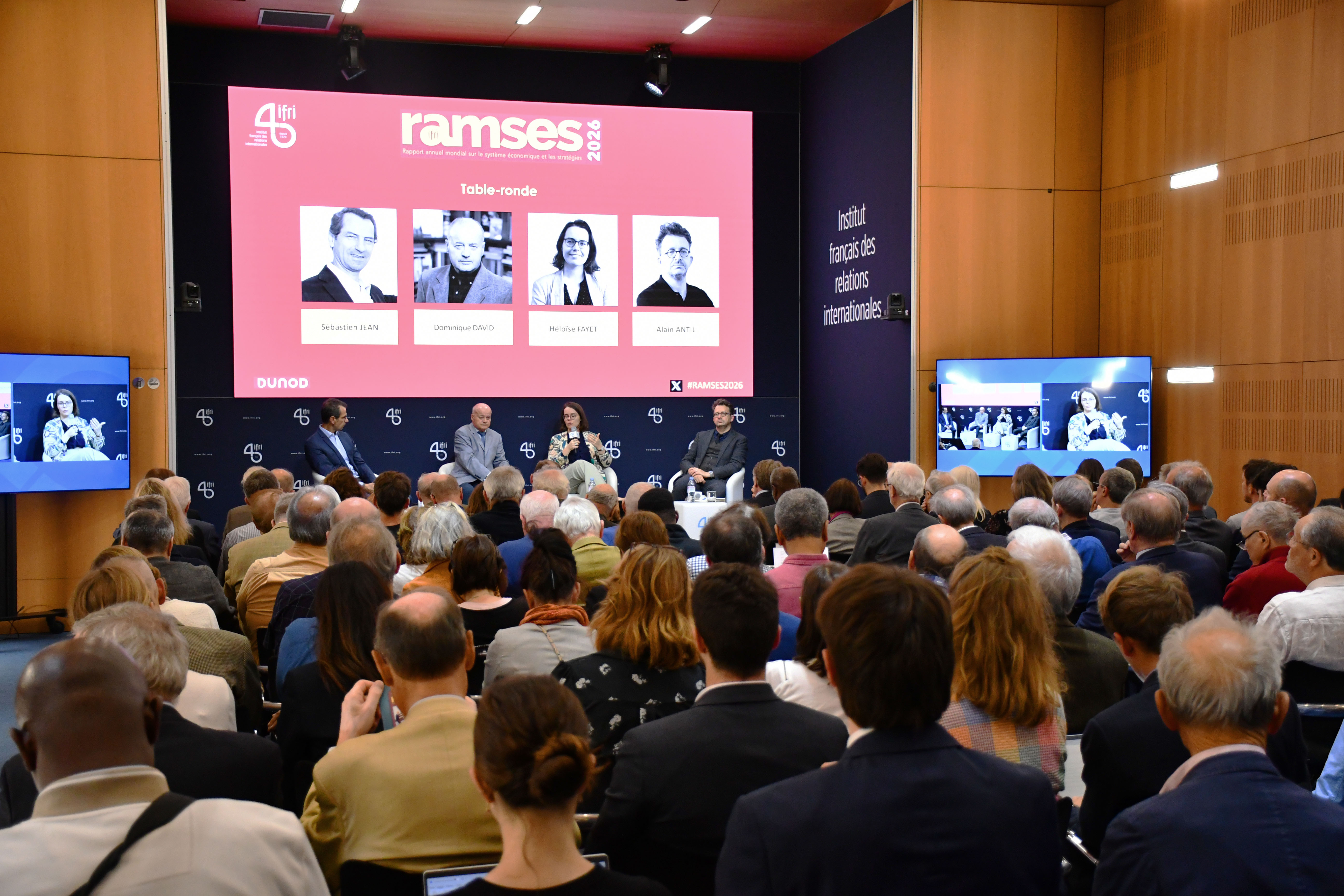
Ifri, a foundation recognized as being of public utility, relies largely on private donors – companies and individuals – to guarantee its sustainability and intellectual independence. Through their funding, donors help maintain the Institute's position among the world's leading think tanks. By benefiting from an internationally recognized network and expertise, donors refine their understanding of geopolitical risk and its consequences on global politics and the economy. In 2026, Ifri partners with over 90 French and international companies and organizations.
Titre container
Latest appearances
Titre en savoir plus
Discover our media interventions
Discover our media interventions
Titre en savoir plus
You would like our research fellows to participate in interviews and debates with your media channels
You would like our research fellows to participate in interviews and debates with your media channels