



Food Systems in the Pacific: Addressing Challenges in Cooperation with Europe
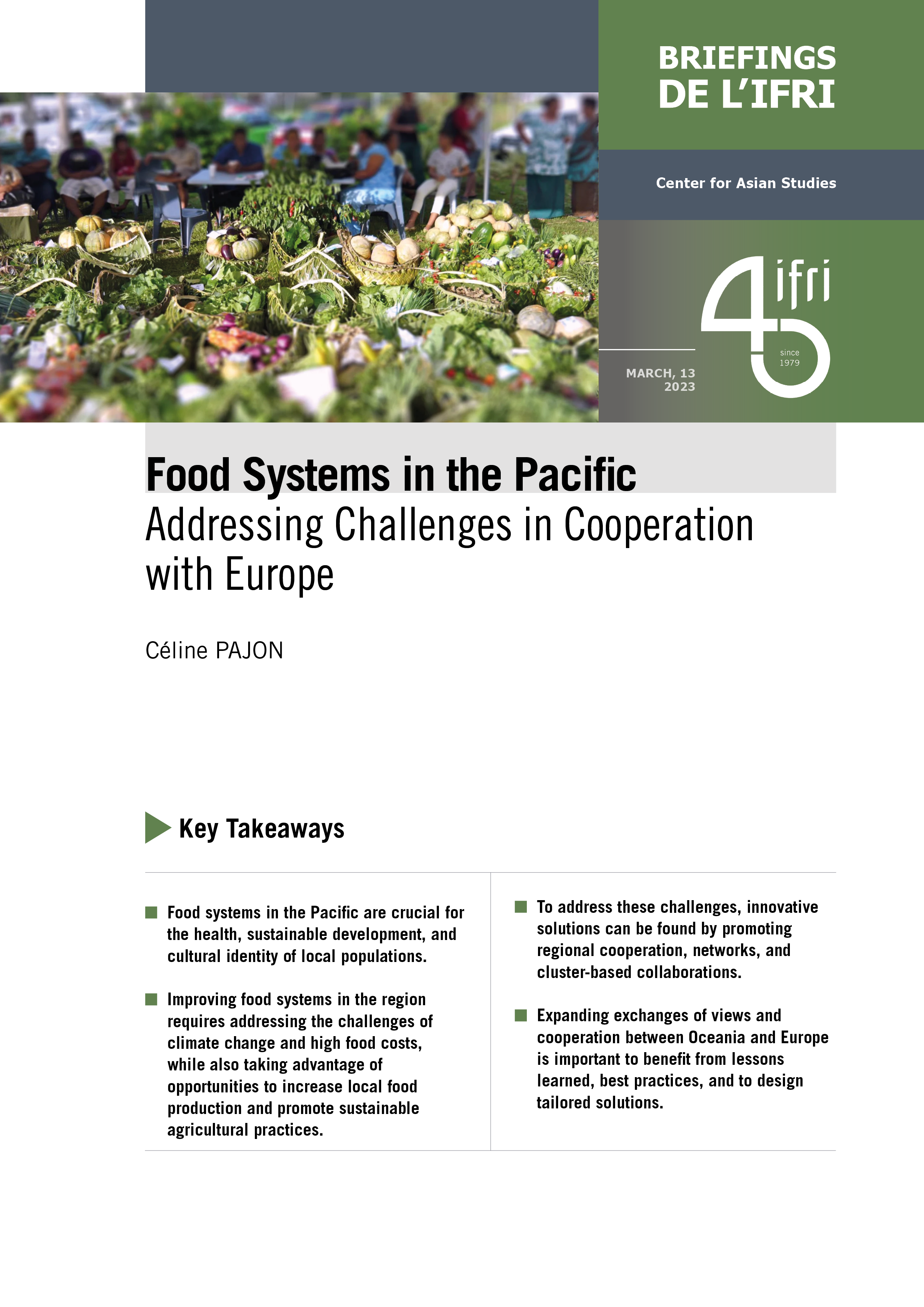
More frequent climate disasters, rising sea levels, the economic fallout of Covid-19 lockdowns, border closures, supply chain constraints, and the global impact of the war in Ukraine have aggravated the challenge of maintaining sustainable and resilient food systems for Pacific Island Countries (PICs).
Food systems in PICs are of great importance due to their impact on the health and well-being of Pacific peoples, local livelihoods, and national economies. Between 50 and 70% of Pacific people depend on agriculture and fishing activities for their livelihoods. The Pacific is home to extensive crop biodiversity, and Pacific countries are developing unique value chains for markets and international supply. However, they also face unique challenges in realizing equitable benefits in the global food system. Additionally, the Pacific needs to tackle issues like malnutrition and non-communicable diseases. Urgent global and local action is needed to manage climate change and other risks and ensure resilient food systems.
Europeans are also confronted with the global food crisis and are actively working with their Pacific partners to find and fund solutions to address current and future risks by investing in local sustainable food systems. This Briefing explains the complex issues at stake regarding food systems in PICs and explores ways to address these challenges, both at the local level and in cooperation with Europeans.
This Briefing is based on discussions that took place during the webinar "Food Security in Times of Crisis: Connecting the Pacific and Europe," organized by the French Institute for International Relations (Ifri)'s Pacific Islands Program in partnership with the Pacific Community (SPC) on December 8, 2022. Contributions from panelists will, therefore, be highlighted.
This Briefing was supported by the Pacific Community (SPC):

This page contains only a summary of our work. If you would like to have access to all the information from our research on the subject, you can download the full version in PDF format.
Food Systems in the Pacific: Addressing Challenges in Cooperation with Europe



Céline PAJON
Research Fellow, Head of Japan and Indo-Pacific Research, Center for Asian Studies, Ifri

Center for Asian Studies
Asia is a nerve center for multiple global economic, political and security challenges. The Center for Asian Studies provides documented expertise and a platform for discussion on Asian issues to accompany decision makers and explain and contextualize developments in the region for the sake of a larger public dialogue.
The Center's research is organized along two major axes: relations between Asia's major powers and the rest of the world; and internal economic and social dynamics of Asian countries. The Center's research focuses primarily on China, Japan, India, Taiwan and the Indo-Pacific, but also covers Southeast Asia, the Korean peninsula and the Pacific Islands.
The Centre for Asian Studies maintains close institutional links with counterpart research institutes in Europe and Asia, and its researchers regularly carry out fieldwork in the region.
The Center organizes closed-door roundtables, expert-level seminars and a number of public events, including an Annual Conference, that welcome experts from Asia, Europe and the United States. The work of Center’s researchers, as well as that of their partners, is regularly published in the Center’s electronic journal Asie.Visions.

China as an ambivalent supporter of the WTO and the multilateral trading system
Amid rising trade tensions between Europe and China and broader uncertainty in the international rules-based trade regime, Beijing has worked to preserve and bolster the multilateral trading system while at the same time failing to reform the domestic policies that have served to undermine that same system.

Pakistan and the Israel-Palestine Conflict: Transformation in Pakistan’s Approach After the War in Gaza
Pakistan has long combined vocal support for the Palestinian cause with covert engagement with Israel. Since the war in Gaza, this balance has become untenable: public opinion is united against Israel, joining Trump’s Board of Peace has drawn rare cross-party criticism, and new regional alignments put normalization out of reach.
The Oceania Factor in France’s Evolving Indo-Pacific Strategy
This paper examines the two-way relationship between France’s Indo-Pacific strategy and developments in Oceania. Oceania was not a priority in the initial years of France’s Indo-Pacific strategy, as the region was largely treated as secondary to major strategic hotspots and key partnerships, while overseas territories were primarily handled as domestic issues and recipients of a top-down strategy.
France’s View: From Diplomacy to Public-Private Action
France has emerged as the EU’s IMEC forerunner, combining port infrastructure, diplomatic alliances and public-private cooperation. With Marseille Fos at its core, the country brings a strategic hub for logistics, energy and digital connectivity to the corridor.