





Practical information
Event reserved for our donators.
Find out more about our donor programs
Paris, July 21th, 2014: After Evian, Marrakech, Vienna, Cannes and Monaco, the 2014 World Policy Conference (WPC) will be held at the Conrad Hotel in Seoul, Korea, from December 8th to 10th, 2014.
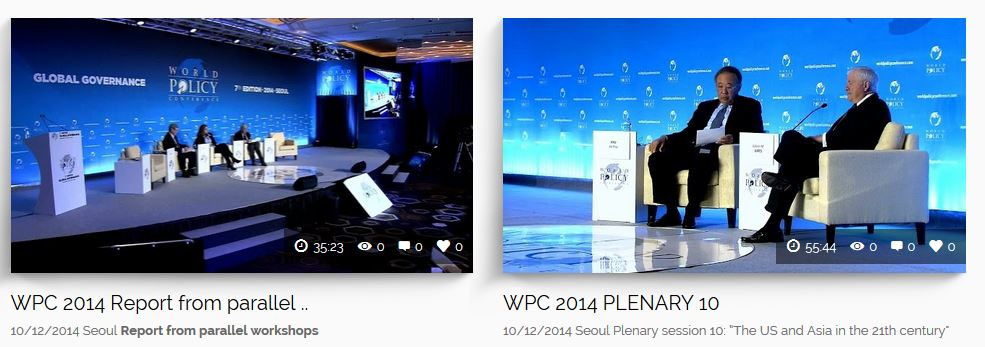
For this 7th edition, about 300 preeminent participants, including political and business leaders, civil society figures, intellectuals, and opinion leaders will gather in Seoul to discuss and structure the fundamental, current issues of worldwide governance. Among the topics that will be addressed are:
- The future of the Korean peninsula
- Security in Asia and Europe
- Climate change
- The economy, with special focus on the ASEAN and MIKTA
- Internet of Things (IoT) and Big Data
Since its launch in 2007, the WPC has hosted some of the world’s foremost figures as well as political, business and social decision-makers such as Ban-Ki Moon, Jean-Claude Trichet, Nicolas Sarkozy, Laurent Fabius, Mario Monti, Joschka Fischer, Prince Albert II, Dmitri Medvedev, Alassane Ouattara, and Prince Turki Al-Faisal.
Leaders whose attendance this year has already been confirmed include, Heads of State and Heads of Government in office, as well as prominent diplomatic and business figures. In particular, the 7th WPC will host widely renowned Asian figures.
Thierry de Montbrial, Managing Director of the IFRI (French International Relations Institute) and founder of WPC, said, “With this seventh edition in Seoul, the WPC has reached the age of reason, and this at the same time as it is becoming totally global, as it was meant to in accordance with its purpose.”
As previous editions have done, this first WPC to take place in Asia will address the five pillars of discussion about governance:
- Globalisation (stemming from the ICT revolution)
- World diversity (between nationalism and the search for identity)
- Major risk prevention (environmental and financial)
- Leadership (involving the Gs, companies known as international giants, civilisations and the major regions)
- Dialogue between civilisations (EU, ASEAN, religions and peace)
Thierry de Montbrial adds, “For the foreseeable future, our intent is to discuss those issues in more depth and with participants hailing from all walks of life, from both the private and public sphere, and whose personal or institutional standing will help the club that we have become to bring a powerful influence to bear in a debate which is vital to humankind.”
The WPC is the only international conference fully devoted to improving worldwide governance. It is part of a movement with no historical precedent, which could bring forth a worldwide civil society, strong enough to boost an international community that still is in its infancy.
Contact:
Dr. Song-Nim Kwon, Executive Director
Phone: +33 (0)1 40 61 72 81
E-mail : [email protected]; [email protected]
www.worldpolicyconference.com
Replay
Other events
COP31 in Antalaya: State of the Global Climate Governance, Issues, Perspectives
COPs have become a year-end marathon to revigorate a world now entering the era of climate overshoot. While Türkiye exhibits the largest coal-fired power generation in OECD Europe, it has embraced the electrification agenda and aims at joining forces with Australia on fostering action and implementation. This is an unusual de facto co-presidency arrangement, but one that could yield promising results. This webinar will take stock of what climate governance has achieved and of the issues still to be negotiated, and explore what impetus this Turkish–Australian partnership could provide.
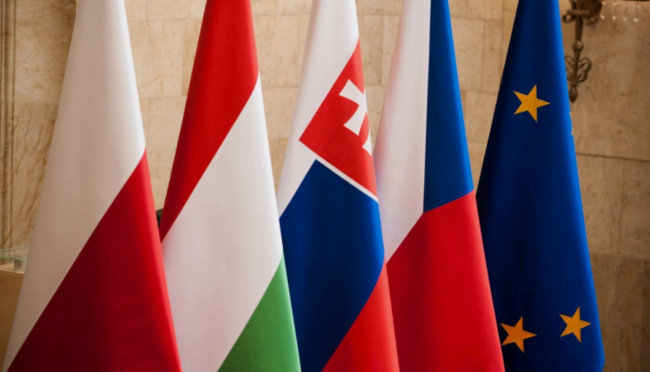
A New Moment for Central Europe? Regional Cooperation in a Time of European Strategic Choices
Recent political developments in Central Europe have revived the debate about the future of regional cooperation and the Visegrád Group. Changes in Hungary, Poland, the Czech Republic and Slovakia, together with Austria’s growing interest in closer cooperation with its neighbours, could create new opportunities for dialogue and coordination around shared priorities.