

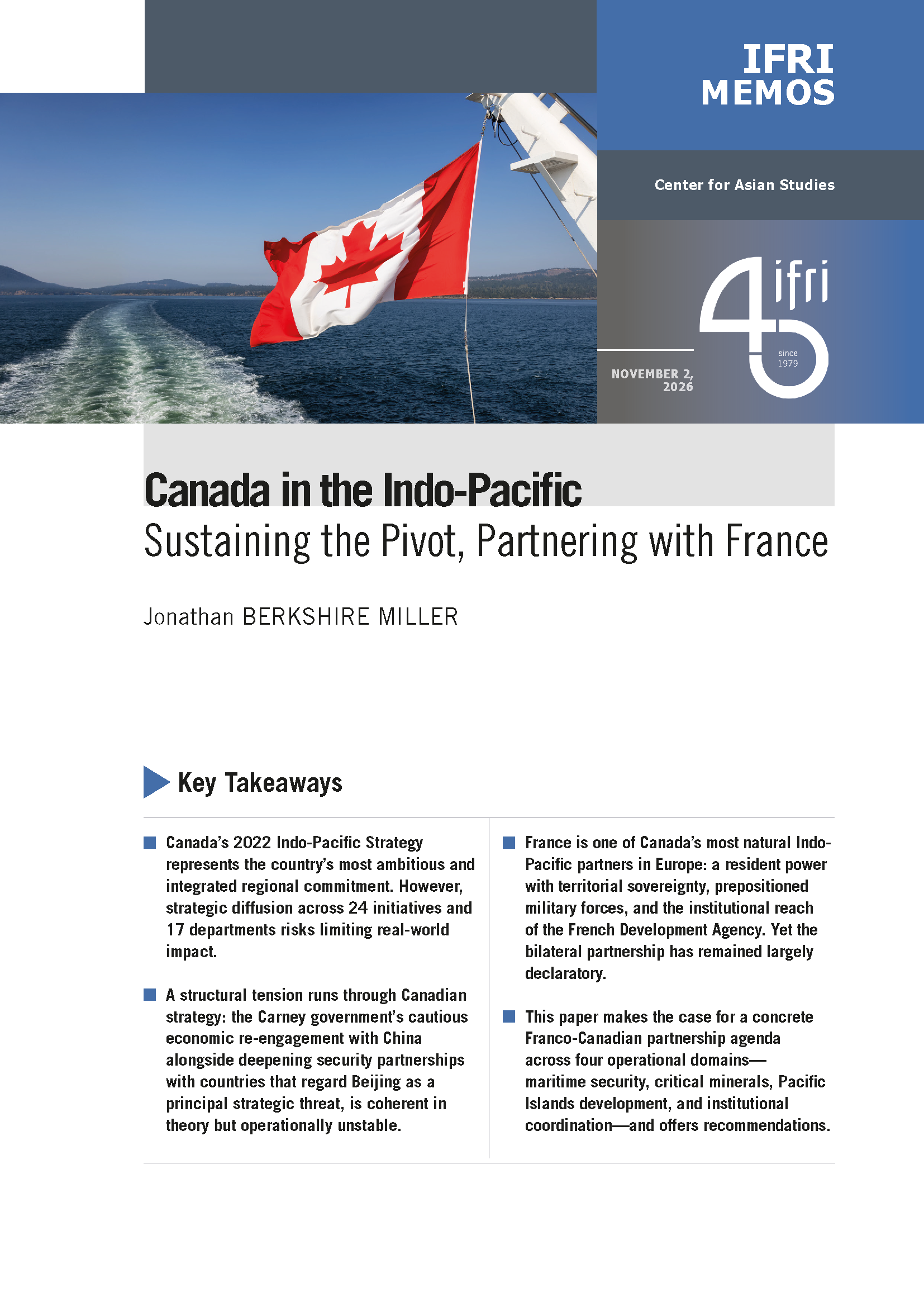
Canada in the Indo-Pacific Sustaining the Pivot, Partnering with France
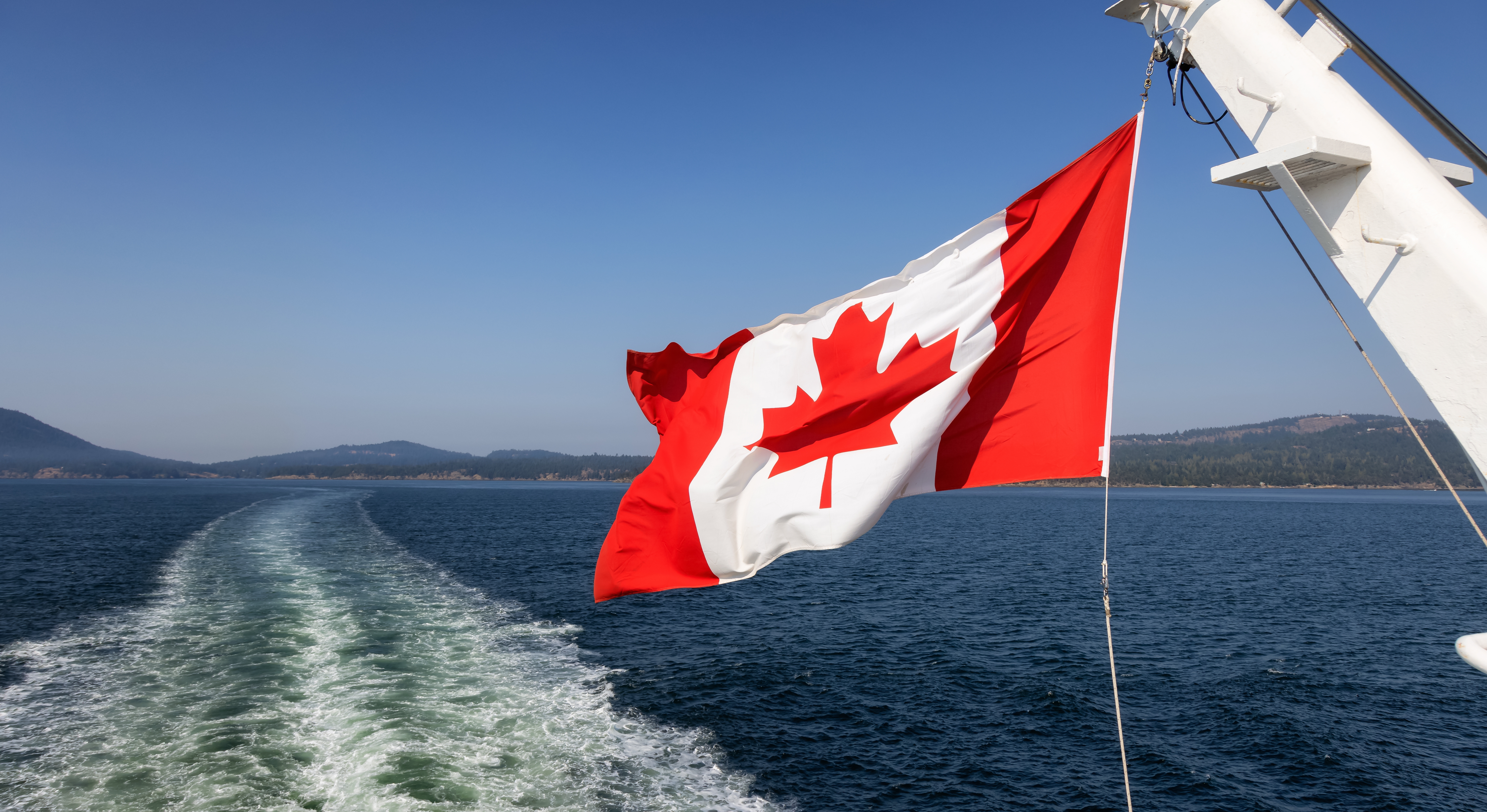
Since the launch of Canada’s inaugural Indo-Pacific Strategy (IPS) in November 2022, Ottawa has moved—with notable but uneven momentum—from the margins of regional engagement to a position of growing strategic visibility. The Strategy, backed by an initial $2.3 billion five-year investment, reflects a long-overdue recognition: Canada is a Pacific nation whose prosperity and security are inextricably linked to the stability of the world’s most economically and strategically consequential region.
Titre
Key Takeaways
Canada’s 2022 Indo-Pacific Strategy represents the country’s most ambitious and integrated regional commitment. However, strategic diffusion across 24 initiatives and 17 departments risks limiting real-world impact.
A structural tension runs through Canadian strategy: the Carney government’s cautious economic re-engagement with China alongside deepening security partnerships with countries that regard Beijing as a principal strategic threat, is coherent in theory but operationally unstable.
France is one of Canada’s most natural Indo-Pacific partners in Europe: a resident power with territorial sovereignty, prepositioned military forces, and the institutional reach of the French Development Agency. Yet the bilateral partnership has remained largely declaratory.
This paper makes the case for a concrete Franco-Canadian partnership agenda across four operational domains— maritime security, critical minerals, Pacific Islands development, and institutional coordination—and offers recommendations.
However, despite these positive strides, there is still a worry that Canada remains an episodic player in the region. Moreover, it is important to situate Canada’s Indo-Pacific engagement within the broader argument, articulated with unusual bluntness by Prime Minister Mark Carney at Davos in January 2026, that middle powers must build coalitions of purpose if the rules-based international order is to survive the pressures of great-power rivalry.
While the IPS has achieved some important things through its comprehensive approach, greater achievements could be reached by recalibrating it into a set of priorities. In addition, Canada’s growing engagement in the Indo-Pacific is providing some opportunities for coordination with France. Canada and France—two resident or near- resident Indo-Pacific powers with closely aligned strategic philosophies—have not yet fully seized the partnership dividend available to them.
Franco-Canadian cooperation in the Indo-Pacific can accelerate in several areas: spanning maritime security, critical minerals, development assistance in the Pacific Islands, and institutional coordination. In a world of weaponized interdependence and retreating multilateral governance, middle-power solidarity is not sentiment—it is strategy.

Available in:
Themes and regions
ISBN / ISSN
Share
This page contains only a summary of our work. If you would like to have access to all the information from our research on the subject, you can download the full version in PDF format.
Canada in the Indo-Pacific Sustaining the Pivot, Partnering with France

Center for Asian Studies
Asia is a nerve center for multiple global economic, political and security challenges. The Center for Asian Studies provides documented expertise and a platform for discussion on Asian issues to accompany decision makers and explain and contextualize developments in the region for the sake of a larger public dialogue.
The Center's research is organized along two major axes: relations between Asia's major powers and the rest of the world; and internal economic and social dynamics of Asian countries. The Center's research focuses primarily on China, Japan, India, Taiwan and the Indo-Pacific, but also covers Southeast Asia, the Korean peninsula and the Pacific Islands.
The Centre for Asian Studies maintains close institutional links with counterpart research institutes in Europe and Asia, and its researchers regularly carry out fieldwork in the region.
The Center organizes closed-door roundtables, expert-level seminars and a number of public events, including an Annual Conference, that welcome experts from Asia, Europe and the United States. The work of Center’s researchers, as well as that of their partners, is regularly published in the Center’s electronic journal Asie.Visions.
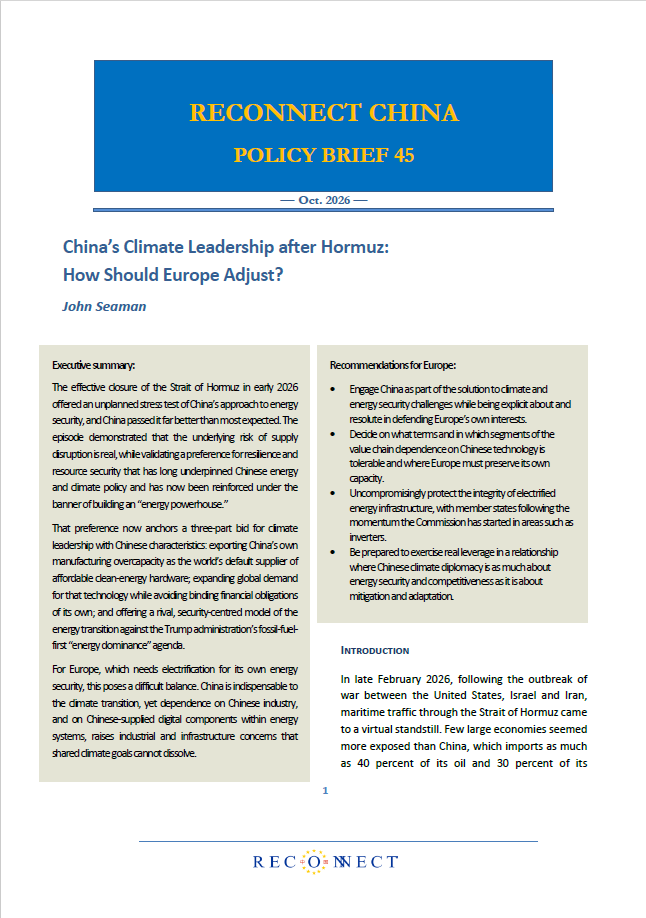
China’s Climate Leadership after Hormuz: How Should Europe Adjust?
The effective closure of the Strait of Hormuz in early 2026 offered an unplanned stress test of China’s approach to energy security, and China passed it far better than most expected. The episode demonstrated that the underlying risk of supply disruption is real, while validating a preference for resilience and resource security that has long underpinned Chinese energy and climate policy and has now been reinforced under the banner of building an “energy powerhouse.”

China as an ambivalent supporter of the WTO and the multilateral trading system
Amid rising trade tensions between Europe and China and broader uncertainty in the international rules-based trade regime, Beijing has worked to preserve and bolster the multilateral trading system while at the same time failing to reform the domestic policies that have served to undermine that same system.

Pakistan and the Israel-Palestine Conflict: Transformation in Pakistan’s Approach After the War in Gaza
Pakistan has long combined vocal support for the Palestinian cause with covert engagement with Israel. Since the war in Gaza, this balance has become untenable: public opinion is united against Israel, joining Trump’s Board of Peace has drawn rare cross-party criticism, and new regional alignments put normalization out of reach.
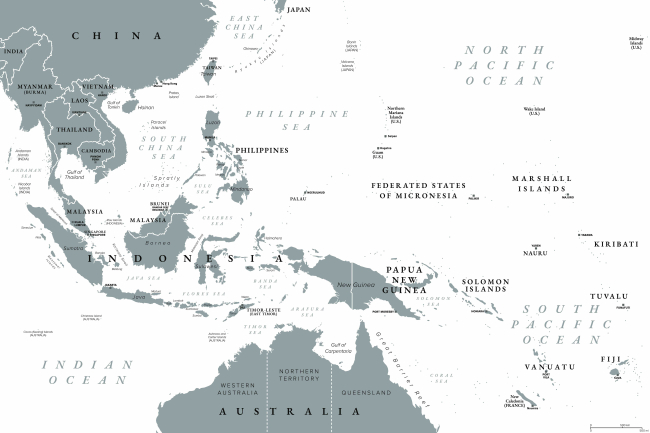
The Oceania Factor in France’s Evolving Indo-Pacific Strategy
This paper examines the two-way relationship between France’s Indo-Pacific strategy and developments in Oceania. Oceania was not a priority in the initial years of France’s Indo-Pacific strategy, as the region was largely treated as secondary to major strategic hotspots and key partnerships, while overseas territories were primarily handled as domestic issues and recipients of a top-down strategy.