



France as a convening power in the Pacific: The Nouméa SPDMM
A little known regional dialogue offers France and other countries a chance to contribute to the “Pacific way”.
On 4 December, France hosts the South Pacific Defence Ministers Meeting (SPDMM) in Nouméa, New Caledonia. The SPDMM marks its tenth anniversary this year, however remains relatively unknown outside of the Pacific.
Initially an Australian government initiative, this distinctive forum serves as a platform for dialogue and coordination, bringing together Australia, Chile, Fiji, France, New Zealand, Papua New Guinea and Tonga, alongside three observers, the United States, Japan, and the United Kingdom. As extreme weather events intensify in the region due to climate change, the meeting offers defence authorities a chance to share concerns and best practices and improve coordination in humanitarian and disaster relief operations (HADR).
A key achievement of the SPDMM, the Povai Endeavour framework streamlines major HADR training exercises in the South Pacific, such as Longreach, a multinational exercise, as well as Croix du Sud and Marara, which are conducted respectively by the French Armed Forces in New Caledonia (FANC) and the French Armed Forces in French Polynesia (FAPF).
France is the only European country with the capacity to make a substantial security contribution to the South Pacific, with a permanent presence of 2800 military personnel in the region. Since 1992, French forces have collaborated under the FRANZ agreement with Australian and New Zealand counterparts to deliver HADR support to Pacific Island countries. Along with the United States, this group forms the “Pacific Quad”, assisting the small island states in monitoring their large maritime territory.
France’s hosting of the SPDMM aligns with the approach outlined by President Emmanuel Macron during his Pacific tour in July. During this visit, Macron presented three pillars for France’s Indo-Pacific strategy: the promotion of multilateralism, cooperation in security and defence, and mitigation of and adaptation to climate change – areas where France can claim legitimacy due to its experience and expertise.
With Vanuatu, Macron issued a joint call for climate action, drawing upon the 2015 Paris Agreement and June’s Paris Agenda for People and the Planet, positioning France as a supporter of Port Vila and other Pacific Island states in their pursuit of climate justice. Furthermore, by 2027, the French Development Agency has pledged a five-fold boost to its financial commitment for climate change mitigation and adaptation in the South Pacific.
Macron has unveiled plans to establish a Pacific Academy in Nouméa. This academy is intended to enhance and complement existing training programs in HADR and civil security for defence and security forces throughout the region. Additionally, in collaboration with the Red Cross, a strengthened coordination hub for emergency response will be set up. The deployment of an extra 200 soldiers, coupled with a total investment of €150 million (A$245 million), will position the Nouméa military base to make a substantial contribution to the enhancement of regional capabilities.
Present discussions regarding the future status of New Caledonia should not disrupt the French military presence on the island. While negotiations explore the possibility of an associated state status with France, it is emphasised that the authority over defence forces remains with Paris. The French government is actively striving to establish New Caledonia as a regional hub for security cooperation, especially in the realm of climate security. In this context, it is crucial for Paris to see an active role for its territories within its Indo-Pacific strategy and to provide clarity on their mode of representation in regional organisations.
The future of the SPDMM will depend on its ability to position itself in the face of the resurgence of power rivalries in the Pacific. It will need to align with other dialogues and security initiatives that are multiplying in the region.
The growing influence of China in the South Pacific, evidenced by the signing of a security treaty with Solomon Islands in March 2022, has raised concerns among the United States, its allies, and partners. This has revived interest from Western nations and has resulted in an influx of security cooperation proposals, not always fitting the needs of island states with limited absorption capacity. Moreover, this geostrategic rivalry holds little significance for Pacific Islands nations, which are more preoccupied with concerns about the potential submersion of atolls, coastal erosion, exploitation of natural resources, impacts of climate change and pollution.
In such a context, the SPDMM must maintain legitimacy and effectiveness.
[...]
> Read the full article on the website of the Interpreter

Available in:
Regions and themes
Share

Céline PAJON
Research Fellow, Head of Japan and Indo-Pacific Research, Center for Asian Studies, Ifri

Center for Asian Studies
Asia is a nerve center for multiple global economic, political and security challenges. The Center for Asian Studies provides documented expertise and a platform for discussion on Asian issues to accompany decision makers and explain and contextualize developments in the region for the sake of a larger public dialogue.
The Center's research is organized along two major axes: relations between Asia's major powers and the rest of the world; and internal economic and social dynamics of Asian countries. The Center's research focuses primarily on China, Japan, India, Taiwan and the Indo-Pacific, but also covers Southeast Asia, the Korean peninsula and the Pacific Islands.
The Centre for Asian Studies maintains close institutional links with counterpart research institutes in Europe and Asia, and its researchers regularly carry out fieldwork in the region.
The Center organizes closed-door roundtables, expert-level seminars and a number of public events, including an Annual Conference, that welcome experts from Asia, Europe and the United States. The work of Center’s researchers, as well as that of their partners, is regularly published in the Center’s electronic journal Asie.Visions.

Pakistan and the Israel-Palestine Conflict: Transformation in Pakistan’s Approach After the War in Gaza
Pakistan has long combined vocal support for the Palestinian cause with covert engagement with Israel. Since the war in Gaza, this balance has become untenable: public opinion is united against Israel, joining Trump’s Board of Peace has drawn rare cross-party criticism, and new regional alignments put normalization out of reach.
The Oceania Factor in France’s Evolving Indo-Pacific Strategy
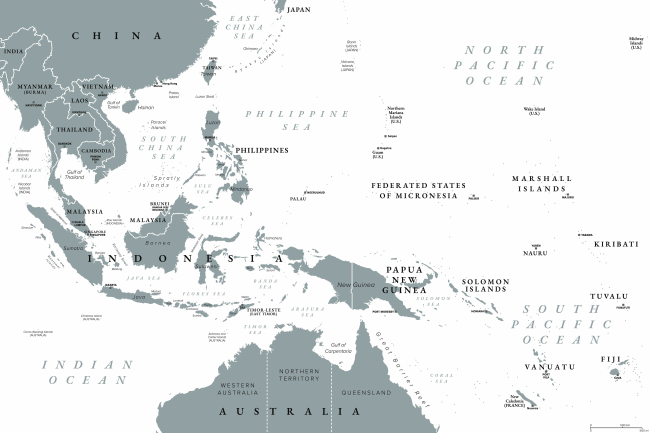
This paper examines the two-way relationship between France’s Indo-Pacific strategy and developments in Oceania. Oceania was not a priority in the initial years of France’s Indo-Pacific strategy, as the region was largely treated as secondary to major strategic hotspots and key partnerships, while overseas territories were primarily handled as domestic issues and recipients of a top-down strategy.
France’s View: From Diplomacy to Public-Private Action
France has emerged as the EU’s IMEC forerunner, combining port infrastructure, diplomatic alliances and public-private cooperation. With Marseille Fos at its core, the country brings a strategic hub for logistics, energy and digital connectivity to the corridor.
Trump II, the Crisis of the Rules-Based Order and Europe’s Indo-Pacific Strategy
This article examines the implications of Trump II for Europe’s engagement in the Indo-Pacific. The piece contends that Trump II is accelerating the erosion of the rules-based order and undermining the relevance of the Free and Open Indo-Pacific (FOIP) concept, while forcing Europe to refocus on its own continental security amid US retrenchment. Paradoxically, these very constraints create conditions for a more autonomous, pragmatic, and explicitly interest-driven European engagement in the Indo-Pacific, rather than outright withdrawal.