Escalation within Continuity: Spain’s Foreign Policy towards Israel and Palestine after October 7th
Over the past two years, Spain has emerged as one of the most vocal countries in supporting the Palestinian cause. While Madrid initially aligned with the prevailing European position, recognizing Israel’s right to self-defense after the 7 October attacks, it soon distinguished itself from most European Union (EU) Member States by questioning and later condemning Israel’s conduct of war in Gaza.
Conversation with Nabil Fahmy, designated Secretary General of the Arab League - WPC 2026
Conversation with Nabil Fahmy, designated Secretary General of the Arab League, chaired by Thierry de Montbrial, Founder and Executive Chairman of Ifri and the World Policy Conference.
A conversation with Anwar Gargash, Diplomatic Advisor to the President of the United Arab Emirates
In an exceptional debate with Thierry de Montbrial, Anwar Gargash, Diplomatic Advisor to the President of the United Arab Emirates shares his perspective on the ongoing war with Iran in the Middle East.
War in the Middle East: Regional Fractures, Global Shockwaves, and the End of the Old Order
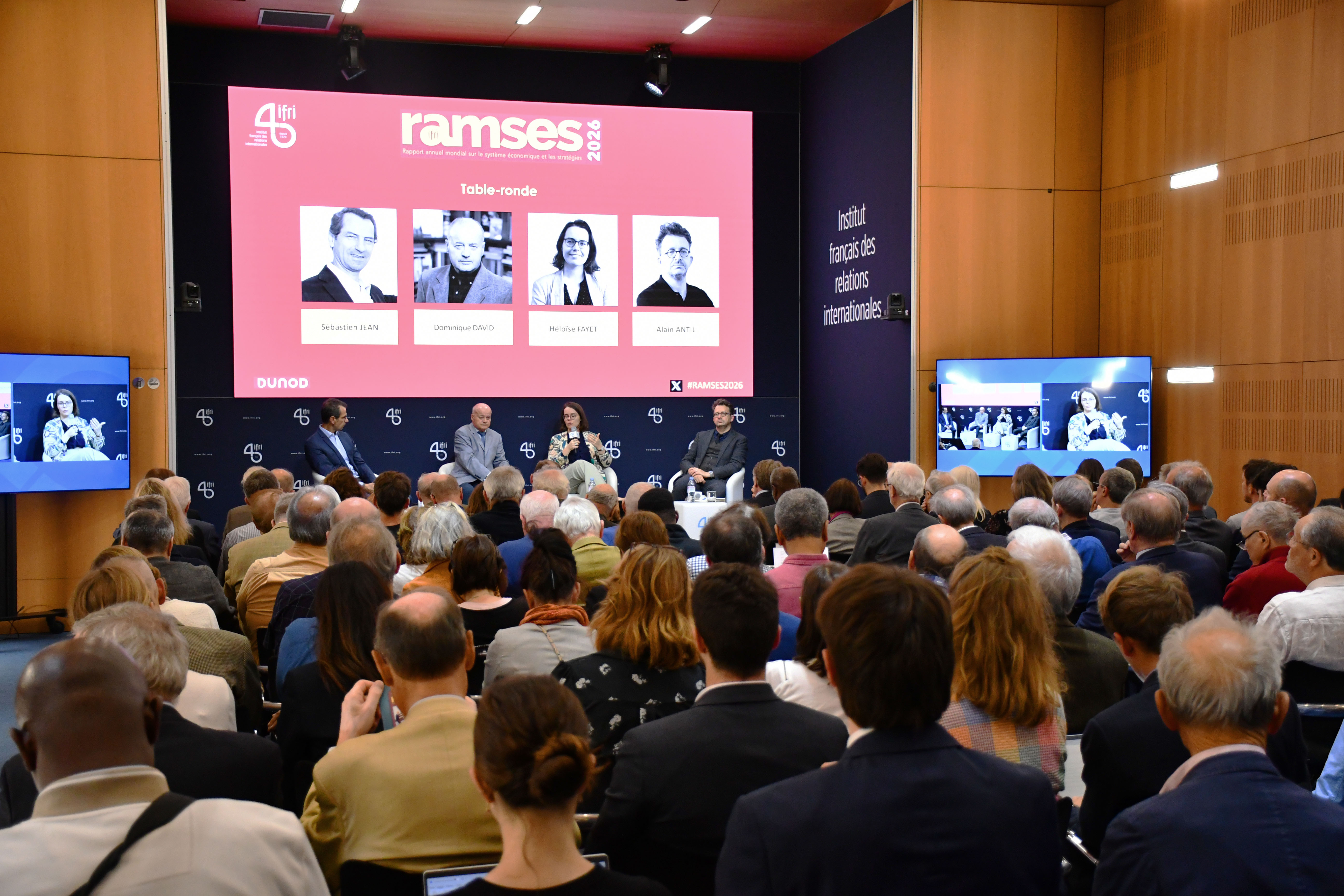
Panel from the World Policy Conference 2026, organized by Thierry de Montbrial and Ifri, from April 24 to 26, 2026.
Australia’s Recognition of Palestine: A Case of Supporting the Status Quo over Accountability
Hamas’s terrorist attacks against Israel on October 7, 2023, killed over a thousand Israelis, altering irrevocably the way the Palestinian/Israeli conflict is viewed internationally. Australia’s government professed profound shock and disgust at Hamas’s attacks, together with its unwavering diplomatic and political support for Israel. But as Israel’s response became more concerned with exacting revenge and as the pretext to fulfill long-held ideological dreams of a Greater Israel, support from Australia became more muted and conditional. This culminated in Australia joining Britain, France, and Canada in formally recognizing a Palestinian state at the United Nations General Assembly meeting in September 2025.
US hosts rare Israel-Lebanon talks, progress unclear
Israel and Lebanon agreed to direct negotiations following talks in Washington on Tuesday.
The Global Economy: Caught in the Storm / Politique étrangère, Vol. 91, No. 1, 2026
The global economy has become the primary arena for the clash of power ambitions in a world where understanding, coordination, and concerted multilateralism seem to have been permanently marginalized. In this fragmented landscape, how will American and Chinese strategies interact? Will the European Union manage to break out of its decades-old framework in order to face new competition? And will it be able, like others, to integrate the announced shift from a production economy to a digital, information economy? And what role will financial institutions, and central banks in particular, play in this transitioning international economy?
Russia, the Palestinians and Gaza: Adjustments after October 7th
The Soviet Union (USSR), and subsequently the Russian Federation as its internationally recognized legal successor, has consistently sought to play a visible role in efforts to resolve the Israeli-Palestinian conflict.
"Iron Swords" A Military Analysis of Israel's War in Gaza
On October 7, 2023, Hamas' attack, dubbed “Al-Aqsa Flood,” caused a major shock and led Israel to launch the longest war in its history. Operation “Iron Swords” was notable for its unprecedented intensity, both in terms of the massive ground forces deployed and the firepower used.
Canada’s Recognition of a Palestinian State: What Consequences on its Foreign Policy Toward Palestine?
On September 21, 2025, Canada became the 148th of 157 countries to recognize Palestine as a state. It did this with the United Kingdom (UK) and Australia, defying the United States (US) and Israeli opposition.
Escalation within Continuity: Spain’s Foreign Policy towards Israel and Palestine after October 7th
Over the past two years, Spain has emerged as one of the most vocal countries in supporting the Palestinian cause. While Madrid initially aligned with the prevailing European position, recognizing Israel’s right to self-defense after the 7 October attacks, it soon distinguished itself from most European Union (EU) Member States by questioning and later condemning Israel’s conduct of war in Gaza.
Australia’s Recognition of Palestine: A Case of Supporting the Status Quo over Accountability
Hamas’s terrorist attacks against Israel on October 7, 2023, killed over a thousand Israelis, altering irrevocably the way the Palestinian/Israeli conflict is viewed internationally. Australia’s government professed profound shock and disgust at Hamas’s attacks, together with its unwavering diplomatic and political support for Israel. But as Israel’s response became more concerned with exacting revenge and as the pretext to fulfill long-held ideological dreams of a Greater Israel, support from Australia became more muted and conditional. This culminated in Australia joining Britain, France, and Canada in formally recognizing a Palestinian state at the United Nations General Assembly meeting in September 2025.
Russia, the Palestinians and Gaza: Adjustments after October 7th
The Soviet Union (USSR), and subsequently the Russian Federation as its internationally recognized legal successor, has consistently sought to play a visible role in efforts to resolve the Israeli-Palestinian conflict.
"Iron Swords" A Military Analysis of Israel's War in Gaza
On October 7, 2023, Hamas' attack, dubbed “Al-Aqsa Flood,” caused a major shock and led Israel to launch the longest war in its history. Operation “Iron Swords” was notable for its unprecedented intensity, both in terms of the massive ground forces deployed and the firepower used.
Canada’s Recognition of a Palestinian State: What Consequences on its Foreign Policy Toward Palestine?
On September 21, 2025, Canada became the 148th of 157 countries to recognize Palestine as a state. It did this with the United Kingdom (UK) and Australia, defying the United States (US) and Israeli opposition.
Israel-Palestine: One Solution, Two States
First proposed in 1936, the two-state solution has got lost over the course of several Israeli-Arab wars, colonization, the failure of the Oslo Accords, and the strategies of Israeli governments seeking rapprochement with certain Arab regimes. But it is currently the only imaginable solution. The numerous obstacles in its path could be overcome if the United States and its allies decided to impose it on the Israelis and Palestinians in opposition to their short-term visions.
Thirty Years on from the Oslo Accords: An Israeli Perspective
The Oslo agreements signed in 1993 raised high hopes for peace in the Middle East. But appraising the state of affairs, thirty years on, the picture is bleak.
The Technology Policies of Digital Middle Powers
Digital technology is an element of power in the international system as well as an area for competition among countries. The study provides a qualitative comparison of the technology policies of nine of the digital middle powers: Brazil, India, Israel, Japan, Kenya, Nigeria, Russia, South Korea, and the United Kingdom. It seeks to reflect the diversity of national technology policies, as well as to identify those countries’ convergences and divergences with Europe, the United States and China.
Towards a War of Norms ? From Lawfare to Legal Operations
Defined as the use of law to establish, perpetuate, or change power relations in order to counter an adversary, lawfare practices reflect a reality that is inherent in international law.
Activists Without Borders
Various associations organise trips to Israel and/or to the Palestinian Territories. Someone who has no previous knowledge of the Near East and who takes part in a journey organised by a pro-Israeli group, would return to France with a very different vision of the Israeli-Palestinian conflict to that of someone who had travelled with a pro-Palestinian group.
For more information concerning the complete work, please click on this link.
War in the Middle East: Regional Fractures, Global Shockwaves, and the End of the Old Order
Panel from the World Policy Conference 2026, organized by Thierry de Montbrial and Ifri, from April 24 to 26, 2026.
A conversation with Anwar Gargash, Diplomatic Advisor to the President of the United Arab Emirates
In an exceptional debate with Thierry de Montbrial, Anwar Gargash, Diplomatic Advisor to the President of the United Arab Emirates shares his perspective on the ongoing war with Iran in the Middle East.
US hosts rare Israel-Lebanon talks, progress unclear
Israel and Lebanon agreed to direct negotiations following talks in Washington on Tuesday.
Thomas Gomart, director of the French Institute of International Relations: 'Trump reasserts the US' strategic centrality'
By bombing Iran alongside Israel, Donald Trump has performed a show of force aimed at China and Russia, explains the director of the French Institute of International Relations in an interview.
Putin Eyes Peacemaking Role In Israel-Iran Air War
Vladimir Putin is eyeing the conflict between Israel and Iran as an opportunity to thrust himself to the forefront of the international stage, more than three years into his invasion of Ukraine.
Israel-Hamas War Exposes Divisions in France
In a polarized France, President Emmanuel Macron must navigate the conflict in a way that doesn’t further inflame the public or advantage his political rivals.
France Links Conversation in Russian to Star of David Graffiti
After more than 200 blue stars were stenciled on buildings in and around Paris, prosecutors say they are investigating whether a foreign intermediary paid a couple to spray paint them.
Conversation with Nabil Fahmy, designated Secretary General of the Arab League - WPC 2026
Conversation with Nabil Fahmy, designated Secretary General of the Arab League, chaired by Thierry de Montbrial, Founder and Executive Chairman of Ifri and the World Policy Conference.
War in the Middle East: Regional Fractures, Global Shockwaves, and the End of the Old Order
Panel from the World Policy Conference 2026, organized by Thierry de Montbrial and Ifri, from April 24 to 26, 2026.
A conversation with Anwar Gargash, Diplomatic Advisor to the President of the United Arab Emirates
In an exceptional debate with Thierry de Montbrial, Anwar Gargash, Diplomatic Advisor to the President of the United Arab Emirates shares his perspective on the ongoing war with Iran in the Middle East.
US hosts rare Israel-Lebanon talks, progress unclear
Israel and Lebanon agreed to direct negotiations following talks in Washington on Tuesday.
Replay - Conference with Badr Abdelatty, Minister of Foreign Affairs of Egypt
Invited to Ifri on October 2, 2025, Egypt’s Minister of Foreign Affairs, Badr Abdelatty, highlighted Egypt’s doctrine of “strategic balance,” which is based on non-alignment and non-interference, while maintaining strong relations with major global powers such as the United States, Russia, and China.
Support independent French research
Ifri, a foundation recognized as being of public utility, relies largely on private donors – companies and individuals – to guarantee its sustainability and intellectual independence. Through their funding, donors help maintain the Institute's position among the world's leading think tanks. By benefiting from an internationally recognized network and expertise, donors refine their understanding of geopolitical risk and its consequences on global politics and the economy. In 2026, Ifri partners with over 90 French and international companies and organizations.