



Baden-Württemberg under Green Leadership – Balance Sheet of Two Government Periods under Winfried Kretschmann
Baden-Württemberg's economic and social structure offered good starting conditions for center-right parties from the beginning, which the Christian Democratic Union of Germany (CDU) initially knew how to use for itself. From 1953 to 2011 the Prime Minister belonged to the CDU. In 2011 the Greens and the Social Democratic Party of Germany (SPD) won an election over the CDU for the first time. Winfried Kretschmann was elected the first Green Prime Minister in a German state.
From 2011 to 2016 he ruled with the SPD in a green-red coalition, and since 2016 the Greens and CDU have formed a green-black coalition.
Right at the beginning of his reign, Kretschmann made a thorough change of style in the relationship between citizenship and politics with his “Politics of Being Heard” and the extensive expansion of citizen participation. In terms of economic policy, he kept the heavily export-oriented industrial country, which is characterized by vehicle and mechanical engineering, on the road to success and prepared it for the ecological structural change. The reform of the electoral law, the realignment of the integration and asylum policy begun under Green-Red, and the nationwide broadband expansion have only progressed gradually.
Personally, Kretschmann quickly gained a high reputation throughout the country, well beyond the green electorate. His pragmatic course of closely combining economy and ecology has the future competitiveness of Baden-Württemberg as a business location in mind and enjoys high approval throughout the state. The green-black coalition can certainly be seen as a model for federal politics.
Ulrich Eith studied political science, mathematics, and sociology, earned his doctorate and habilitation in political science. He is Professor of political science at the University of Freiburg since 2007 and is director of the Wiesneck House of Studies in Buchenbach since 2008 (Studienhaus Wiesneck, Institut für politische Bildung Baden-Württemberg e.V.).
This publication is available the following languages (pdf):
- FRENCH: Le Bade-Wurtemberg sous la direction des Verts – Bilan des deux mandats de Winfried Kretschmann à la tête du Land.
- GERMAN: Baden-Württemberg unter grüner Führung – Bilanz zweier Regierungsperioden unter Winfried Kretschmann.


The Study Committee on Franco-German Relations (Cerfa)
The Study Committee on Franco-German Relations (Cerfa) was created in 1954 by an inter-governmental agreement between the Federal Republic of Germany and France, in order to raise awareness of Germany in France and analyze Franco-German relations, including in their European and international dimensions. In its conferences and seminars, which bring together experts, political leaders, senior decision-makers and representatives of civil society from both countries, Cerfa develops the Franco-German debate and stimulates political proposals. It regularly publishes studies through two collections: Cerfa notes and studies as well as Franco-German visions.
Cerfa maintains close relations with the network of German foundations and think tanks. In addition to its research and debate activities, Cerfa promotes the emergence of a new Franco-German generation through original cooperation programs. This is how in 2021-2022, Cerfa led a program on multilateralism with the Konrad Adenauer Foundation in Paris. This program is aimed at young professionals from both countries interested in the issues of multilateralism in the context of their activities. It covered a wide range of themes relating to multilateralism, such as international trade, health, human rights and migration, non-proliferation and disarmament. Previously, Cerfa had participated in the Franco-German future dialogue, co-led with the DGAP from 2007 to 2020, and supported by the Robert Bosch Foundation and the Daniel Vernet group (formerly the Franco-German Reflection Group) which was founded in 2014 upon the initiative of the Genshagen Foundation.
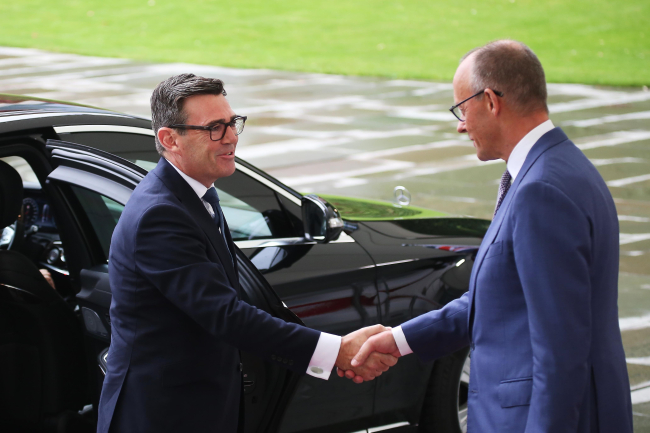
A Partnership Built on Security: Post-Brexit Rapprochement between Germany and the United Kingdom
Since the UK’s withdrawal from the EU, UK-German relations have undergone a remarkable transformation: from Berlin’s deliberate distancing from London during the Brexit negotiations, when Germany consistently prioritised EU-27 unity over bilateral arrangements, to a gradual rapprochement, culminating, for the time being, in the 2025 Kensington Treaty of Friendship.
Recalibrating Europe’s Security: Building Partnerships in an Era of ‘Wrecking-Ball Politics
The 2026 Munich Security Conference report observes that “the world has entered a period of wrecking-ball politics.” Indeed, the era of Western predominance, dependable alliances and capable multilateral institutions has given way to shifting balances of power and deepening uncertainty.
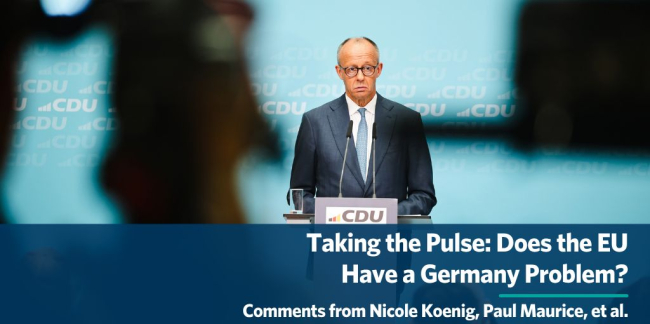
Taking the Pulse: Does the EU Have a Germany Problem?
Are Germany’s economic, industrial, and political struggles becoming a liability for the EU’s ability to rise to the geopolitical moment?
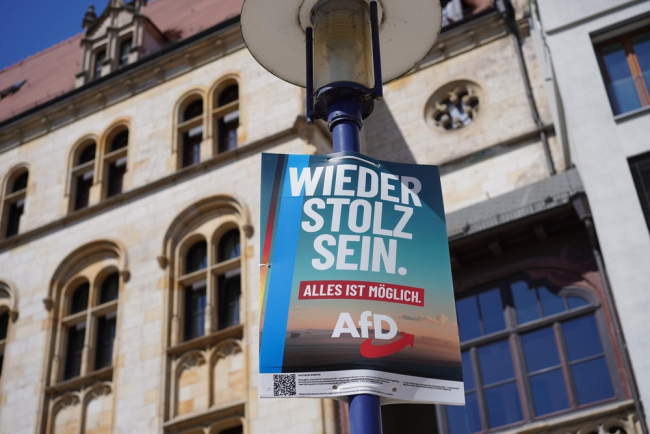
From Protest to Power? The AfD Ahead of the Eastern State Elections
The September state elections will test the AfD’s transition from protest force to potential governing power amid growing political fragmentation and dissatisfaction with Chancellor Friedrich Merz and his coalition. While firmly established in eastern Germany, the AfD is also gaining ground in the west, raising questions about coalition-building and the future direction of German politics.