






France, the U.S.' Oldest and Most Complicated Ally: A Stubborn Defender of a Truly European Industrial and Defence Policy
France, the U.S.’ oldest ally, is also the EU country which most stubbornly defends genuinely European industrial and defence policies. It calls for ‘strategic autonomy’ in all political domains, a position increasingly difficult to hold against a hardening international climate.
FRANCE AND THE US – TWO TIGHTLY INTERKNIT COUNTRIES WITH FUNDAMENTAL POLITICAL DIVERGENCES
As the first state to recognise America in the 18th century, France is considered to be its ‘oldest ally’. Two centuries later, the US’s role in France’s liberation from Nazi Germany has further tightened the bonds between these two countries.
Immediately following the Second World War, US-French priorities took divergent paths, with the Suez crisis (1956) still regarded as a major humiliation for France. In 1966, President Charles de Gaulle, who embodied a policy of autonomy, loosened France’s ties with NATO by withdrawing from its integrated command. Under de Gaulle, France developed its own nuclear capacities, criticised the US’s presence in Vietnam, recognised China in 1964 and called for French-speaking Quebec’s national independence in 1967. Almost four decades later, France opposed George W. Bush’s ‘Iraqi Freedom’, another important development in these two countries’ bilateral relationship. The Obama years were marked by the ‘Pivot to Asia’ and the US’s failure to intervene in Syria. Under Trump the US grew more unpredictable and transactional. This was followed by two major blows under Joe Biden: firstly, the withdrawal from Afghanistan in 2021; and secondly, the launching of AUKUS, a security partnership between Australia, the UK and the US – including Australia’s cancelling of a 56-bn-EUR submarine deal with the French company Naval Group. However, these mishaps were compensated for by the US support to Ukraine in response to Russia’s war of aggression.
[...]
Marie Krpata is Research Fellow at the Study Committee on Franco-German Relations (Cerfa) at the French Institute of International Relations – Ifri, where she dedicates her research activities to the European Union and the external relations of the Franco-German couple.
>This article was published in "France, the U.S.’ Oldest and Most Complicated Ally: A Stubborn Defender of a Truly European Industrial and Defence Policy". In: Kaeding, M., Pollak, J., Schmidt, P. (eds) The United States and the Future of Europe. Springer, Cham (

Available in:
Themes and regions
ISBN / ISSN
DOI
Springer, Cham
Share

Marie KRPATA
Research Fellow, Study Committee on Franco-German Relations (Cerfa), Ifri


The Study Committee on Franco-German Relations (Cerfa)
The Study Committee on Franco-German Relations (Cerfa) was created in 1954 by an inter-governmental agreement between the Federal Republic of Germany and France, in order to raise awareness of Germany in France and analyze Franco-German relations, including in their European and international dimensions. In its conferences and seminars, which bring together experts, political leaders, senior decision-makers and representatives of civil society from both countries, Cerfa develops the Franco-German debate and stimulates political proposals. It regularly publishes studies through two collections: Cerfa notes and studies as well as Franco-German visions.
Cerfa maintains close relations with the network of German foundations and think tanks. In addition to its research and debate activities, Cerfa promotes the emergence of a new Franco-German generation through original cooperation programs. This is how in 2021-2022, Cerfa led a program on multilateralism with the Konrad Adenauer Foundation in Paris. This program is aimed at young professionals from both countries interested in the issues of multilateralism in the context of their activities. It covered a wide range of themes relating to multilateralism, such as international trade, health, human rights and migration, non-proliferation and disarmament. Previously, Cerfa had participated in the Franco-German future dialogue, co-led with the DGAP from 2007 to 2020, and supported by the Robert Bosch Foundation and the Daniel Vernet group (formerly the Franco-German Reflection Group) which was founded in 2014 upon the initiative of the Genshagen Foundation.
Recalibrating Europe’s Security: Building Partnerships in an Era of ‘Wrecking-Ball Politics
The 2026 Munich Security Conference report observes that “the world has entered a period of wrecking-ball politics.” Indeed, the era of Western predominance, dependable alliances and capable multilateral institutions has given way to shifting balances of power and deepening uncertainty.
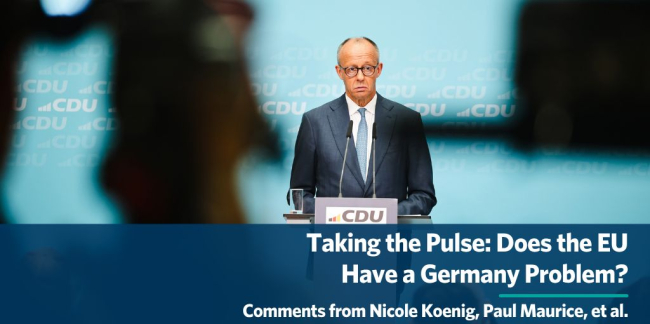
Taking the Pulse: Does the EU Have a Germany Problem?
Are Germany’s economic, industrial, and political struggles becoming a liability for the EU’s ability to rise to the geopolitical moment?
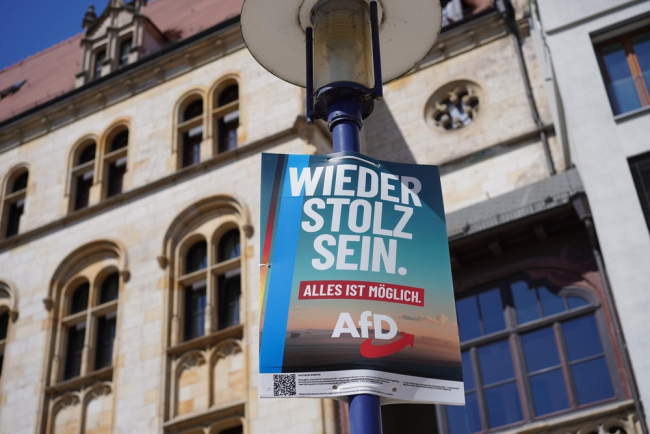
From Protest to Power? The AfD Ahead of the Eastern State Elections
The September state elections will test the AfD’s transition from protest force to potential governing power amid growing political fragmentation and dissatisfaction with Chancellor Friedrich Merz and his coalition. While firmly established in eastern Germany, the AfD is also gaining ground in the west, raising questions about coalition-building and the future direction of German politics.
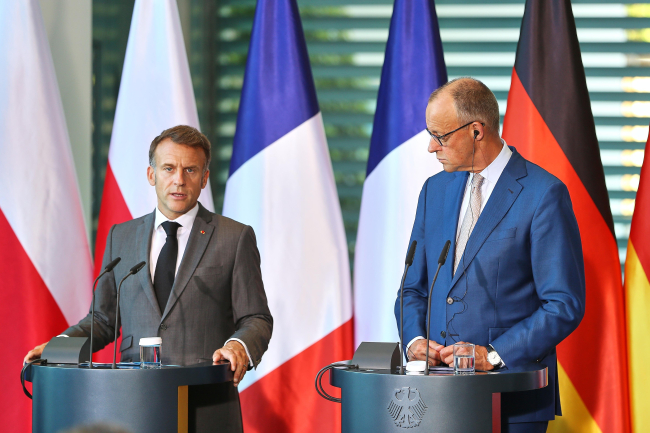
France-Germany: Overcoming Differences to Strengthen European Sovereignty
The Franco-German “reset” launched with Friedrich Merz’s appointment as Chancellor in May 2025 and given concrete form at the Franco-German Council of Ministers (FGCM) in Toulon in August 2025 was intended to address the structural challenges affecting the bilateral relationship. Yet it is clear that these ambitions have only been partially translated into concrete action. Since the beginning of 2026, Franco-German relations have entered a phase in which short-term challenges have combined with deeper divergences over priorities, policy approaches, and strategic culture.