




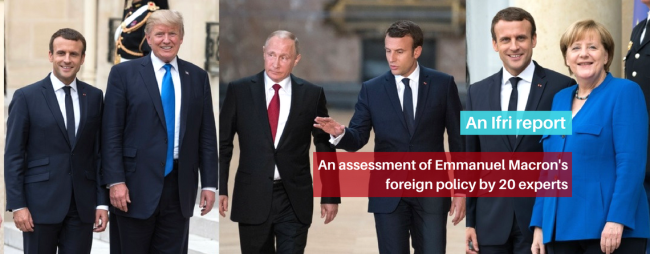
Macron, Diplomat: A New French Foreign Policy?
How can we define Emmanuel Macron’s foreign policy since he took office? After Nicolas Sarkozy’s brazen style of “gutsy diplomacy” and François Hollande’s “normal diplomacy”, the eighth president of the Fifth Republic seems to have opted for an agile classicism. In substance, he makes no claim to any radical break with the past, but sees his approach as being in line with historical tradition.
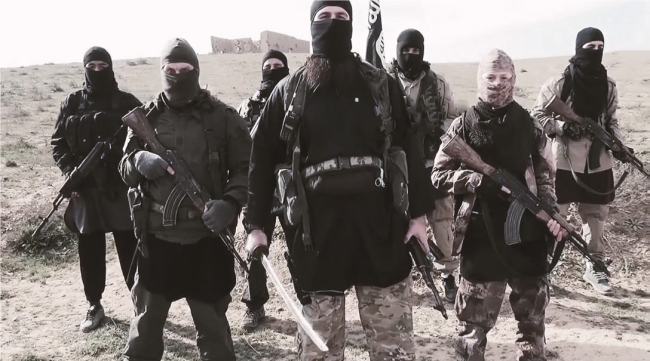
137 Shades of Terrorism. French Jihadists Before the Courts
This study, based on original judicial sources, assesses the profiles of 137 individuals sentenced in France for cases related to jihadism.

European Foreign Policy in 2027: Preparing for the Unexpected
What risks might the European Union be facing in 2027? Shaken by growing internal agitation as well as wider geopolitical developments, the European Union (EU) needs to redefine its role on the world scene while strengthening its core project. Integration has taken place on all levels and risks are therefore increasingly a concern to the Union as a whole.
The Strategic Role of Land Forces: A French Perspective
Although the first and foremost domain in the history of warfare, Land power has been dissociated from the concept of “strategic forces” for some time now, as these generally referred to long-range and/or high-yield strike capabilities, above all nuclear weapons.
Europe de la défense : les différences persistent entre Berlin et Paris

Macron wants a powerful EU
French President Emmanuel Macron is accelerating EU defense cooperation. The biggest obstacle are the French-German cultural differences. Can terrorism, Trump and Putin force closer military cooperation in Europe? Yes, says Barbara Kunz, research fellow at the French Institute for International Relations (Ifri) in Paris and expert on defense cooperation in the EU.
Beyond ‘pro’ and ‘anti’ Putin: Debating Russia Policies in France and Germany
Attitudes vis-à-vis Russia expressed in the public sphere are heterogeneous, in France more so than in Germany. In both France and Germany, the general public is by and large skeptical of Vladimir Putin and his policies. The picture is more diverse in the political realm. In Germany, there (still) is an approach that might be qualified as “mainstream”. The French debate, in turn, is highly fragmented.
Mixing Business with Europe: What Role for Companies on the Future of the EU?
The European Union (EU) is facing what the European Commission President, Jean-Claude Juncker, calls a ‘polycrisis’. The EU is under increasing pressure to deliver and address citizens’ concerns.
RT Brings Its Russian Perspective to France
RT, dubbed as an "organ of influence and deceitful propaganda" by President Emmanuel Macron in May during a joint news conference with Vladimir Putin, has now launched RT France. Has France become the latest front in Russia's information war?

RT Brings Its Russian Perspective to France
PARIS — Minutes after it began broadcasting on Monday night, the new television channel RT France took aim at the country and its president, Emmanuel Macron. “President Assad accuses France of supporting terrorism,” the scroll at the bottom of the screen stated. France and the United States are part of a coalition committed to removing Syria’s president, Bashar al-Assad, and Mr. Assad has accused France of merely prolonging Syria’s civil war, which has claimed hundreds of thousands of lives since 2011.
Decarbonizing Germany’s Power Sector: Ending Coal with a Carbon Floor Price?
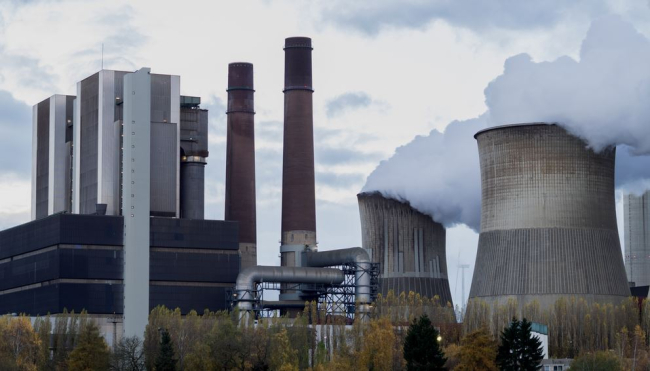
Germany has a long tradition of climate policy programmes with ambitious greenhouse gas emission reduction targets and comprehensive climate and energy policy packages.
This target-driven policy approach is, however, increasingly facing challenges due to the lack of progress on greenhouse gas emission reductions in key sectors, i.e. the power, the transport and the building sector.
France, Germany, and the Quest for European Strategic Autonomy: Franco-German Defence Cooperation in A New Era
How can France and Germany contribute to reaching the goal of European strategic autonomy? This key question has been guiding the work with the present report. In the light of a more demanding security environment, but also a rare momentum for further European integration, Berlin and Paris have to take their security and defense cooperation to the next level, bilaterally as well as in the EU.
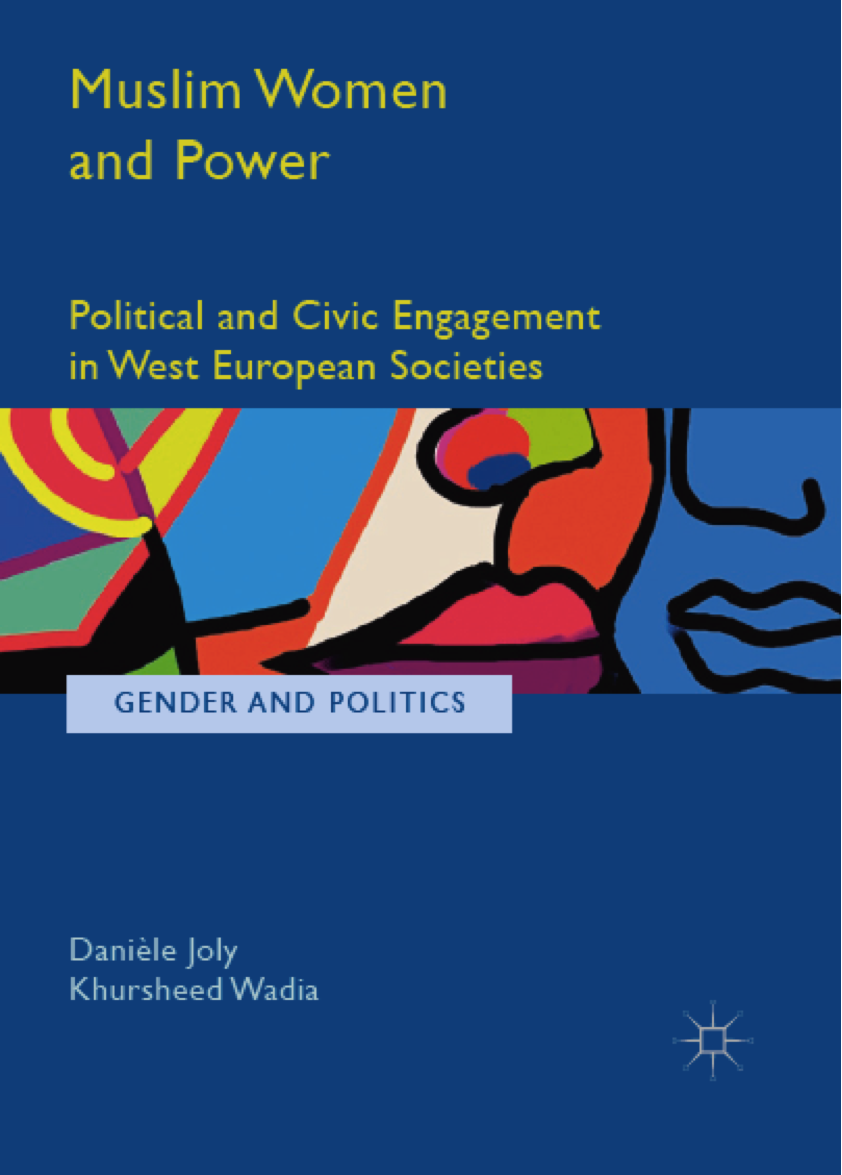
Muslim Women and Power: Political and Civic Engagement in West European Societies
This book explores Muslim women’s political and civic engagement in Britain and France.
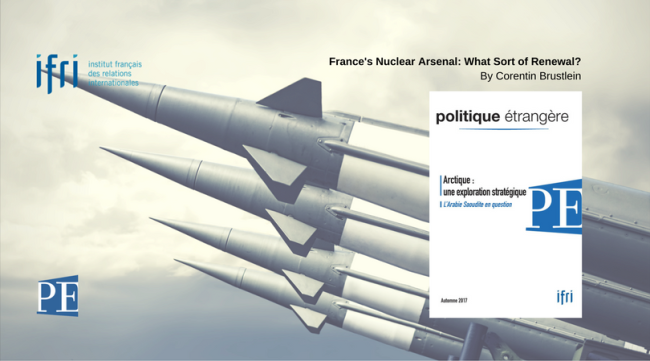
France's Nuclear Arsenal: What Sort of Renewal?
Over the course of the next few years, France will have to renew its nuclear arsenal to ensure that it remains a credible dissuasion in the eyes of its potential enemies.
France and Japan in Africa: a Promising Partnership
If some African countries are on their way to achieving dynamic economic growth, many are also still struggling with a lack of economic and social infrastructure, latent governance issues and often complex and risky security environments. In this context, both Japan and European countries, especially France, are making efforts to increase not only their development assistance, but also private investments and security cooperation in Sub-Saharan Africa.
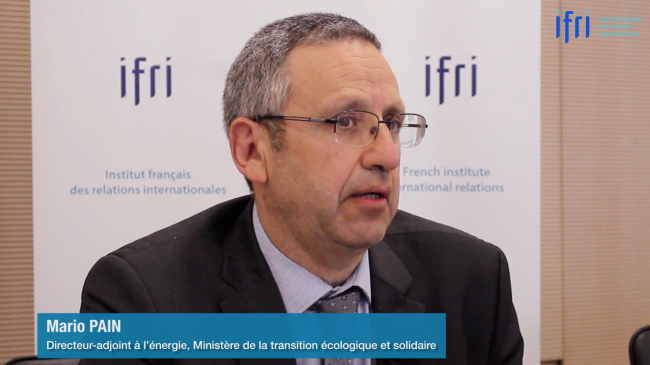
The Transformation of the Electricity French System in 2030 - Mario Pain
Deputy Director, Ministère de la transition écologique et solidaire, describes the main challenges for the French energy system at the 2030 horizon and highlights the need to find the right balance between EU harmonization and national measures to achieve energy transition at the lowest cost.
ENTSO-E's views on the Clean Energy Package - An Interview with Laurent SCHMITT
Laurent Schmitt, Secretary General, ENTSO-E, explains how to improve cooperation between transmission system operators and strengthen security of electricity supply, and how the Clean Energy Package will enhance the design of electricity market as a continuation of the network codes.
Reforming the EU electricity markets - Florian ERMACORA
Florian Ermacora, Head of the Internal Energy Market Unit in DG Energy, explains how the Clean Energy Package will improve the functioning of the internal electricity market, and how the new market design will help integrating larger shares of renewables.
La politique française de soutien aux exportations d'armement : raisons et limites d'un succès
During François Hollande’s five-year term French defense exports have reached quite spectacular results. Arms sales abroad have increased at least fourfold since 2012, when the former presidential team came to power.
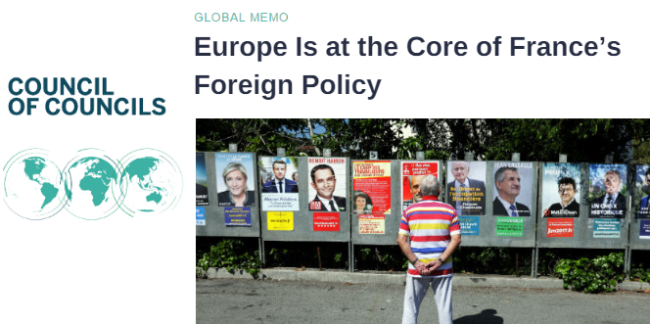
Europe Is at the Core of France’s Foreign Policy
It remains difficult to predict who will be the eventual winner of France’s upcoming presidential elections, with the first round to take place April 23 and a runoff between the top two candidates set for May 7.
Ifri, a foundation recognized as being of public utility, relies largely on private donors – companies and individuals – to guarantee its sustainability and intellectual independence. Through their funding, donors help maintain the Institute's position among the world's leading think tanks. By benefiting from an internationally recognized network and expertise, donors refine their understanding of geopolitical risk and its consequences on global politics and the economy. In 2026, Ifri partners with over 90 French and international companies and organizations.
