




Politique étrangère

Strategy in Theory
The term “strategy” goes back to Greek antiquity and its meaning has evolved over time. Although today the term is bandied about and employed in all contexts, in the past, attempts to define it have been made by the greatest military thinkers.
Relations between the Holy See and the People’s Republic of China
The Catholic Church in China is divided into two branches: one is encompassed within the Communist Party and is largely independent of Rome; the other comes under the Pope’s authority and is tormented by Beijing’s government, which entirely rejects its authority.
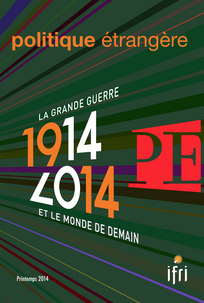
World War I, in Theory
The First World War gave rise to the emergence of the discipline of international relations, but it was the Second World War and the Cold War that fostered its development.
The "War to End All Wars": Total War, Total Peace?
The Paris Peace Conference of 1919-1920 marked the end of the First World War whose purpose was to establish the conditions for enduring, if not perpetual peace.
The Legacy of the Great War: Sovereign States, Globalization and Regionalism
The Great War has shaped many 20th century practices and norms.
Ifri, a foundation recognized as being of public utility, relies largely on private donors – companies and individuals – to guarantee its sustainability and intellectual independence. Through their funding, donors help maintain the Institute's position among the world's leading think tanks. By benefiting from an internationally recognized network and expertise, donors refine their understanding of geopolitical risk and its consequences on global politics and the economy. In 2026, Ifri partners with over 90 French and international companies and organizations.
