



Macron in Japan: Upgrading the Franco-Japanese Strategic Partnership in the Indo-Pacific

On June 26, French President Emmanuel Macron will make his first, what is deemed to be a long overdue visit to Japan, a year after his previous travels to Asia led him to China (January 2018), India (March 2018), and Australia (May 2018).
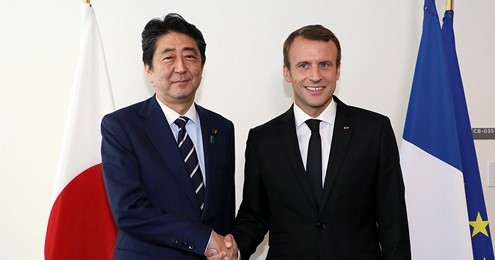
Arguably, his belated visit does not reflects a lack of interest or engagement in bilateral relations with Tokyo. Since his election, Macron has met six times the Japanese Prime Minister Shinzo Abe, who was invited as guest of honor to Bastille Day last year. In 2018, the two countries celebrated the 160th anniversary of their bilateral relations, and the partnership is advancing on all fronts: from economic cooperation, with the implementation of the EU-Japan Economic Partnership Agreement, to an ambitious space agenda.
A new roadmap to expand the cooperation for the next five years will be adopted during Macron’s visit. But the most promising area to upgrade the “Exceptional Partnership” is likely to be maritime security cooperation in the Indo-Pacific area.
Japan stands out as a key partner as France has been recently developing an Indo-Pacific strategy. The French government has shown its resolve to step up its diplomatic and security commitments in this vast area where it has 1.6 million citizens, territories, and a large Exclusive Economic Zone. Key challenges such as China’s maritime expansion and growing constraints on the freedom of navigation, crimes at sea, proliferation of Weapons of Mass Destruction, terrorism, but also natural disasters and pressure on maritime resources are increasingly putting French interests at risk. In response, Paris wants to foster a multipolar, rules-based Indo-Pacific in partnership with like-minded countries.
President Macron highlighted in May 2018 the “Paris-Delhi-Canberra axis” in this regards, and Japan is likely to be identified as the third key coordinating partner. Indeed, Paris and Tokyo, two liberal democracies, share a number of common concerns regarding unilateral challenges to the international order and the possible advent of what many observers view as an illiberal Chinese hegemony in the region. France and Japan’s security cooperation has been steadily expanded and formalized, with an annual 2+2 Dialogue at the ministerial level since 2014, an agreement on the transfer of defense equipment and technology (2016) and an acquisition and cross-servicing agreement (ACSA) (2018). Joint exercises have been upgraded, from Japanese participation in multinational humanitarian assistance and disaster relief (HA/DR) exercises held by France in the South Pacific to exercises of control at sea with the Frigate Vendemiaire in 2018 and 2019. As Japan has been diversifying its security partnerships beyond its U.S. ally to include India, Australia and the UK, among others, it also allowed Japan and France to hold quadrilateral drills with the U.S. and U.K. near Guam in 2017. This year, combined naval exercises gathered the French aircraft carrier Charles de Gaulle with a Japanese helicopter carrier, a U.S. guided missile destroyer and an Australian submarine in the Indian Ocean.
Tokyo is increasingly seen by Paris as a crucial and active player to coordinate with, as part of a wider network of strategic partners that will help to compete with China on a level playing field and allow for a division of labor in the vast Indo-Pacific area.


Céline PAJON
Chercheuse, responsable de la recherche Japon et Indo-Pacifique, Centre Asie de l'Ifri

Center for Asian Studies
Asia is a nerve center for multiple global economic, political and security challenges. The Center for Asian Studies provides documented expertise and a platform for discussion on Asian issues to accompany decision makers and explain and contextualize developments in the region for the sake of a larger public dialogue.
The Center's research is organized along two major axes: relations between Asia's major powers and the rest of the world; and internal economic and social dynamics of Asian countries. The Center's research focuses primarily on China, Japan, India, Taiwan and the Indo-Pacific, but also covers Southeast Asia, the Korean peninsula and the Pacific Islands.
The Centre for Asian Studies maintains close institutional links with counterpart research institutes in Europe and Asia, and its researchers regularly carry out fieldwork in the region.
The Center organizes closed-door roundtables, expert-level seminars and a number of public events, including an Annual Conference, that welcome experts from Asia, Europe and the United States. The work of Center’s researchers, as well as that of their partners, is regularly published in the Center’s electronic journal Asie.Visions.

Pakistan and the Israel-Palestine Conflict: Transformation in Pakistan’s Approach After the War in Gaza
Pakistan has long combined vocal support for the Palestinian cause with covert engagement with Israel. Since the war in Gaza, this balance has become untenable: public opinion is united against Israel, joining Trump’s Board of Peace has drawn rare cross-party criticism, and new regional alignments put normalization out of reach.
The Oceania Factor in France’s Evolving Indo-Pacific Strategy
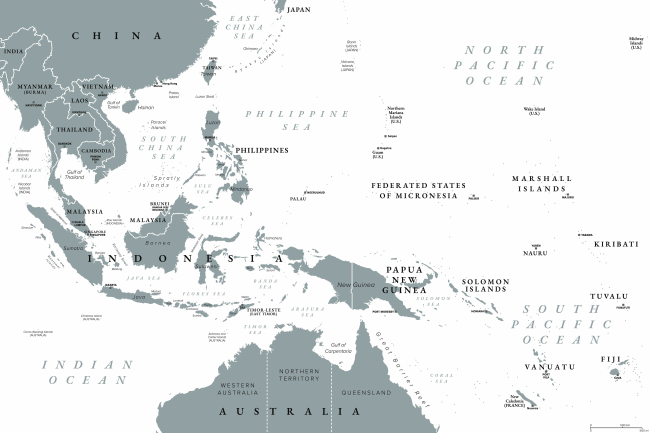
This paper examines the two-way relationship between France’s Indo-Pacific strategy and developments in Oceania. Oceania was not a priority in the initial years of France’s Indo-Pacific strategy, as the region was largely treated as secondary to major strategic hotspots and key partnerships, while overseas territories were primarily handled as domestic issues and recipients of a top-down strategy.

France’s View: From Diplomacy to Public-Private Action
France has emerged as the EU’s IMEC forerunner, combining port infrastructure, diplomatic alliances and public-private cooperation. With Marseille Fos at its core, the country brings a strategic hub for logistics, energy and digital connectivity to the corridor.
Trump II, the Crisis of the Rules-Based Order and Europe’s Indo-Pacific Strategy
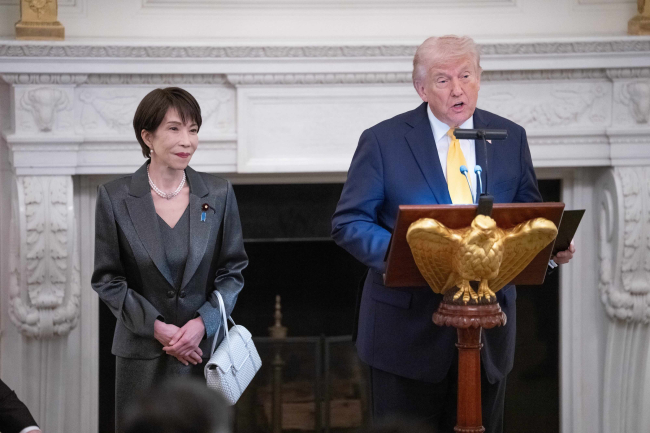
This article examines the implications of Trump II for Europe’s engagement in the Indo-Pacific. The piece contends that Trump II is accelerating the erosion of the rules-based order and undermining the relevance of the Free and Open Indo-Pacific (FOIP) concept, while forcing Europe to refocus on its own continental security amid US retrenchment. Paradoxically, these very constraints create conditions for a more autonomous, pragmatic, and explicitly interest-driven European engagement in the Indo-Pacific, rather than outright withdrawal.