



Search on Ifri.org

About Ifri

Frequent searches

Suggestions

See all

The French Army and the Military Revolution of the First World War

Date de publication
20 March 2014
Accroche

In 1914 the firepower of modern weaponry produced a massacre. To limit losses, the warring parties dug themselves into trenches. The French army was forced to innovate.

Michel GOYA

German-Russian Relations: Balance Sheet since 2000 and Perspectives until 2025

Date de publication
01 October 2012
Accroche

The relationship between Germany and Russia, according to official portrayals in Berlin, is one of ‘strategic partnership’ supplemented by ‘modernisation partnership’. The closeness and at times demonstrative cordiality of the relations have given rise to suspicion about Germany being an advocate of Russian interests in Europe for the benefit of its economy but at the expense of Europe’s trans-Atlantic links. 

Hannes ADOMEIT

German-Russian relations : End of the "honeymoon"?

Date de publication
01 September 2005
Hannes ADOMEIT

France, Germany, Turkey: A New Triangle of Powers

Date de publication
30 September 2013
Accroche

Relations between Germany, France and Turkey have been strictly bilateral for a long time, with varying intensity, styles and areas of cooperation. The European perspective that is now part of these relations has introduced a three-way dynamic. 

Year 2 of Germany's Energy Transition

Date de publication
11 November 2013
Accroche

After a decade characterised by the take-off of renewable energies, Germany decided in 2010 to make them the top priority. At the same time, it decided to make exemplary efforts in terms of energy efficiency and the reduction of greenhouse gases. The audacious nature of this policy was strengthened by the “turn” taken in 2011 to give up nuclear energy in the wake of the Fukushima accident.

Image de couverture de la publication
ETFIM Country Report: Germany

European Task Force on Irregular Migrations - Country Report: Germany

Date de publication
29 September 2011
Accroche

From a European comparative perspective, Germany represents the case of a highly restrictive migration control regime. Between 400,000 and 600,000 migrants live in the country without legal resident status. Their access to social rights such as health care and education is severely restricted, and individual or collective regularization channels do not exist. 

Barbara LAUBENTHAL Patricia PIELAGE

Germany and the Arab Spring

Date de publication
13 October 2012
Accroche

Much of the analyses of German reactions to the Arab Spring uprisings have focused on Germany’s contentious decision relating to Libya. By siding with the critics of military intervention in abstaining from UNSC 1973, Germany vexed its allies and arguably displayed an astonishing lack of geostrategic foresight and moral rectitude.

Timo BEHR

Britain's potential exit from the EU – Weimar Triangle Analyses: French, Polish and German viewpoints on European questions

Date de publication
20 February 2013
Accroche

On an initiative of the German Council of Foreign Relations (DGAP), the Study Committee for Franco-German Relations (Cerfa) of the French Institute of International Relations (IFRI) and the Polish Institute of International Affairs (PISM) are regularly publishing short contributions on a common subject, written by three experts of these institutes. The purpose of these “Weimar Triangle Analyses” is to give the French, Polish and German views on central questions of European politics and European integration.

Vivien PERTUSOT Lorenz WOJCIECH Almut MÖLLER

The intervention in Mali: Weimar Triangle Analyses: French, Polish and German viewpoints on European questions

Date de publication
28 March 2013
Accroche

On an initiative of the German Council of Foreign Relations (DGAP), the Study Committee for Franco-German Relations (Cerfa) of the French Institute of International Relations (IFRI) and the Polish Institute of International Affairs (PISM) are regularly publishing short contributions on a common subject, written by three experts of these institutes. The purpose of these “Weimar Triangle Analyses” is to give the French, Polish and German views on central questions of European politics and European integration.

Alain ANTIL Kacper REKAWEK Cornelius VOGT

States' Power in the European Union

Date de publication
15 May 2013
Accroche

On an initiative of the IP-Journal of the German Council of Foreign Relations (DGAP), the Study Committee for Franco-German Relations (Cerfa) of the French Institute of International Relations (IFRI) and the Polish Institute of International Affairs (PISM) are regularly publishing short contributions on a common subject, written by three experts of these institutes. The purpose of these “Weimar Triangle Analyses” is to give the French, Polish and German views on central questions of European politics and European integration.

Yann-Sven RITTELMEYER Almut MÖLLER Agata GOSTYNSKA Roderick PARKES

Support independent French research

Ifri, a foundation recognized as being of public utility, relies largely on private donors – companies and individuals – to guarantee its sustainability and intellectual independence. Through their funding, donors help maintain the Institute's position among the world's leading think tanks. By benefiting from an internationally recognized network and expertise, donors refine their understanding of geopolitical risk and its consequences on global politics and the economy. In 2026, Ifri partners with over 90 French and international companies and organizations.
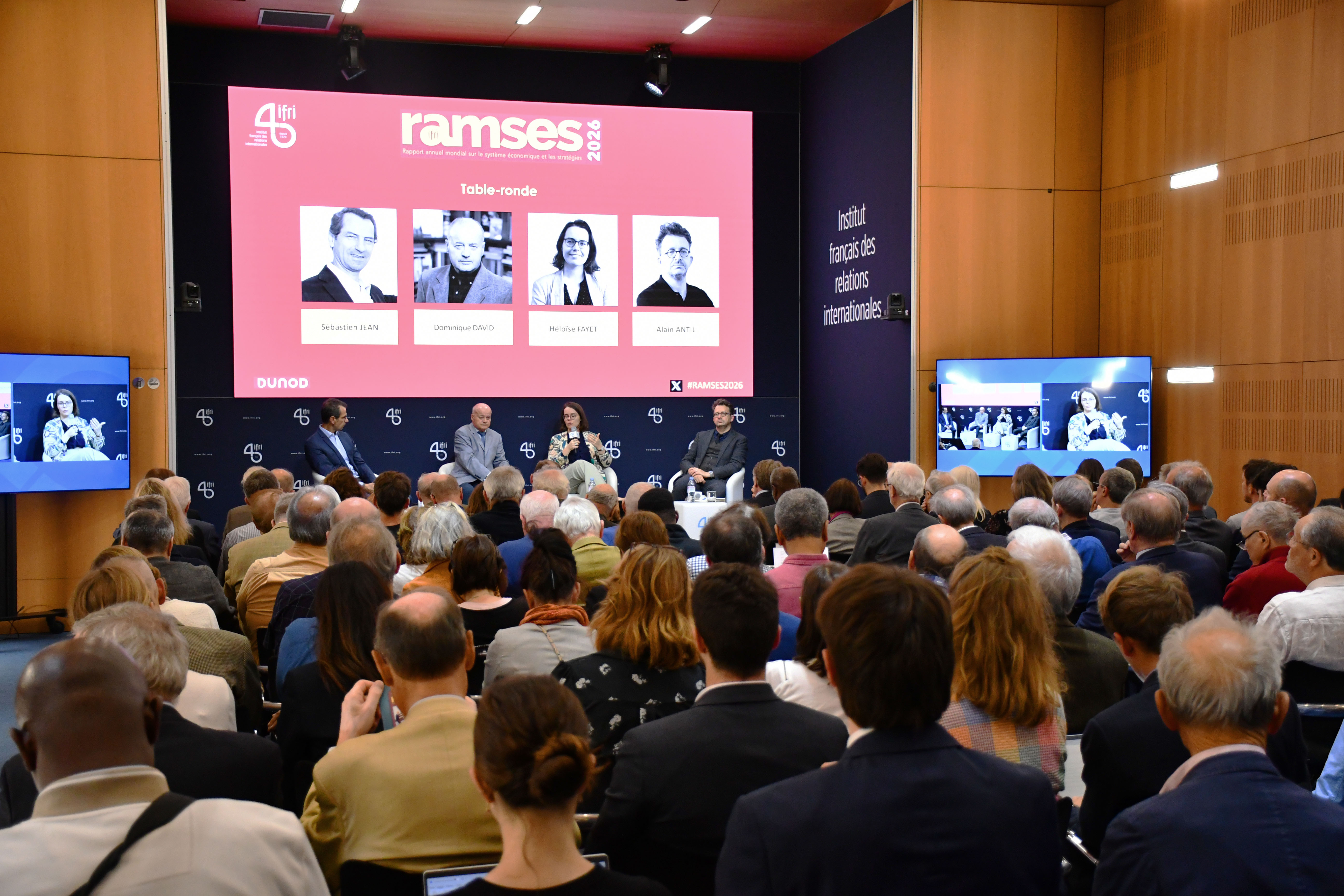
Presentation of Ramses 2026, Ifri, Paris