






Economic Security and East Asia: De-risking in an Era of Strategic Competition

Practical information
Annual Conference of Ifri's Center for Asian and Indo-Pacific Studies. As strategic competition becomes an increasingly dominant feature of the international system today, the “de-risking” of interdependent economic ties has emerged as a new mantra for managing geopolitical uncertainty.

Once kept at arm’s length, the fields of economics and security are increasingly being pulled together to create both new levers of influence and tools with which to bolster resilience.
Across East Asia, North America and Europe, new strategies to enhance economic security have surfaced in recent years, framing the policy debate and shaping economic interactions. What does “economic security” mean for key actors in these regions? How will East Asia’s regional economic order and its central role in global value chains be affected? What ambitions does the United States harbor in this domain and how does Europe’s own strategy impact its relations with East Asian partners?
Opening remarks
9:30-9:50 CEST
- Marc HECKER, Director of Research and Communications, Ifri
- François Chih-chung WU, Representative, Taipei Representative Office in France
Economic Security in the 21st Century
9:50-10:20 CEST
- Chern-Chyi CHEN, Deputy Minister of Economic Affairs, Taiwan (online)
Chaired by Françoise NICOLAS, Director, Center for Asian and Indo-Pacific Studies, Ifri
Coffee break
10:20-10:30
East Asian Approaches to Economic Security: Toward a new paradigm of regional economic order?
10:30-12:20 CEST
- Henry GAO, Professor of Law, Singapore Management University
- Kristy Tsun-Tzu HSU, Director, Taiwan ASEAN Studies Center, Chung-hua Institution of Economic Research
- Seungjoo LEE, Professor of Political Science and International Relations, Chung-Ang University
- Pavida PANANOND, Professor of International Business, Thammasat Business School (online)
- Kazuto SUZUKI, Director & Group Head, Economic Security, Institute of Geoeconomics, International House of Japan (online)
Chaired by Françoise NICOLAS, Director, Center for Asian and Indo-Pacific Studies, Ifri
Lunch break
12:20-14:00
How does the U.S. approach to economic security shape its role in East Asia?
14:00-15:15 CEST
- Emily BENSON, Director, Project on Trade and Technology, Center for Strategic and International Studies (CSIS)
- Mathilde VELLIET, Research Fellow, Geopolitics of Technology Program, Ifri
Chaired by John SEAMAN, Research Fellow, Center for Asian and Indo-Pacific Studies, Ifri
Coffee break
15:15-15:30
Europe’s Economic Security Strategy and its Impact on Relations with East Asia
15:30-17:00 CEST
- Denis REDONNET, Deputy Director General, DG Trade, European Commission (online)
- Elena SUAREZ, Senior Adviser, International Relations Department, BusinessEurope
- Sébastien JEAN, Senior Associate, Ifri, Professor, CNAM
- Yanmei XIE, Geopolitics Analyst, Gavekal Research
Chaired by Marie KRPATA, Research Fellow, Study Committee on Franco-German Relations, Ifri
The conference will take place in hybrid format in English – simultaneously at Ifri (Paris) and in virtual space .
All times are listed in Paris time (CEST).
Other events
France-Ukraine Forum 2026
More than four and a half years after the start of the full-scale war launched by Russia against Ukraine, the 2026 France-Ukraine Forum will bring together policymakers, experts, academics, and civil society representatives from both countries to discuss three main topics: the formats and conditions for a lasting diplomatic settlement; Ukraine’s Euro-Atlantic integration, encompassing both the EU accession process and closer ties with NATO; and the societal transformations of postwar Ukraine, as well as its prospects for reconstruction.
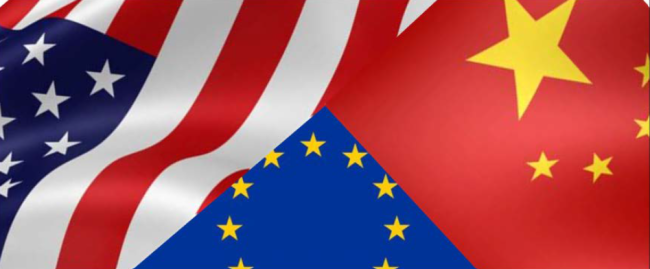
The EU in a World of Economic Warfare: Trade, Geopolitics, and the Battle for Economic Sovereignty
The international trading system has become a primary theatre of geopolitical competition. Tariffs, sanctions, and technology controls have replaced dialogue as the default instruments of economic relations.
The Road to 27 Electrification Action Plans: Planning and Investing in Europe’s Electric Future
The European Commission’s Electrification Action Plan places the continent on an electric path to structurally reduce dependence on fossil fuel imports and boost the energy transition in industry, transport and buildings.