



The Geopolitical Maturation of the European Political Community
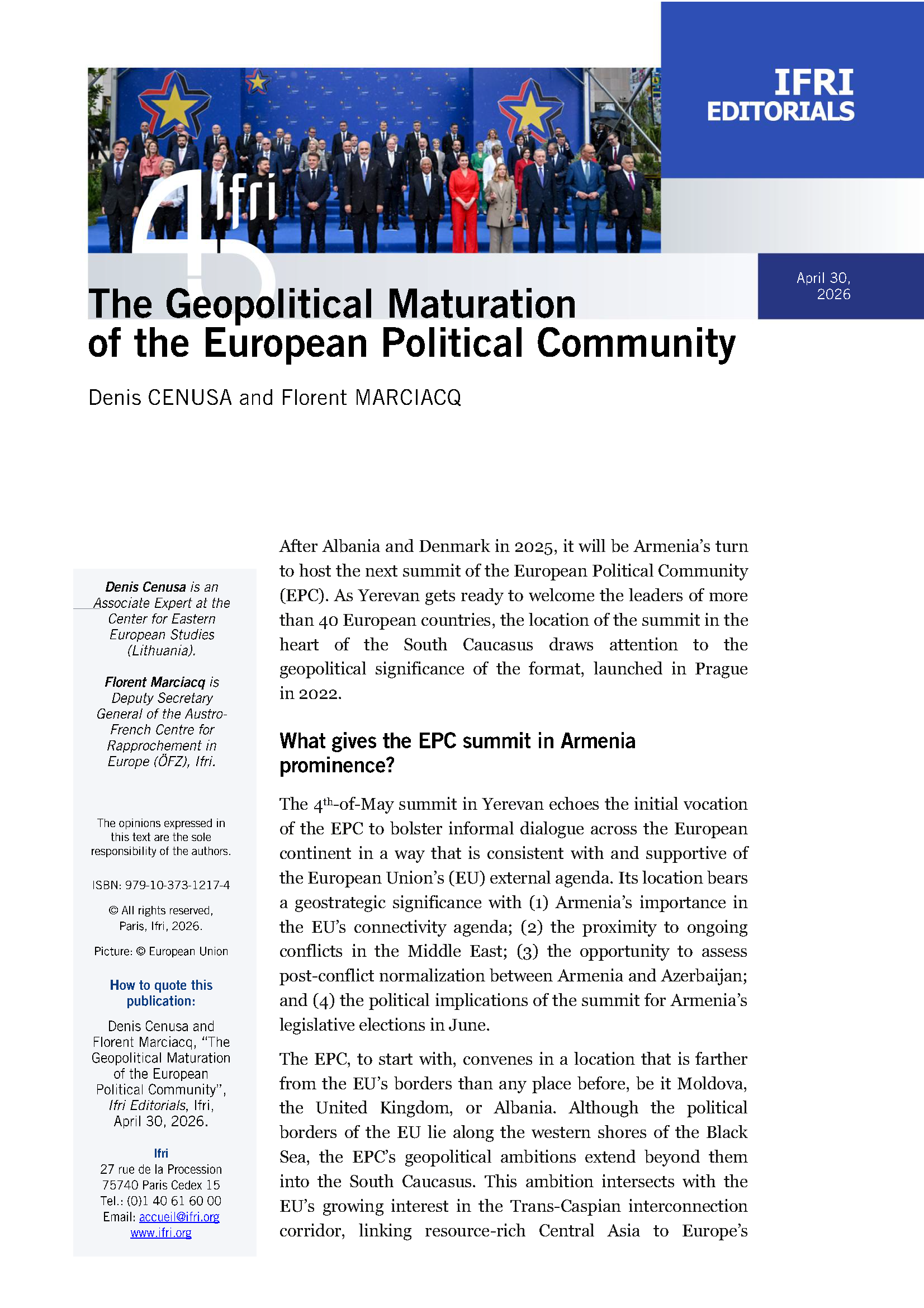
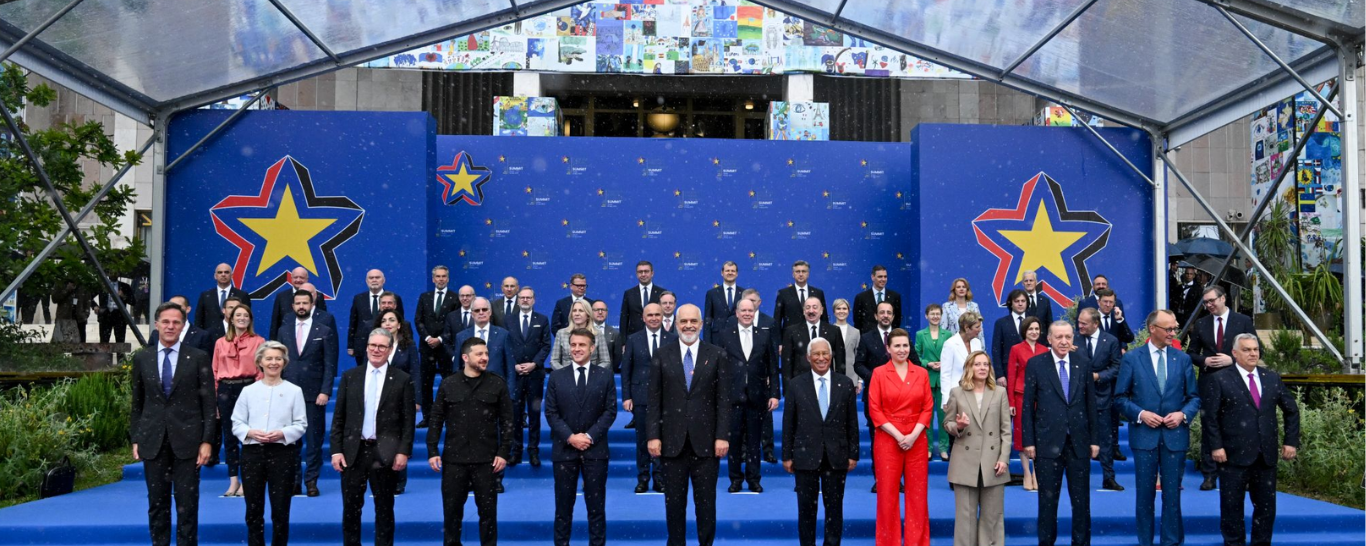
After Albania and Denmark in 2025, it will be Armenia’s turn to host the next summit of the European Political Community (EPC). As Yerevan gets ready to welcome the leaders of more than 40 European countries, the location of the summit in the heart of the South Caucasus draws attention to the geopolitical significance of the format, launched in Prague in 2022.
Titre Edito
What gives the EPC summit in Armenia prominence?
What gives the EPC summit in Armenia prominence?
The 4th-of-May summit in Yerevan echoes the initial vocation of the EPC to bolster informal dialogue across the European continent in a way that is consistent with and supportive of the European Union’s (EU) external agenda. Its location bears a geostrategic significance with:
- Armenia’s importance in the EU’s connectivity agenda;
- the proximity to ongoing conflicts in the Middle East;
- the opportunity to assess post-conflict normalization between Armenia and Azerbaijan;
- the political implications of the summit for Armenia’s legislative elections in June.
The EPC, to start with, convenes in a location that is farther from the EU’s borders than any place before, be it Moldova, the United Kingdom, or Albania. Although the political borders of the EU lie along the western shores of the Black Sea, the EPC’s geopolitical ambitions extend beyond them into the South Caucasus. This ambition intersects with the EU’s growing interest in the Trans-Caspian interconnection corridor, linking resource-rich Central Asia to Europe’s energy- and mineral-intensive market. The EPC summit will be the occasion to signal the political and economic significance of the Trans-Caspian Transport Corridor (TCTC) as an alternative and less vulnerable transport and energy route. The corridor brings together the South Caucasus, the Black Sea, and Central Asia within a broader configuration that fits the EU’s quest for strategic autonomy. The pro-EU orientation of Armenia adds strategic depth to this agenda. Amid Georgia’s temporary withdrawal from the EU accession process until at least 2028, the Armenian parliament has recently approved the idea of pursuing EU membership.
Second, the EPC summit was scheduled long before the United States–Israel military actions against Iran began unfolding in late February 2026. Neither the status of a founding member of Donald Trump’s Board of Peace nor the receipt of US diplomatic assistance for building interconnection projects with Azerbaijan has made Armenia a target for Iran. By contrast, all neighboring countries suspected of collaboration with the US have faced Iranian retaliatory measures, with drone missile attacks on civilian, primarily energy assets, and military infrastructures. The decision not to cancel the summit, despite the fragile US–Iran two-week ceasefire agreed on April 8th, suggests that Armenia received guarantees from Iran. Nor is it ruled out that Türkiye and Azerbaijan have also sought arrangements to secure the airspace near Armenia during the summit.
Third, the EPC summit in Armenia takes place after a peace deal, brokered by the US, was signed by Nikol Pashinyan and Ilham Aliyev in August 2025. One of the key principles of the EPC is its contribution to regional security. From its inception, at the 2022 summit in Prague, the EPC has aimed to build consensus between Yerevan and Baku, while focusing on the preconditions for a peace deal related to border delimitation. Despite not leading to an ultimate peace agreement, the talks facilitated by then European Council President, Charles Michel, and Emmanuel Macron on the EPC platform were diplomatic efforts to bridge the gap between the two sides. They paved the way, in that sense, for the EU’s first Common Security and Defense Policy mission to Armenia, launched to monitor its borders.
Lastly, the EPC Summit in Yerevan is held about a month ahead of the consequential legislative elections in Armenia (June 12, 2026). The gathering of more than 40 European leaders is likely to boost the image of Pashinyan’s ruling party, “Civil Contract”, which is mobilizing pro-EU votes. According to a February 2026 survey, 24% of respondents said they would vote for Pashinyan’s political party, i.e., three times more than the main opposition party, “Strong Armenia”, which is linked to the Armenian-Russian oligarch Samvel Karapetyan and was indirectly endorsed by Russian leader Vladimir Putin during the bilateral meeting with Pashinyan on April 9th (video: from minute 8:25 to 8:53). Moreover, an additional high-level event is planned with the Armenian leadership bilaterally, the first EU–Armenia summit. The combination of the two EU events could increase Pashinyan’s popularity amid discontent over the Karabakh issue, the border-related concessions to Azerbaijan, and the church reform included in the electoral program to remove the current head of the Apostolic Church, Catholicos Karekin II. The legislative initiative of the ruling party enabling the start of EU accession procedures, alongside the EPC and the EU–Armenia summit, may confirm Pashinyan as Armenia’s first state leader to bring the country so close to the EU. At the same time, this can also push Pashinyan too far away from the multi-vector foreign policy approach, which allowed Armenia to maintain a balancing act between Russia and the EU. In response, Russia could put more pressure on Armenia, as it did immediately after Pashinyan’s meeting with Putin, in early May. Putin, on that occasion, warned his Armenian counterpart about the consequences in trade and energy that distancing politically from Moscow would have for Armenia.
Titre Edito
What’s on the EPC’s agenda in Yerevan?
What’s on the EPC’s agenda in Yerevan?
The agenda of the summit in Yerevan will reflect both continuity and urgency. The opening session will bring heads of state and government together for a broad strategic exchange, setting the tone for discussions that increasingly blend security, governance, and economic resilience. Since its launch in 2022, the EPC has evolved into a flexible platform for high-level diplomatic and political coordination beyond the EU’s formal structures, allowing leaders to address shared challenges in a less constrained setting. Yerevan’s summit is expected to reinforce this role.
A central thematic focus will remain democratic resilience and hybrid threats, a priority carried over from previous summits such as Moldova. Leaders are expected to assess progress in countering foreign information manipulation and electoral interference, while advancing the operationalization of the newly launched European Centre for Democratic Resilience. This comes at a moment when the EU launched on April 21st, 2026, a new European Union Partnership Mission in Armenia, replicating a similar mission established in Moldova to counter hybrid threats and Russian interference. Discussions will also link to the European Democratic Shield initiative, aimed at strengthening institutional safeguards and public trust in national and EU institutions. With elections across Europe increasingly targeted by disinformation campaigns, the EPC format is increasingly used as a platform to coordinate responses across both EU and non-EU states, ensuring that vulnerabilities in one country do not spread cross-border and become systemic risks for the wider continent.
The second thematic roundtable will address connectivity and energy transition. Discussions are likely to focus on infrastructure interdependence, energy diversification, and the strategic implications of green transitions in a fragmented geopolitical landscape. With energy security still shaped by the aftershocks of Russia’s war in Ukraine and novel implications stemming from the blockade of the Strait of Hormuz, participants are expected to examine how regional cooperation, ranging from grid interconnections to transport corridors, can reduce vulnerabilities. The dialogue in this area, however, requires balancing national energy priorities and the costs for the population and business with broader European climate objectives.
Beyond the formal sessions, Yerevan will host a dense schedule of bilateral and informal meetings, underscoring the EPC’s role as a diplomatic accelerator. Among these, a high-level gathering of the anti-drug coalition, launched in Copenhagen and now comprising nearly 40 participants including the European Commission and the Council of Europe, will focus on operational steps. Priorities include disrupting maritime trafficking routes, tackling illicit financial flows, and addressing emerging threats such as synthetic drugs. This agenda complements existing EU strategies against drug trafficking and maritime security, reinforcing the EPC’s function as a bridge between policy frameworks and coordinated action.
Titre Edito
Conclusion
Conclusion
Ultimately, the Yerevan summit illustrates how the EPC is transitioning from a symbolic forum into a discrete, almost surgical, geopolitical instrument with an increasing capacity to stir cross-national political enthusiasm and policy creative ideas.
Its ability to convene a broad set of European actors, across institutional, geographic, and political divides, gives it unique added value at a time of fragmented security and competing alignments. Yet its future relevance will depend on whether dialogue can translate into sustained coordination and tangible outcomes. In Armenia, this challenge is particularly acute, as domestic, regional, and global dynamics intersect. If successful, the summit may confirm the EPC not only as a space for conversation, but as an emerging driver of European strategic coherence and ambition.

Available in:
Themes and regions
ISBN / ISSN
Share
This page contains only a summary of our work. If you would like to have access to all the information from our research on the subject, you can download the full version in PDF format.
The Geopolitical Maturation of the European Political Community
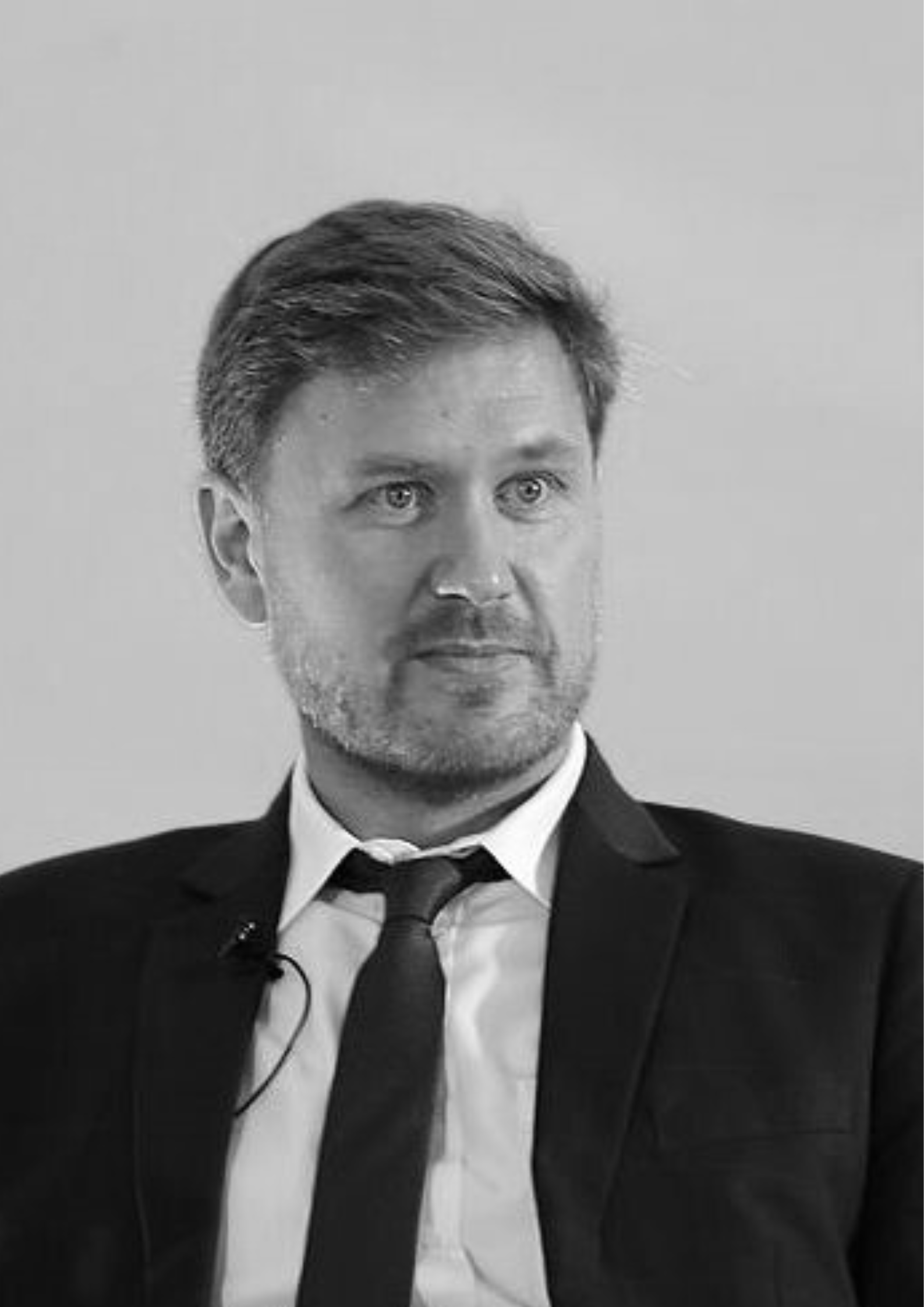
Florent MARCIACQ
Associate Research Fellow and Deputy Secretary General of the Austro-French Centre for Rapprochement in Europe (ÖFZ), Ifri
Austro-French Centre for Rapprochement in Europe (ÖFZ)
The Austro-French Centre for Rapprochement in Europe (ÖFZ/CFA) is a Franco-Austrian intergovernmental organization, initiated in 1976 by Prime Minister Jacques Chirac and Federal Chancellor Bruno Kreisky, in order to develop economic relations between Western and Eastern Europe, contributing to the creation of a Europe of peace.
After the fall of the Berlin Wall, the ÖFZ/CFA refocused its action on the problems following the enlargement of the European Union, and integrated the following countries in its field of activities : Hungary, Poland, Czech Republic, Slovak Republic, Slovenia, the Baltic countries, Romania and Bulgaria. ÖFZ/CFA's vocation, as a space for reflection and exchange, is in fact reinforced by the need to support the new member countries of the Union in their integration process. Since 2004, the ÖFZ/CFA has also turned towards the Union's new neighbors, in particular towards the countries of the Western Balkans, which perceive their future from a European perspective.
The ÖFZ/CFA strives to place all of its exchanges in a global perspective concerning the future of our continent. Today it centers its activities around three directions: the Franco-Austrian bilateral dialogue, the future of the European Union, the future recomposition of the continent.
Reports of all events organized by the ÖFZ/CFA are available on its website (http://oefz.at). The ÖFZ/CFA's budget is provided by the French and Austrian foreign ministries. Depending on the themes addressed, the ÖFZ/CFA calls on European public and private institutions to help finance its meetings. The CFA's orientations benefit from the recommendations of an Orientation Council, approved by a Board of Directors, which elects from among its members a president and a secretary general.
The Balkans: A New Great Game?
What political spaces make up the Old Continent? This question is at the heart of the Ukrainian conflict.
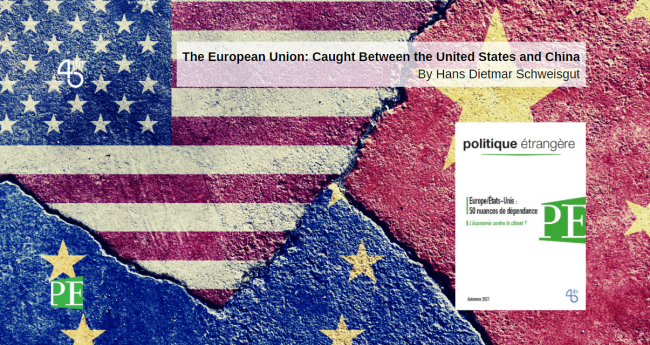
The European Union: Caught Between the United States and China
The United States and the European Union (EU) are now both in agreement regarding China – long viewed benevolently – as a systemic rival in the international order.

The Governance of Energy Poverty in Southeastern Europe
This report presents the outcomes of a recently-completed research project1 aimed at uncovering the different ways in which energy poverty – understood as a condition wherein the domestic energy services available to a household are below socially and materially necessitated levels – is produced by, and mitigated through, the interaction of relevant decision-making institutions in the energy, social welfare, health and housing domains. The project focused on conditions in Southeastern Europe, where energy prices have been recently on the rise despite falling incomes and poor access to efficient and adequate energy services.
Serbia moving ahead towards trade liberalization with EU?
An Interim Agreement on Trade and Trade related aspects (ITA), signed between the European Community and Serbia in April 2008, entered into force on February 1, 2010. This ITA, as a part of the Stabilization and Association Agreement, “establishes a bilateral free trade area over a period lasting a maximum of six years starting from the entry into force of this Agreement in accordance with the provisions of this Agreement and in conformity with those of the GATT 1994 and the WTO”.