


Japan and the South China Sea: Forging Strategic Partnerships in a Divided Region

In the midst of growing tensions with China, Japan is deepening its strategic engagement in Southeast Asia. Preserving stability in the South China Sea, which is threatened by renewed frictions around contested territories, is a vital interest for sea lane-dependent Japan. Moreover, Tokyo considers Southeast Asian countries as crucial partners in balancing against an increasingly powerful and more assertive China.
Therefore, Tokyo is stepping up its security cooperation in the region through the promotion of regional maritime and security institutions, but more importantly, by building strategic partnerships and helping to foster the maritime capacities of key like-minded countries (notably Indonesia, the Philippines and Vietnam).
These initiatives augment the “great game” of influence currently underway in Southeast Asia and in which Japan is soft-balancing China and supporting a more sustainable US presence. Still, forging strategic partnerships is not an easy task as ASEAN countries, if increasingly polarized, are not passive in the face of the great powers contest.
As East Asia grows seemingly more divided and as a competition for influence is flaring up, Europe is politically absent. Yet, expectations for more politico-military involvement from European countries in the region do exist, especially in Japan. If discussions about a possible “EU pivot” to East Asia are developing, many obstacles and limitations still constrain an expansion of European influence in the region.

Available in:
Regions and themes
ISBN / ISSN
Share
This page contains only a summary of our work. If you would like to have access to all the information from our research on the subject, you can download the full version in PDF format.
Japan and the South China Sea: Forging Strategic Partnerships in a Divided Region


Céline PAJON
Chercheuse, responsable de la recherche Japon et Indo-Pacifique, Centre Asie de l'Ifri

Center for Asian Studies
Asia is a nerve center for multiple global economic, political and security challenges. The Center for Asian Studies provides documented expertise and a platform for discussion on Asian issues to accompany decision makers and explain and contextualize developments in the region for the sake of a larger public dialogue.
The Center's research is organized along two major axes: relations between Asia's major powers and the rest of the world; and internal economic and social dynamics of Asian countries. The Center's research focuses primarily on China, Japan, India, Taiwan and the Indo-Pacific, but also covers Southeast Asia, the Korean peninsula and the Pacific Islands.
The Centre for Asian Studies maintains close institutional links with counterpart research institutes in Europe and Asia, and its researchers regularly carry out fieldwork in the region.
The Center organizes closed-door roundtables, expert-level seminars and a number of public events, including an Annual Conference, that welcome experts from Asia, Europe and the United States. The work of Center’s researchers, as well as that of their partners, is regularly published in the Center’s electronic journal Asie.Visions.

Space Security and Missile Defense : Japan's Quest for Autonomy and Indispensability
Seeking greater autonomy without loosening its alliance with the United States, Japan has steadily turned space into a pillar of its defense, building sovereign capabilities that also make it an indispensable partner, to Washington and beyond. This approach raises questions for Europe, whose ties with Japan are multiplying but which has yet to define what it can concretely bring to Tokyo, particularly in missile warning.
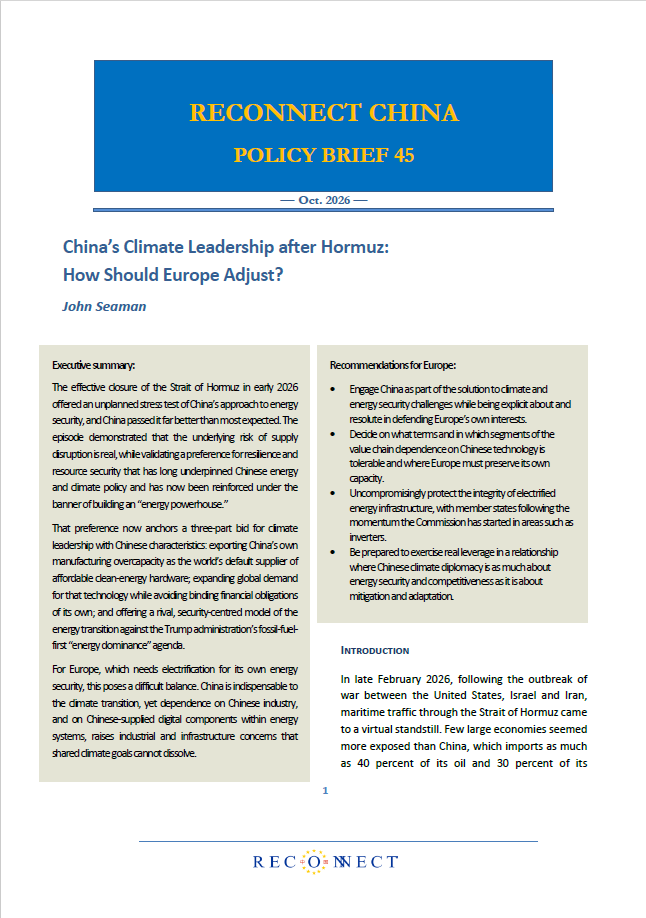
China’s Climate Leadership after Hormuz: How Should Europe Adjust?
The effective closure of the Strait of Hormuz in early 2026 offered an unplanned stress test of China’s approach to energy security, and China passed it far better than most expected. The episode demonstrated that the underlying risk of supply disruption is real, while validating a preference for resilience and resource security that has long underpinned Chinese energy and climate policy and has now been reinforced under the banner of building an “energy powerhouse.”

China as an ambivalent supporter of the WTO and the multilateral trading system
Amid rising trade tensions between Europe and China and broader uncertainty in the international rules-based trade regime, Beijing has worked to preserve and bolster the multilateral trading system while at the same time failing to reform the domestic policies that have served to undermine that same system.

Canada in the Indo-Pacific: Sustaining the Pivot, Partnering with France
Since the launch of Canada’s inaugural Indo-Pacific Strategy (IPS) in November 2022, Ottawa has moved—with notable but uneven momentum—from the margins of regional engagement to a position of growing strategic visibility. The Strategy, backed by an initial $2.3 billion five-year investment, reflects a long-overdue recognition: Canada is a Pacific nation whose prosperity and security are inextricably linked to the stability of the world’s most economically and strategically consequential region.