International Trade
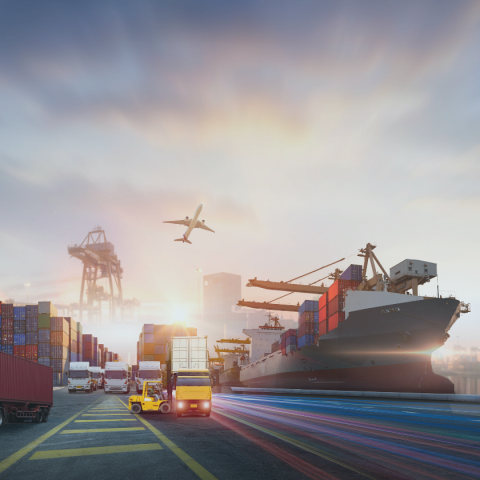
International trade has risen sharply in the era of globalization. The Covid-19 pandemic, the war in Ukraine and rising geopolitical tensions are leading to a reconfirguation of value chains.
Related Subjects
Replay - Conference with Chris Wright, Secretary, U.S. Department of Energy
Welcomed at the French Institute of International Relations (Ifri), Chris Wright outlined his vision of American energy policy built around two core axes: the human reality of energy access, and a data-driven approach. For the Secretary, energy is the foundation of prosperity, health, and longer life expectancy on a global scale. His doctrine rests on an ambition of American "energy dominance" — not merely independence, but the capacity to produce at scale in order to lower domestic costs, reindustrialize the country, and support U.S. allies.
The Global Battle for Control of the Seas Continues to Rage in the 21st Century
Just as the Greek cities in the Mediterranean did over two thousand years ago, today the United States and China are seeking to control the sea lanes. Europe is watching the ships go by. On July 6, off the coast of Yemen, not far from Djibouti and the Bab al-Mandab Strait, the Greek and Liberian bulk carrier Magic Seas, loaded with fertilizer and steel, sank after being attacked by drone boats and rocket launchers. The next day, the Eternity C, hit by missile fire, sank, killing some of the crew.
quoted by Leila Abboud in the Financial Times
How do maritime companies cooperate with the navies? An interview with Christine Cabau (CMA-CGM)
On the sidelines of the Paris Naval Conference 2025, on February 4, 2025, organized by Ifri and the French Navy (Marine nationale), Christine Cabau, Executive Vice-President in Charge of Assets and Operations, CMA-CGM, shares insights on how maritime companies collaborate with the navies to secure maritime economy.
How do maritime companies cooperate with the navies? An interview with Evan FUERY, EQUINOR
On the sidelines of the Paris Naval Conference 2025, on February 4, 2025, organized by Ifri and the French Navy (Marine nationale), Evan FUERY, Senior Vice-President for Corporate Security and Crisis Management, EQUINOR, shares insights on how maritime companies collaborate with the navies to secure maritime economy.
How do maritime companies cooperate with the navies? An interview with Simon Bergulf, MÆRSK
On the sidelines of the Paris Naval Conference 2025, on February 4, 2025, organized by Ifri and the French Navy (Marine nationale), Simon BERGULF, Group Representative Europe Public and Regulatory Affairs, Head of Energy transition and Operations, Maersk, shares insights on how maritime companies collaborate with the navies to secure maritime economy.
De-globalization or Re-globalization? (World Policy Conference 2024 - Plenary Session)
Saturday, December 14, 2024 - 17th edition of the World Policy Conference in Abu Dhabi, United Arab Emirates. Plenary session 3: De-globalization or Re-globalization?
Replay - The European Union in Competition with the United States and China. How to Balance Free Trade, Competitiveness and Economic Security?
Video replay from Ifri's conference, on December 3, 2024. As the geopolitical context has changed, so has the approach to international economic relations and the rules-based multilateral framework. Covid and Russia’s war against Ukraine have exposed the risks of extended supply chains and of having become dependent on a single supplier.
When the chips are down: China threatens to cut supply on rare minerals
China has just announced controls on exports of rare minerals - gallium and germanium - whose production it dominates and which are essential for the manufacture of electronic components.
U.N. Security Council meets on Nord Stream at Russia's request
Remarks by Marc-Antoine Eyl-Mazzega, director of Ifri's Center for Energy & Climate, on the occasion of the meeting of the U.N. Security Council on Nord Stream at Russia's request, on September 30, 2022.
Support independent French research
Ifri, a foundation recognized as being of public utility, relies largely on private donors – companies and individuals – to guarantee its sustainability and intellectual independence. Through their funding, donors help maintain the Institute's position among the world's leading think tanks. By benefiting from an internationally recognized network and expertise, donors refine their understanding of geopolitical risk and its consequences on global politics and the economy. In 2025, Ifri supports more than 80 French and foreign companies and organizations.