



German Nuclear: Green Is Good Politics
In polarized politics, the voter must take on faith the wisdom inherent in the principled political position. Who cannot be impressed by the nuclear catastrophe at Fukushima, especially after living through the fallout from Chernobyl? But is it reasonable to send the voter to the booth with only half the information? Does the German voter have any idea what it means to shut down its nuclear power in just ten years? Have German politicians made any effort to tell them?
Decoupling the Oil and Gas Prices: Natural Gas Pricing in the Post-Financial Crisis Market
This paper looks into natural gas pricing in the post-financial crisis market and, in particular, examines the question whether the oil-linked gas pricing system has outlived its utility as global gas markets mature and converge more rapidly than expected and as large new resources of unconventional gas shift the gas terms-of-trade.
Political Oil Prices: A Measured Response if Any
Oil prices are becoming an increasingly worrisome factor in today’s economies. They have risen dramatically over the past 6 or 7 months and are now driving inflation in many economies and acting as a drag on nearly all. They are not at these levels because markets are fundamentally out of balance.
European Energy Policy: Energy Savings Glass 2/3 Empty
Summing up Europe’s climate policies suggests we still haven’t grasped the full potential for energy savings. We act as if we were living in a system with infinite resources easily exploited by human innovation and ingenuity. We focus on the efficiencies we can gain from components of our system, but not on the system as a whole and we do not consider how the other billions of people on earth can achieve our level of comfort with a resource or carbon-constrained future and with aspirations that necessarily imply sharply growing energy consumption.
Rising (Oil-linked) Gas Prices: A Message from Shale Gas
One benefit that should flow soon from large new sources of shale gas that have been and will be unleashed into world markets - is the realization that gas prices linked to oil prices don’t make sense any more.
The Effects of Baghdad Politics on Kurdistani Gas Prospects
This paper examines the effects of internal Iraqi politics on the potential for exporting Kurdistani natural gas. It examines Baghdad’s policy with regards to both oil and gas, and predicts what effects it will have on Kurdistan’s gas prospects.
Renewables in Transport: Directive 2009/28/EC - Devils in its Details
This Actuelle precedes a longer and more exhaustive paper on Electric Vehicles, under the title "The Electric Vehicle in the Climate Change Race: Tortoise, Hare or both?" by Maïté de Boncourt.
As part of the 3*20 targets reached in December 2008, the EC decided that the EU should, by 2020, source 20% of its Final Energy Consumption (FEC) renewably.
The Electric Vehicle in the Climate Change Race: Tortoise, Hare or Both?
Europe is seeking ways to decrease the growing negative impact of passenger cars on climate, currently responsible for up to 12% of total EU CO2 emissions. After biofuels in the nineties and hydrogen in 2000, the new answer to climate change appears to be electric. But contrary to many marketing messages, electric cars are not zero emissions cars. They will not necessarily contribute to actual CO2 emission reductions before 2020 and even then, not in every country.
Migrations et développement : l'enjeu environnemental et l'avenir des politiques migratoires
This paper analyzes the future of migrations related to climate changes and environment degradations.
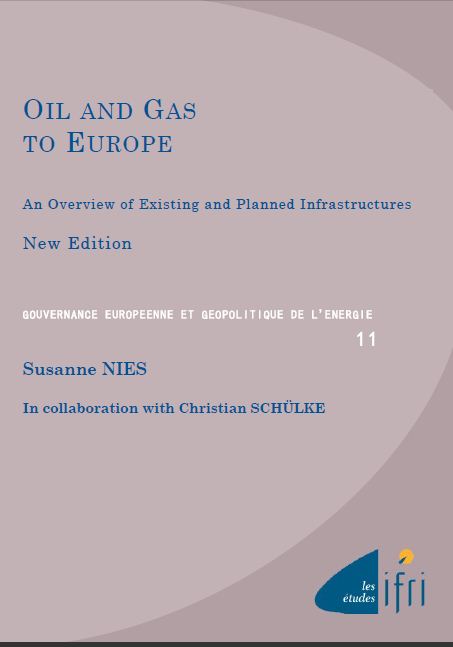
Oil and Gas Delivery to Europe: An Overview of Existing and Planned Infrastructures. New Edition
The European Union’s hydrocarbon energy supply depends heavily on imports. While the European Commission has recommended diversifying and increasing domestic resources, notably with renewable resources which should grow to 20% by 2020, dependence on hydrocarbon imports will remain not only substantial, but will increase.
Support independent French research
Ifri, a foundation recognized as being of public utility, relies largely on private donors – companies and individuals – to guarantee its sustainability and intellectual independence. Through their funding, donors help maintain the Institute's position among the world's leading think tanks. By benefiting from an internationally recognized network and expertise, donors refine their understanding of geopolitical risk and its consequences on global politics and the economy. In 2026, Ifri partners with over 90 French and international companies and organizations.
