





From Ambition to Action: Exploring Technological Partnerships with India
Practical information
Accessibility
Themes and regions
Related centers and programs
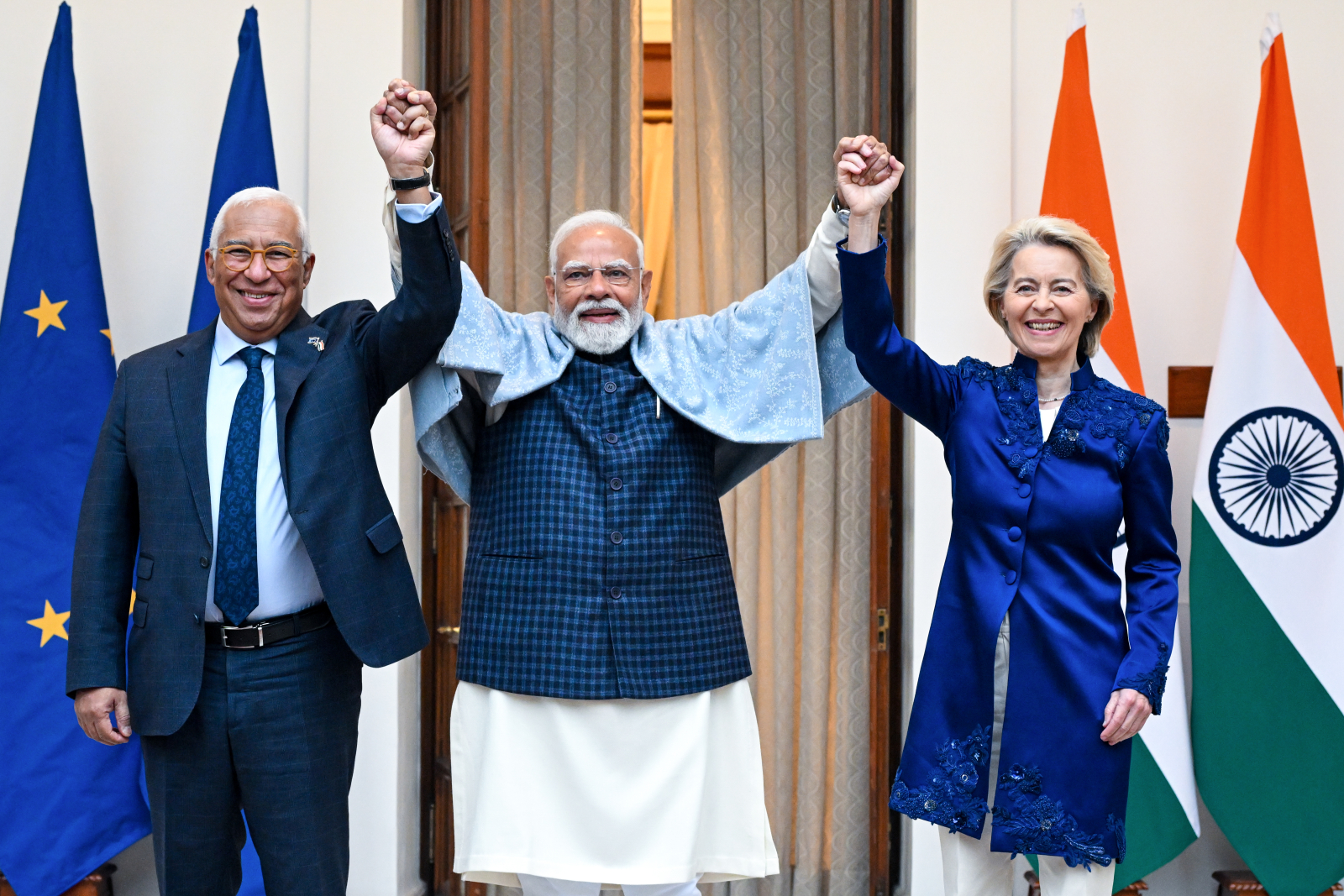
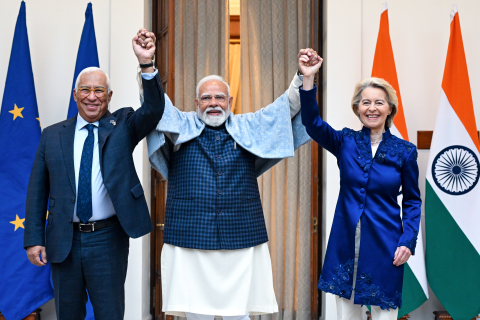
The 16th EU-India Summit, held on January 27th in New Delhi with European leaders António Costa, Ursula von der Leyen, and Prime Minister Narendra Modi, marks a significant milestone in deepening EU-India relations. At the same time, official bilateral visits from EU member states are on the rise, including that of the French President, who visited India in February to participate in the Artificial Intelligence Summit. As India asserts its technological ambitions and seeks to reduce its dependence on China, Europe is stepping up its efforts to diversify its strategic partnerships.
Replay
What opportunities arise from the convergence of these two dynamics? Can cooperation in cutting-edge sectors—from electric vehicles to artificial intelligence and semiconductors—transform the Indo-European relationship into a lever for strategic autonomy? What are the benefits, but also the risks, for Europe in this rapprochement? More broadly, does India have the industrial, technological, and diplomatic capabilities to become not only an essential partner, but also a key player in the new international order?
Speakers:
- Clara Chappaz, Ambassador for Digital Affairs and Artificial Intelligence, Ministry for Europe and Foreign Affairs,
- Gabriele Bertolli, Deputy Head of the Unit "International Affairs and Policy Outreach", Directorate General for Communications Networks, Content and Technology, European Commission,
- Suman Bery, Vice Chairperson, Niti Aayog,
- Trisha Ray, Associate Director and Resident Fellow, GeoTech Center, Atlantic Council.
Moderation:
Sylvia Malinbaum, Head of India and South Asia Research, Center for Asian Studies, Ifri.
Related Subjects
Other events
France-Ukraine Forum 2026
More than four and a half years after the start of the full-scale war launched by Russia against Ukraine, the 2026 France-Ukraine Forum will bring together policymakers, experts, academics, and civil society representatives from both countries to discuss three main topics: the formats and conditions for a lasting diplomatic settlement; Ukraine’s Euro-Atlantic integration, encompassing both the EU accession process and closer ties with NATO; and the societal transformations of postwar Ukraine, as well as its prospects for reconstruction.
The EU in a World of Economic Warfare: Trade, Geopolitics, and the Battle for Economic Sovereignty
The international trading system has become a primary theatre of geopolitical competition. Tariffs, sanctions, and technology controls have replaced dialogue as the default instruments of economic relations.
The Road to 27 Electrification Action Plans: Planning and Investing in Europe’s Electric Future
The European Commission’s Electrification Action Plan places the continent on an electric path to structurally reduce dependence on fossil fuel imports and boost the energy transition in industry, transport and buildings.