



From the Balkans to Turkey: a Austrian perspective on EU enlargement
Report written by Séverine Neervoort, Intern, Ifri Brussels
An Austrian outlook
Austria has a unique perspective on the enlargement process. Given that it joined the European Union in 1995 and participated in the negotiations with accession candidates from 1998, it has experience with both sides of the process. In order to present the Austrian vision on the last accession candidates, Robert Weiss reminded us that the geographical situation plays an important role in the position that a member state might take on a candidate country. A common border for example often means a common history, better knowledge of the country and of course special interests.
In general, the enlargement policy is a “win-win situation”. Indeed, it widens the EU influence in the world, spreads its values and develops the European market. On the other hand, future member states assert their international position by being part of the European Union. They also receive help to build their own institutions and sometimes stabilize their democracy. The last enlargement managed to create a bridge between Western and Eastern Europe, as well as it brought stability.
In October 2005, the EU began ambitious negotiations with Croatia and Turkey. Robert Weiss tried and answered two key questions in his presentation: What are the particularities of this next enlargement process? What are the main subjects discussed in the Council?
A new framework for negotiations
While the aim of this enlargement is quite comparable to the precedent, the framework is different. First, accession candidates are asked to fulfil two benchmarks, an opening benchmark and a closing one, which are an imperative condition for accession. The opening benchmark did not exist before. Then, there is a suspension clause, which allows the European Union to suspend the negotiations any violation of democratic values or human rights should occur during the process. Last but not least, there is no fixed date for the accession: It is an open end date process.
The European Union is negotiating with two very different candidates. The geographical situation of Croatia and Turkey cannot be compared: One is a relatively small country, the other is much bigger and with only a small part of its territory in Europe. Furthermore, Turkey has a very influential power with certain principles not always compatible with the European values. The maturity of their institutions also differs very widely: While Croatia is still developing its own institutions, Turkey has been a strong nation-state for a very long time.
A general approach to the discussions in the Council
Robert Weiss, who is the Austrian representative in the Enlargement working group of the Council presented the main subjects discussed in the Council. In the case of Turkey accession, it seems that the arguments can be summarized in two points. First, according to Turkey advocates, the External Policy Dimension is crucial. The accession of this country would strengthen the European defence and security, as well as it would help diversify energy supply. Some describe Turkey as a bridge to the Middle East. The arguments against it concern Internal Policy, such as the organisation of the EU with Turkey as a member, or for example the future of Common Agriculture Policy. With the fulfilment of the benchmarks, Turkey and the EU will certainly reach a strong cooperation. To Austria, the best outcome would be a “EU-Turkey community”, a special partnership, but not necessarily an accession as a full member.
Croatia seems to be coping with the regular framework; that explains why the Commission thinks it might be possible for the negotiations to end in 2009, as mentioned by Mr. Barroso and Mr. Rehn. Croatia still needs to implement some painful reforms, that is why its government has to focus on its political will and should convince the population that the reforms are done in order to make an early entrance in the EU possible. Mr. Weiss observed that the Croatia accession could be an important signal for the Western Balkans, that are now in the stabilisation association process. It shows that the EU keeps its commitments when the candidate implements the reforms.
The presentation was followed by an interesting debate with the audience. Several questions were asked to Mr. Weiss: About Austrian public opinion on the adhesion of Croatia and Turkey or about the French presidency of the European Union, but most of them concerned the sensitive question of Turkish adhesion.
Robert WEISS is First Secretary at the Permanent Representation of Austria to the European Union.

Available in:
Regions and themes
ISBN / ISSN
Share
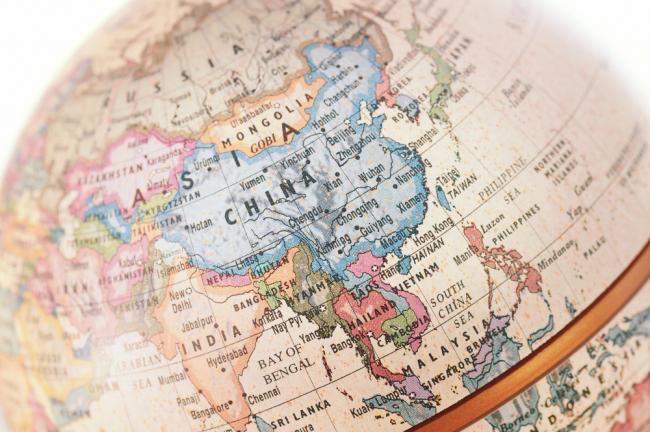
Center for Asian Studies
Asia is a nerve center for multiple global economic, political and security challenges. The Center for Asian Studies provides documented expertise and a platform for discussion on Asian issues to accompany decision makers and explain and contextualize developments in the region for the sake of a larger public dialogue.
The Center's research is organized along two major axes: relations between Asia's major powers and the rest of the world; and internal economic and social dynamics of Asian countries. The Center's research focuses primarily on China, Japan, India, Taiwan and the Indo-Pacific, but also covers Southeast Asia, the Korean peninsula and the Pacific Islands.
The Centre for Asian Studies maintains close institutional links with counterpart research institutes in Europe and Asia, and its researchers regularly carry out fieldwork in the region.
The Center organizes closed-door roundtables, expert-level seminars and a number of public events, including an Annual Conference, that welcome experts from Asia, Europe and the United States. The work of Center’s researchers, as well as that of their partners, is regularly published in the Center’s electronic journal Asie.Visions.
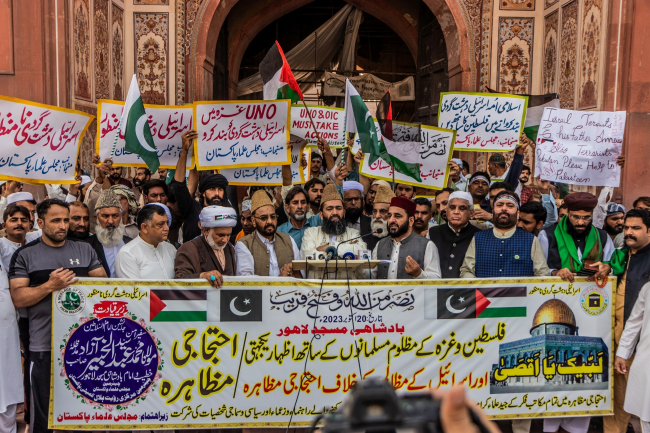
Pakistan and the Israel-Palestine Conflict: Transformation in Pakistan’s Approach After the War in Gaza
Pakistan has long combined vocal support for the Palestinian cause with covert engagement with Israel. Since the war in Gaza, this balance has become untenable: public opinion is united against Israel, joining Trump’s Board of Peace has drawn rare cross-party criticism, and new regional alignments put normalization out of reach.
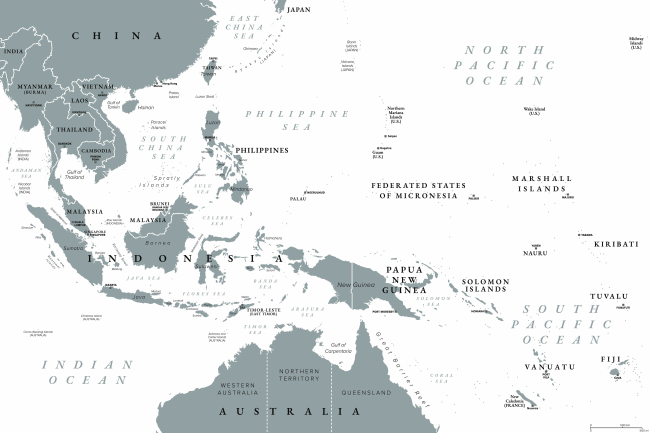
The Oceania Factor in France’s Evolving Indo-Pacific Strategy
This paper examines the two-way relationship between France’s Indo-Pacific strategy and developments in Oceania. Oceania was not a priority in the initial years of France’s Indo-Pacific strategy, as the region was largely treated as secondary to major strategic hotspots and key partnerships, while overseas territories were primarily handled as domestic issues and recipients of a top-down strategy.

France’s View: From Diplomacy to Public-Private Action
France has emerged as the EU’s IMEC forerunner, combining port infrastructure, diplomatic alliances and public-private cooperation. With Marseille Fos at its core, the country brings a strategic hub for logistics, energy and digital connectivity to the corridor.
Trump II, the Crisis of the Rules-Based Order and Europe’s Indo-Pacific Strategy
This article examines the implications of Trump II for Europe’s engagement in the Indo-Pacific. The piece contends that Trump II is accelerating the erosion of the rules-based order and undermining the relevance of the Free and Open Indo-Pacific (FOIP) concept, while forcing Europe to refocus on its own continental security amid US retrenchment. Paradoxically, these very constraints create conditions for a more autonomous, pragmatic, and explicitly interest-driven European engagement in the Indo-Pacific, rather than outright withdrawal.