



The G7 Leaders’ Summit in France: An Unexpected Success
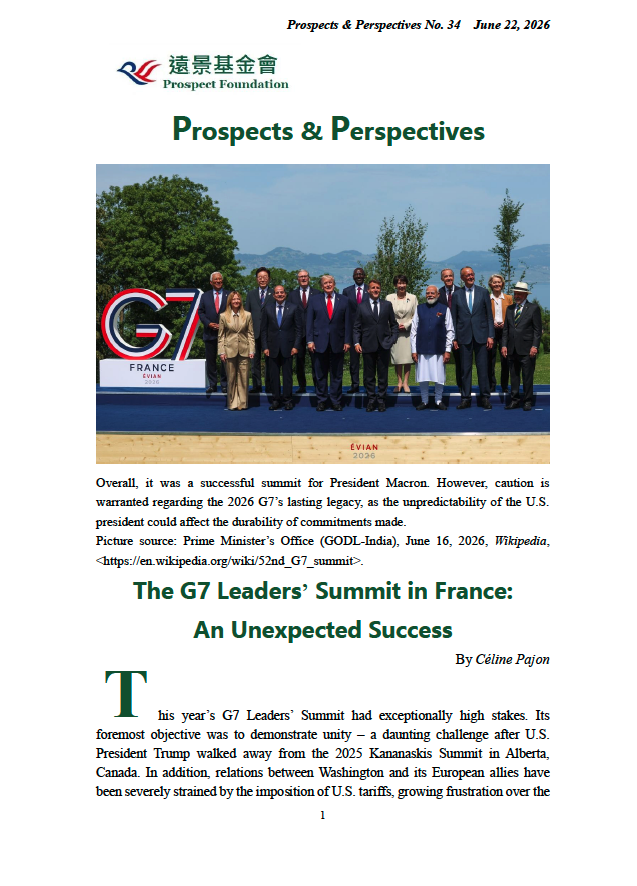
Overall, it was a successful summit for President Macron. However, caution is warranted regarding the 2026 G7’s lasting legacy, as the unpredictability of the U.S. president could affect the durability of commitments made.
This year’s G7 Leaders’ Summit had exceptionally high stakes. Its foremost objective was to demonstrate unity – a daunting challenge after U.S. President Trump walked away from the 2025 Kananaskis Summit in Alberta, Canada. In addition, relations between Washington and its European allies have been severely strained by the imposition of U.S. tariffs, growing frustration over the U.S.’ reduced support for Ukraine, as well as the U.S. and Israeli strikes on Iran, which triggered a conflict that disrupted vital maritime trade routes. Against a deteriorating international backdrop, and as the Sino-U.S. trade war continues, mounting global macroeconomic imbalances threatened to trigger a major financial and economic crisis. In this context, a successful summit was crucial not only for the credibility and future of the G7, but also as a key test of the resilience of the international system.
A show of unity on Iran, Ukraine and the Indo-Pacific
No effort was spared to ensure that the volatile U.S. president would attend the Summit and remain in good spirits (no mention of climate change in the debates, for instance). To that effect, French President Macron astutely planned an exceptional dinner at the royal Palace of Versailles for his gold-loving guest. The Summit got off to a good start with Trump announcing a preliminary peace deal with Iran.
Indeed, Iran and Ukraine dominated the agenda. Flattery regarding Trump’s deal-making skills with Iran – he even rushed to sign the agreement in Versailles to capitalize on the symbolism – also paid dividends on Ukraine. Ukrainian President Volodymyr Zelenskyy, invited as a special guest, was able to explain that his country was no longer in the losing camp and stirred emotions by showing Trump moving images of Russian attacks on civilians. Trump eventually performed a U-turn, declaring that it was time for Russia to negotiate and endorsing a G7 Joint Statement pledging support for Ukraine and increased pressure on the Russian war economy.
Although these two conflicts commanded the greatest attention, policymakers did not lose sight of the Indo-Pacific. It was the third region highlighted in the leaders’ statement on geopolitical issues. The text reaffirmed support for a free and open Indo-Pacific grounded in the rule of law, expressed deep concern over North Korea’s nuclear and ballistic missile programs, and opposed unilateral attempts to alter the status quo by force or coercion in the East and South China Seas and across the Taiwan Strait. This reference was far from guaranteed. Trump has shown limited interest in the Indo-Pacific – underscored by the recent renaming of INDOPACOM back to PACOM – as well as in the promotion of the rule of law and non-proliferation. Moreover, following his summit with Xi Jinping in May, he adopted a notably accommodating tone toward Beijing, even suggesting that arms sales to Taiwan could serve as a bargaining chip.
Overall, this display of unity was highly significant in demonstrating the continuity and relevance of the G7 format, particularly as the United States is set to host the Summit next year. Another positive sign was the Summit’s strong output, with a total of nine joint thematic statements adopted.
Substantial commitments on economic security
The wars in Iran and Ukraine disrupted the agenda set by the French presidency, which had sought to focus discussions on global macroeconomic imbalances, based on the assessment that the United States is over-consuming, China is overproducing, and Europe is under-investing. The objective was to address these structural distortions before they trigger a severe global economic crisis. In this respect, the agenda had the potential to provide common ground for all parties.
Economic security was clearly front and center. Addressing over-dependence on China for critical minerals emerged as a priority and the most promising area for agreement. Much of the agenda focused on streamlining existing bilateral and mini-lateral deals aimed at diversifying supplies, expanding refining and recycling capacity, and strengthening value-chain resilience. This included a G7 commitment to reduce dependence on China for rare earths to no more than 60% by 2030, a Japan-led initiative on joint stockpiling of critical minerals, and the establishment of a non-binding G7 Critical Minerals Resilience and Production Alliance.
Another key issue was AI governance. A recent development shaping the G7 agenda was the U.S. decision to restrict non-American access to the latest versions of AI models developed by Anthropic, raising broader questions about technological sovereignty, equitable access, and dependence on U.S. tech. Against this backdrop, G7 discussions focused on the initial contours of an AI governance framework. Among the proposals under consideration was the creation of a mechanism through which selected “trusted partners” would be granted access to advanced U.S. AI models, potentially easing current restrictions on non-American users.
Engaging new partners to sustain G7 relevance
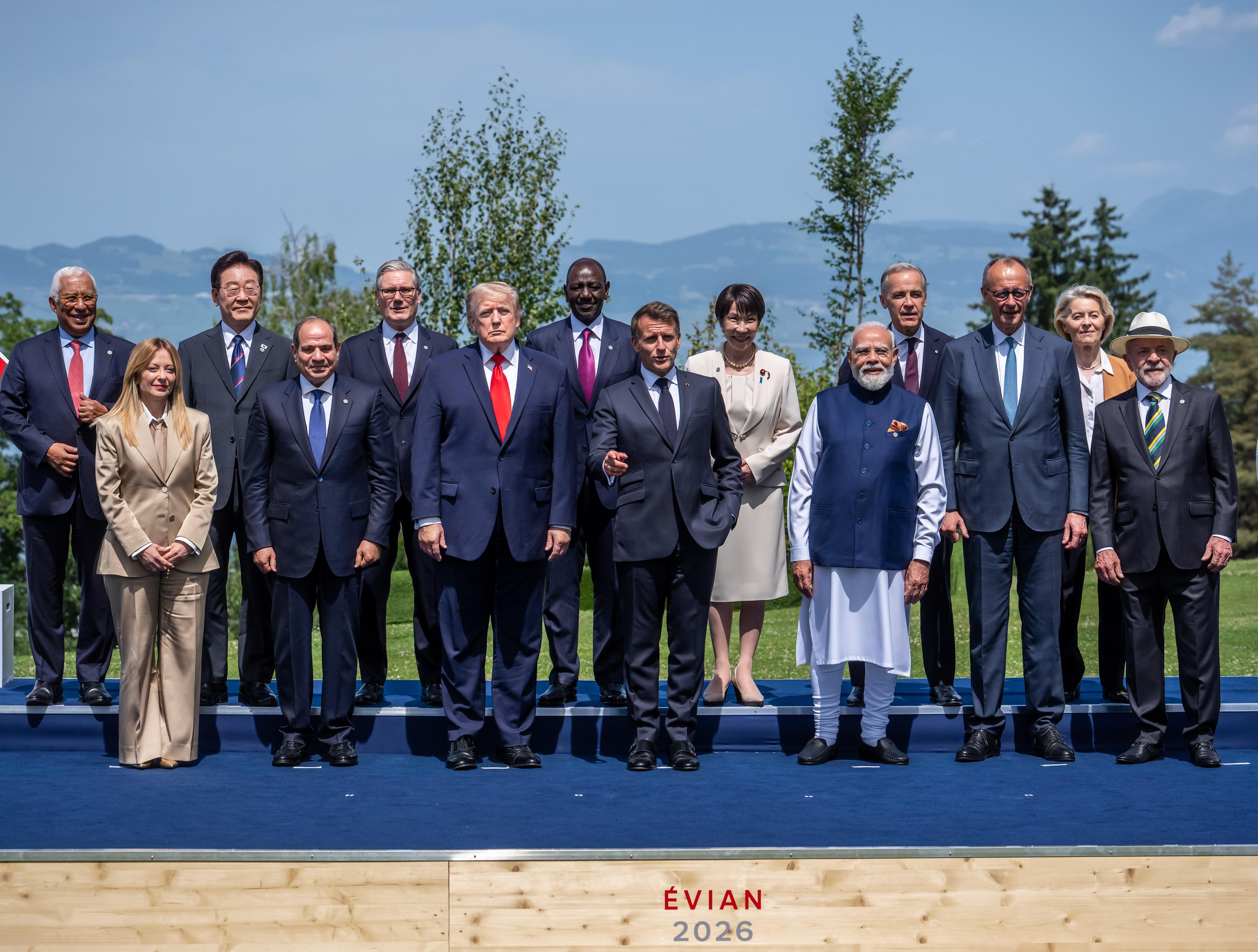
The French President early on advocated for an inclusive enlargement of the G7 to strengthen its legitimacy, whose legitimacy has increasingly been questioned as its representativity has been fading. Macron invited India, Brazil, and Kenya as key partners from the Global South and South Korea as a like-minded country. He initially sought to integrate them into discussions from the outset, and for the first time, a sherpa meeting including partner countries was convened. However, this approach faced resistance from some members for whom the G7 remains a central strategic format.
Partner countries were ultimately invited to join discussions once a general G7 consensus had been reached, with the opportunity to participate actively and later endorse joint statements. Several areas were opened to this format, including drug trafficking and health issues, and the statement on ensuring a safe digital space for minors was endorsed by all participants. Against a backdrop of declining development assistance, another statement also commits to stepped-up efforts to address the case of high debt burdens and to deepen engagement with the private sector.
Another noteworthy development was the French presidency’s attempt to engage China on the sidelines of the G7 Summit, reflecting the view that Beijing is an unavoidable partner in any serious discussion of global macroeconomic imbalances.
President Macron’s invitation was not met with a positive response when conveyed to Xi during his visit to China in December 2025. The initiative also raised concerns among some G7 members, notably Japan, which questioned the signal such an invitation would send.
Eventually, a virtually held Global Convergence for Growth Summit was organized on June 11, bringing together the G7, partner countries, and China. The initiative also aimed to engage China ahead of potential stronger European decisions on trade frictions. While the conference did not produce major announcements, its very existence was seen as a signal of a more balanced and nuanced approach to China by the G7.
Overall, it was a successful summit for President Macron, which also marked his final G7 summit. However, caution is warranted regarding the 2026 G7’s lasting legacy, as the unpredictability of the U.S. president could affect the durability of commitments made. Ultimately, the outcome of the G7 will also depend on evolving U.S.-China relations, particularly as both countries have entered an intense diplomatic sequence following the Beijing summit, with the upcoming Asia-Pacific Economic Cooperation (APEC) meeting in Shenzhen, China, in November and the G20 summit in Miami in December.

Available in:
Themes and regions
Share
This page contains only a summary of our work. If you would like to have access to all the information from our research on the subject, you can download the full version in PDF format.
The G7 Leaders’ Summit in France: An Unexpected Success


Céline PAJON
Research Fellow, Head of Japan and Indo-Pacific Research, Center for Asian Studies, Ifri

Center for Asian Studies
Asia is a nerve center for multiple global economic, political and security challenges. The Center for Asian Studies provides documented expertise and a platform for discussion on Asian issues to accompany decision makers and explain and contextualize developments in the region for the sake of a larger public dialogue.
The Center's research is organized along two major axes: relations between Asia's major powers and the rest of the world; and internal economic and social dynamics of Asian countries. The Center's research focuses primarily on China, Japan, India, Taiwan and the Indo-Pacific, but also covers Southeast Asia, the Korean peninsula and the Pacific Islands.
The Centre for Asian Studies maintains close institutional links with counterpart research institutes in Europe and Asia, and its researchers regularly carry out fieldwork in the region.
The Center organizes closed-door roundtables, expert-level seminars and a number of public events, including an Annual Conference, that welcome experts from Asia, Europe and the United States. The work of Center’s researchers, as well as that of their partners, is regularly published in the Center’s electronic journal Asie.Visions.

China as an ambivalent supporter of the WTO and the multilateral trading system
Amid rising trade tensions between Europe and China and broader uncertainty in the international rules-based trade regime, Beijing has worked to preserve and bolster the multilateral trading system while at the same time failing to reform the domestic policies that have served to undermine that same system.

Pakistan and the Israel-Palestine Conflict: Transformation in Pakistan’s Approach After the War in Gaza
Pakistan has long combined vocal support for the Palestinian cause with covert engagement with Israel. Since the war in Gaza, this balance has become untenable: public opinion is united against Israel, joining Trump’s Board of Peace has drawn rare cross-party criticism, and new regional alignments put normalization out of reach.
The Oceania Factor in France’s Evolving Indo-Pacific Strategy
This paper examines the two-way relationship between France’s Indo-Pacific strategy and developments in Oceania. Oceania was not a priority in the initial years of France’s Indo-Pacific strategy, as the region was largely treated as secondary to major strategic hotspots and key partnerships, while overseas territories were primarily handled as domestic issues and recipients of a top-down strategy.
France’s View: From Diplomacy to Public-Private Action
France has emerged as the EU’s IMEC forerunner, combining port infrastructure, diplomatic alliances and public-private cooperation. With Marseille Fos at its core, the country brings a strategic hub for logistics, energy and digital connectivity to the corridor.