






What Do Companies Fear? The New Geography of Geopolitical Risk
Geopolitical risk has established itself, within the space of a few years, as a central variable in corporate strategy.
Yet neither its definition nor its perception commands any consensus. This study offers a systematic mapping of the phenomenon, drawing on an original corpus: the annual reports of the world’s 100 largest companies by market capitalization, analyzed using artificial intelligence tools applied to their most strategically significant sections—Risk Factors, Management Discussion & Analysis, and letters to shareholders. The aim is not to measure the geopolitical risk to which these companies are exposed, but to analyze how they formulate it, prioritize it, and integrate it into their governance.
Titre Edito
A dual geography of risk
A dual geography of risk
The first finding of this analysis is that geopolitical risk is neither an exogenous variable nor a uniform reality. Its formulation follows a dual geography: that of the registered headquarters, which anchors each company within a specific national, ideological, and regulatory framework; and that of operations, which determines the concrete nature of its vulnerabilities. To understand what a company fears is, first and foremost, to understand where it stands and how it sees the world.
This dual geography reveals four groups:
- American companies—which alone account for 73% of the total capitalization of the Top 100 in 2025—understand geopolitical risk primarily as a threat to their hegemony and to national security.
- European companies adopt a normative reading, centered on the erosion of the rule of law, the retreat of multilateralism, and the weakening of regulatory predictability. Caught between Washington and Beijing, they articulate their principal vulnerability around the transatlantic relationship—described simultaneously as irreplaceable and as an increasingly significant source of uncertainty.
- Chinese companies, for their part, explicitly align their discourse with the priorities of the Party: ideological compliance is a pillar of their risk management in its own right.
- Indian companies, finally, represent the most singular case: they read the recomposition of the world order as a structural opportunity, a posture made possible by an openly assumed policy of multi-alignment.
- Aramco, based in Saudi Arabia, stands in a category of its own.
Titre Edito
A sectoral nature of risk
A sectoral nature of risk
The second finding concerns the variety of forms geopolitical risk takes across sectors.
In the energy sector, risk bears primarily on traffic infrastructure: pipeline sabotage, disruptions in the Red Sea, blockage of the Strait of Hormuz, expropriations, and windfall surtaxes. Geopolitics strikes directly at assets, operational costs, and price volatility. In the financial sector, risk is tied to lawfare: the extraterritoriality of American sanctions constitutes the principal threat, while international payment systems have become a theatre of confrontation between powers. In the pharmaceutical sector, risk concerns about dependence on Asian active pharmaceutical ingredients are forcing companies to reconsider their supply chains. In the technology sector, risk is fragmentation: the question is no longer whether the global digital ecosystem will split into distinct blocs, but how quickly.
Titre Edito
A revealing temporal asymmetry
A revealing temporal asymmetry
One cross-cutting finding runs through the entire corpus: geopolitical risk absorbs the present, while the climate threat maps out the horizon. Climate risk is acknowledged by virtually all the companies analyzed, yet it is predominantly deferred to medium- and long-term scenarios—2030, 2050, or even 2100. This temporal differentiation is itself a risk: it exposes organizations to severe disruption when climate effects materialize at a pace their models had not anticipated.
Titre Edito
Artificial intelligence (AI) as a third dimension
Artificial intelligence (AI) as a third dimension
To the dual geography that structures risk perception, a third dimension may soon be added: the position occupied by each company within the emerging hierarchy of artificial intelligence. AI is now integrated into annual reports, no longer as a tool but as a strategic infrastructure in its own right. This recomposition will not be neutral—it will follow, and amplify, the fault lines already at work.
Titre Edito
Fragmentation as a market
Fragmentation as a market
A final finding: any reading of these annual reports that confined itself to threats would be incomplete. Several companies have undergone a reversal of perspective worth noting - geopolitical fragmentation is no longer merely a risk to be hedged, it is opening up new markets.
LEARN MORE:
Read this Ifri Study by Thomas Gomart and Siméo Pont: "Manufacturing Risk: Geopolitical Doxa and the Corporate World" (April 2025).

Available in:
Themes and regions
ISBN / ISSN
Share
This page contains only a summary of our work. If you would like to have access to all the information from our research on the subject, you can download the full version in PDF format.
What Do Companies Fear? The New Geography of Geopolitical Risk



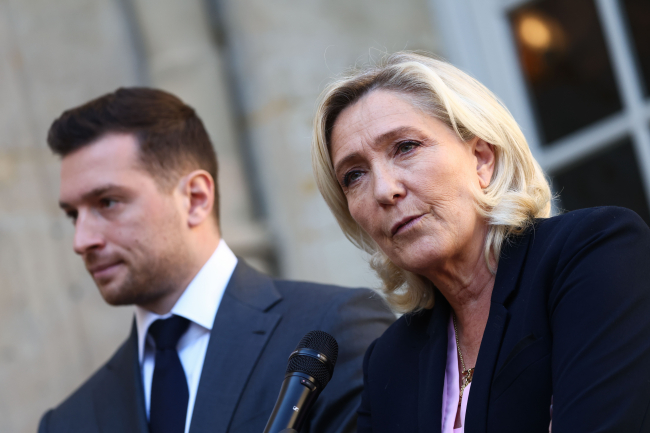
A Sovereignist Foreign Policy? The World as Seen by National Rally Lawmakers
The National Rally’s (Rassemblement national—RN) “de-demonization” strategy appears to be paying off: Marine Le Pen and Jordan Bardella’s party is steadily gaining ground in elections, and polls place it in the lead for the spring 2027 French presidential election. The period of normalization for this far-right movement has coincided with an era of upheaval on the international stage. Within this context, a fundamental question arises: what would the RN’s foreign policy look like if it came to power?
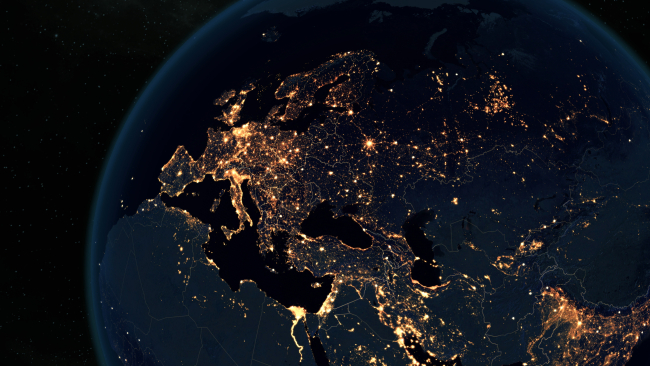
Europe-Russia: Balance of Power Review
European countries can no longer avoid the "Russian question," as Russia has chosen war. They have the necessary potential—that is, the economic means, military capabilities, and technological expertise—to face Russia by 2030, provided they demonstrate the political will to do so.
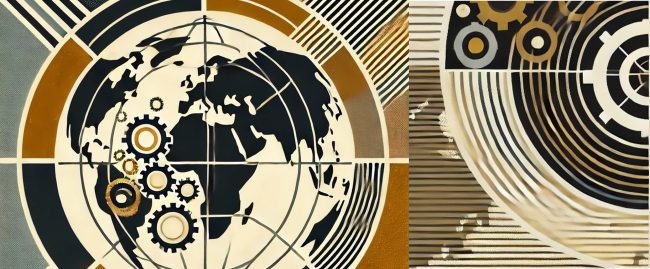
Manufacturing Risk: Geopolitical Doxa and the Corporate World
The evolving power dynamics between the United States, China, and Russia are creating new geopolitical realities that businesses can no longer evade. Geopolitical risk has become unavoidable, yet many companies remain unprepared to navigate its complexities. Corporate leaders can no longer afford to overlook its implications.
Towards the Second Crusade?
Europeans first grew aware of a possible pandemic exactly one year ago. The wave is here. It has submerged the world, claiming many lives and causing tremendous collateral damage.