




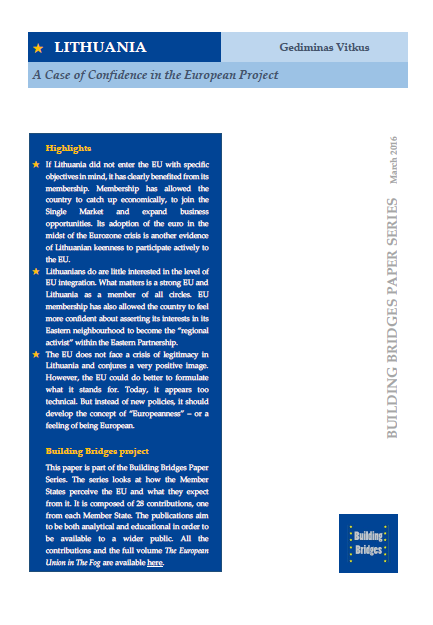
Lithuania: A Case of Confidence in the European Project
If Lithuania did not enter the EU with specific objectives in mind, it has clearly benefited from its membership. Membership has allowed the country to catch up economically, to join the Single Market and expand business opportunities. Its adoption of the euro in the midst of the Eurozone crisis is another evidence of Lithuanian keenness to participate actively to the EU.
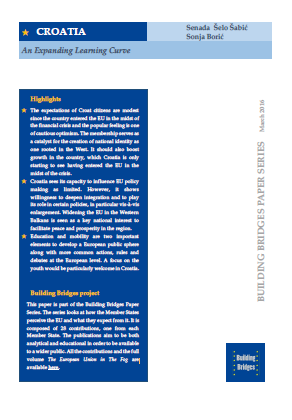
Croatia: An Expanding Learning Curve
The expectations of Croat citizens are modest since the country entered the EU in the midst of the financial crisis and the popular feeling is one of cautious optimism. The membership serves as a catalyst for the creation of national identity as one rooted in the West. It should also boost growth in the country, which Croatia is only starting to see having entered the EU in the midst of the crisis.

Slovakia: Country of Many Paradoxes
Slovakia might be perceived as a “latecomer” in preparing for EU accession only in the 1990s, but it caught up rapidly. Among its chief objectives was for Slovakians to achieve higher living standards and gain an external system of checks and balances, which would improve the country’s democratic processes and public administration.

Malta: No Bridge is "A Bridge Too Far"
Malta as an isolated country saw relations with the EU as a bridge building effort with the peoples of the European Continent, which would also secure supplies, open markets, help obtain energy and strengthen security.

Sweden: Mind Rather Than Heart in EU Politics
The Swedish decision to enter the EU was not based so much on the hope of gaining something, but rather on the fear of being left out if it did not. It was probably the desire for a ‘negative safety’ that made the Swedes vote in favour of the EU as the alternative cost would probably have been too high.
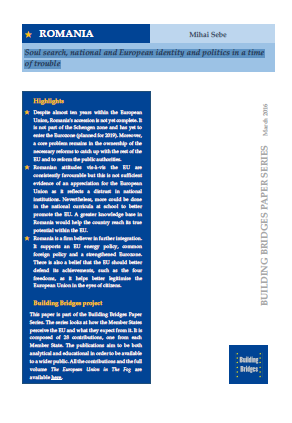
Romania: Soul Search, National and European Identity and Politics in a Time of Trouble
Despite almost ten years within the European Union, Romania’s accession is not yet complete. It is not part of the Schengen zone and has yet to enter the Eurozone (planned for 2019). Moreover, a core problem remains in the ownership of the necessary reforms to catch up with the rest of the EU and to reform the public authorities.
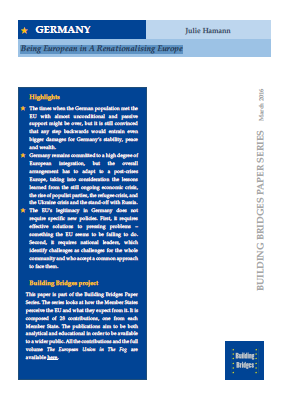
Germany: Being European in a Renationalising Europe
The times when the German population met the EU with almost unconditional and passive support might be over, but it is still convinced that any step backwards would entrain even bigger damages for Germany’s stability, peace and wealth.
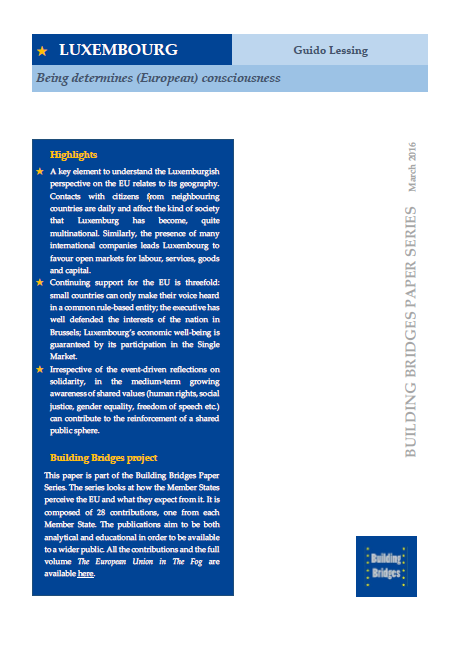
Luxembourg: Being Determines (European) Consciousness
A key element to understand the Luxembourgish perspective on the EU relates to its geography. Contacts with citizens from neighbouring countries are daily and affect the kind of society that Luxembourg has become, quite multinational. Similarly, the presence of many international companies leads Luxembourg to favour open markets for labour, services, goods and capital.
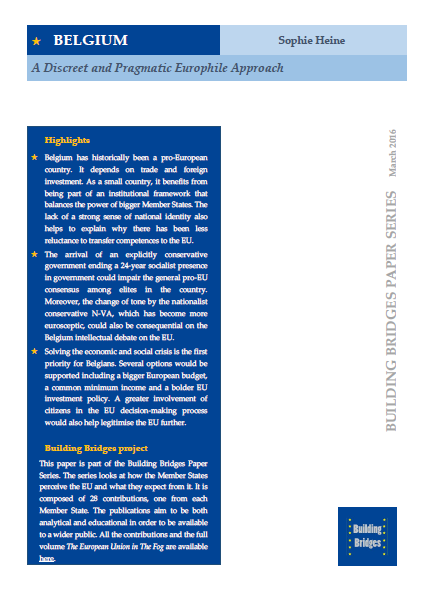
Belgium: A Discreet and Pragmatic Europhile Approach
Belgium has historically been a pro-European country. It depends on trade and foreign investment. As a small country, it benefits from being part of an institutional framework that balances the power of bigger Member States. The lack of a strong sense of national identity also helps to explain why there has been less reluctance to transfer competences to the EU.
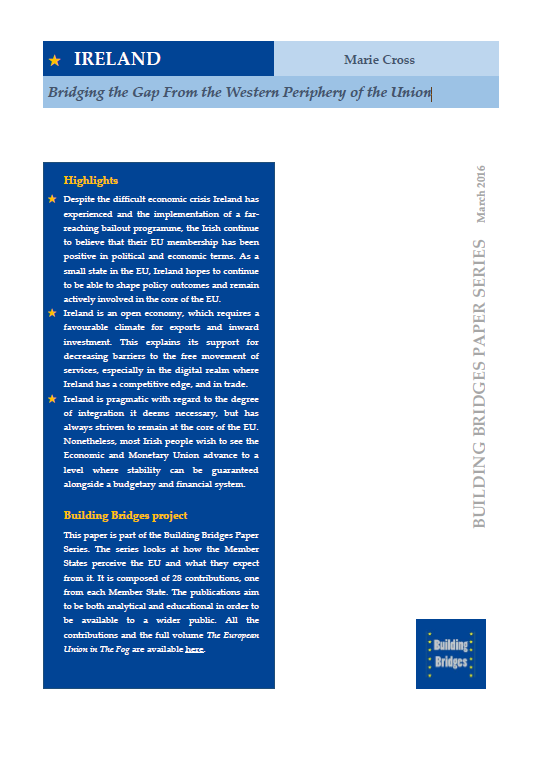
Ireland: Bridging the Gap from the Western Periphery of the Union
Despite the difficult economic crisis Ireland has experienced and the implementation of a far-reaching bailout programme, the Irish continue to believe that their EU membership has been positive in political and economic terms. As a small state in the EU, Ireland hopes to continue to be able to shape policy outcomes and remain actively involved in the core of the EU.
Building Bridges Conversation Series - France & UK
This new episode of the Building Bridges Conversation Series is part of the "Building Bridges" project, which aims to foster debate on the future of the European Union and offer top quality analyses on how each member state perceives the EU. In this video, Vivien Pertusot, coordinator of the project, discusses with Dominique David from Ifri (France) and Anand Menon from King's College (UK).
Building Bridges Conversation Series - Ireland & the Netherlands
This new episode of the Building Bridges Conversation Series is part of the "Building Bridges" project, which aims to foster debate on the future of the European Union and offer top quality analyses on how each member state perceives the EU. In this video, Vivien Pertusot, coordinator of the project, discusses with Marie Cross from the Institute of International and European Affairs (Ireland) and Adriaan Schout from Clingendael (the Netherlands).
Building Bridges Conversation Series - Luxembourg & Spain
This new episode of the Building Bridges Conversation Series is part of the "Building Bridges" project, which aims to foster debate on the future of the European Union and offer top quality analyses on how each member state perceives the EU. In this video, Vivien Pertusot, coordinator of the project, discusses with Guido Lessing from the Centre d’études et de recherches européennes (Luxembourg) and Charles Powell from Real Instituto Elcano (Spain).
Building Bridges Conversation Series - Bulgaria & Denmark
This new episode of the Building Bridges Conversation Series is part of the "Building Bridges" project, which aims to foster debate on the future of the European Union and offer top quality analyses on how each member state perceives the EU. In this video, Vivien Pertusot, coordinator of the project, discusses with Maja Kluger Rasmussen from Think Europa (Denmark) and Antoinette Primatarova from the Centre for Liberal Strategies (Bulgaria).
EU Reform: Mapping out a state of flux
“EU Reform” is widely discussed across Europe but rarely defined. This report analyses how the 28 member states of the European Union understand “EU reform” and provides an insight into how their views might play out in debates on the future of the EU as well as on day-to-day politics.
Building Bridges Conversation Series - Slovakia & Poland
This first episode of the Building Bridges Conversation Series is part of the "Building Bridges" project, which aims to foster debate on the future of the European Union and offer top quality analyses on how each member state perceives the EU. In this video, Vivien Pertusot, coordinator of the project discusses with Ana Benje from Comenius University (Slovakia) and Nathan Dufour from PISM (Poland).
Malta: No Bridge is "A Bridge Too Far"
Malta as an isolated country saw relations with the EU as a bridge building effort with the peoples of the European Continent, which would also secure supplies, open markets, help obtain energy and strengthen security.
Sweden: Mind Rather Than Heart in EU Politics
The Swedish decision to enter the EU was not based so much on the hope of gaining something, but rather on the fear of being left out if it did not. It was probably the desire for a ‘negative safety’ that made the Swedes vote in favour of the EU as the alternative cost would probably have been too high.
Romania: Soul Search, National and European Identity and Politics in a Time of Trouble
Despite almost ten years within the European Union, Romania’s accession is not yet complete. It is not part of the Schengen zone and has yet to enter the Eurozone (planned for 2019). Moreover, a core problem remains in the ownership of the necessary reforms to catch up with the rest of the EU and to reform the public authorities.
Germany: Being European in a Renationalising Europe
The times when the German population met the EU with almost unconditional and passive support might be over, but it is still convinced that any step backwards would entrain even bigger damages for Germany’s stability, peace and wealth.
Luxembourg: Being Determines (European) Consciousness
A key element to understand the Luxembourgish perspective on the EU relates to its geography. Contacts with citizens from neighbouring countries are daily and affect the kind of society that Luxembourg has become, quite multinational. Similarly, the presence of many international companies leads Luxembourg to favour open markets for labour, services, goods and capital.
Belgium: A Discreet and Pragmatic Europhile Approach
Belgium has historically been a pro-European country. It depends on trade and foreign investment. As a small country, it benefits from being part of an institutional framework that balances the power of bigger Member States. The lack of a strong sense of national identity also helps to explain why there has been less reluctance to transfer competences to the EU.
Ireland: Bridging the Gap from the Western Periphery of the Union
Despite the difficult economic crisis Ireland has experienced and the implementation of a far-reaching bailout programme, the Irish continue to believe that their EU membership has been positive in political and economic terms. As a small state in the EU, Ireland hopes to continue to be able to shape policy outcomes and remain actively involved in the core of the EU.
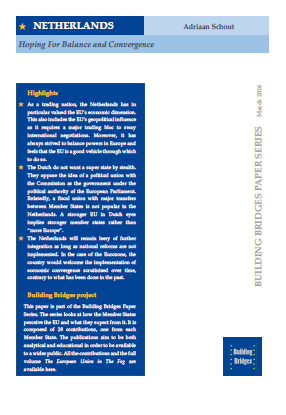
Netherlands: Hoping For Balance and Convergence
As a trading nation, the Netherlands has in particular valued the EU’s economic dimension. This also includes the EU’s geopolitical influence as it requires a major trading bloc to sway international negotiations. Moreover, it has always strived to balance powers in Europe and feels that the EU is a good vehicle through which to do so.
EU Reform: Mapping out a state of flux
“EU Reform” is widely discussed across Europe but rarely defined. This report analyses how the 28 member states of the European Union understand “EU reform” and provides an insight into how their views might play out in debates on the future of the EU as well as on day-to-day politics.
Ifri, a foundation recognized as being of public utility, relies largely on private donors – companies and individuals – to guarantee its sustainability and intellectual independence. Through their funding, donors help maintain the Institute's position among the world's leading think tanks. By benefiting from an internationally recognized network and expertise, donors refine their understanding of geopolitical risk and its consequences on global politics and the economy. In 2026, Ifri partners with over 90 French and international companies and organizations.
