



Franco-German Civil Society: Object and Actor of Bilateral Relations. Balance and Perspectives after the Signing of the Treaty of Aachen
The treaty signed by France and Germany in Aachen on January 22, 2019 highlights the role of civil society in bilateral cooperation and aims to contribute to "bringing societies [and citizens in both countries] closer together".
Since the beginning of the millennium, the media and public actors have been promoting "citizens initiatives", which are supposed to be a guarantee of democracy and commitment from below.
Starting from a definition of civil society in relation to economic and state actors, this article aims to analyze current issues and implications of said civil society in bilateral and European relations, after recalling the historical contribution of these actors to Franco-German relations. As an example, twinning is analyzed in depth in order to distinguish different periods. The partnerships between cities allow us to understand how civil societies contribute to a collective reflection on the past as well as how they face contemporary challenges, such as the 'closing' of borders during the coronavirus pandemic.
Today, associations or societal forums are considered as the foundation of European construction. They have also managed to specify their needs and to communicate them better to politicians. This dedication even resulted in the successful implementation of the Citizens’ Fund. They are coordinating their work, as reflected in the initiatives of the two major federations of Franco-German associations, the Federation of Franco-German Associations for Europe (FAFA) and the Vereinigung der Deutsch-Französischen Gesellschaften / Federation of the German-French Societies (VDFG), which intend to be a Franco-German citizens' office aiming to go beyond the bilateral perimeter to play a greater role in Europe. However, it is clear that the work carried out by French and German associations is still often bilateral. The Europeanization of Franco-German social initiatives remain a challenge for the coming years.
Prof. Dr. Corine Defrance is Research Director at the CNRS and Deputy Director of the UMR SIRICE (Sorbonne Identités, relations internationales et civilisations de l'Europe) research center. She is an Associate Professor at the University of Paris 1-Panthéon-Sorbonne.
Dr. Tanja Herrmann holds a PhD in History and defended a dissertation in Cotutelle at the University of Mainz and the University Paris 1 Panthéon-Sorbonne on the second boom of Franco-German town twinning (1985-1994) in October 2017.
This publication is available the following languages:
- FRENCH: "Société civile franco-allemande : enjeu et acteur des relations bilatérales. Bilan et perspectives après la signature du traité d’Aix-la-Chapelle" (pdf)
- GERMAN: "Die deutsch-französische Zivilgesellschaft: Gegenstand und Akteur der bilateralen Beziehungen. Bilanz und Perspektiven nach Unterzeichnung des Aachener Vertrags" (pdf)


The Study Committee on Franco-German Relations (Cerfa)
The Study Committee on Franco-German Relations (Cerfa) was created in 1954 by an inter-governmental agreement between the Federal Republic of Germany and France, in order to raise awareness of Germany in France and analyze Franco-German relations, including in their European and international dimensions. In its conferences and seminars, which bring together experts, political leaders, senior decision-makers and representatives of civil society from both countries, Cerfa develops the Franco-German debate and stimulates political proposals. It regularly publishes studies through two collections: Cerfa notes and studies as well as Franco-German visions.
Cerfa maintains close relations with the network of German foundations and think tanks. In addition to its research and debate activities, Cerfa promotes the emergence of a new Franco-German generation through original cooperation programs. This is how in 2021-2022, Cerfa led a program on multilateralism with the Konrad Adenauer Foundation in Paris. This program is aimed at young professionals from both countries interested in the issues of multilateralism in the context of their activities. It covered a wide range of themes relating to multilateralism, such as international trade, health, human rights and migration, non-proliferation and disarmament. Previously, Cerfa had participated in the Franco-German future dialogue, co-led with the DGAP from 2007 to 2020, and supported by the Robert Bosch Foundation and the Daniel Vernet group (formerly the Franco-German Reflection Group) which was founded in 2014 upon the initiative of the Genshagen Foundation.
Franco-German Relations Through the Lens of Donald Trump’s Second Term: Between Strategic Realignments, European Sovereignty, and the Enduring Transatlantic Bond
Donald Trump’s return to the presidency of the United States in 2025 acts as a powerful catalyst for the Franco-German relationship. Faced with growing uncertainty over the reliability of US security guarantees, Germany, more directly affected by the questioning of the transatlantic relationship, is gradually moving closer to the French position in favor of strengthening European strategic sovereignty.
MAGA and AfD: Toward a Transatlantic Alliance of Nationalist Right-Wing Parties
The rapprochement between Donald Trump’s MAGA movement and Germany’s AfD has accelerated significantly since Trump’s return to the White House.
VW, Mercedes, and BMW in the Face of Donald Trump—A Tightrope Walk Between Investing in the U.S., Maintaining Operations in Europe, and Catching Up in Electric Mobility
The German automotive industry faces a threefold challenge: competition from China; a difficult transition to electric vehicles; and US tariffs.
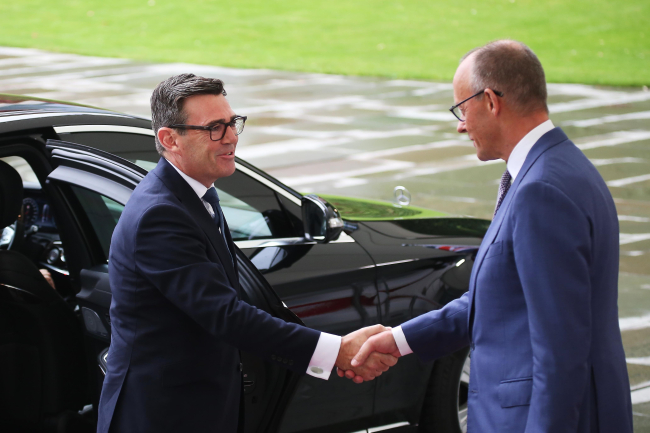
A Partnership Built on Security: Post-Brexit Rapprochement between Germany and the United Kingdom
Since the UK’s withdrawal from the EU, UK-German relations have undergone a remarkable transformation: from Berlin’s deliberate distancing from London during the Brexit negotiations, when Germany consistently prioritised EU-27 unity over bilateral arrangements, to a gradual rapprochement, culminating, for the time being, in the 2025 Kensington Treaty of Friendship.