



Paris Naval Conference 2024: The Evolving Role of the Carrier Strike Group

Practical information
This second edition of the Paris Naval Conference, bringing together high-level speakers from France, the UK, the USA, Italy and India, and organized by Ifri and the French Navy, aims to redefine the role of CSGs in a changing strategic context, particularly in terms of the future threats it faces.

Carrier Strike Groups (CSGs) are the flagship of the world's leading navies and their role has evolved significantly in recent years.
Built around an aircraft carrier accompanied by surface ships, submarines and embarked aircraft, a CSG offers unrivalled power projection capability, enabling a state to defend its interests on the international stage. However, they can be costly and vulnerable to certain attacks, which paradoxically reinforces their role in strategic signalling and diplomacy.
This second edition of the Paris Naval Conference will also be the occasion to promote original research on this topic through the organization of the Admiral Castex Prize.
The detailed program is available on the brochure at the following link.
PROGRAM
11 a.m. - 11.15 a.m.: Opening remarks by Thomas Gomart, Director of Ifri, and General Thierry Burkhard, French Chief of Staff
11.15 a.m. - 12.45 p.m. : Roundtable No. 1 – Future Challenges and Perspectives for Navies, with the Chiefs of Staff and their Representatives
- Admiral Nicolas Vaujour, CEMM
- Admiral Enrico Credendino, Capo di Stato Maggiore, Marina Militare
- Admiral Lisa Franchetti, Chief of Naval Operations, U.S. Navy
- Admiral Sir Ben Key, First Sea Lord, Royal Navy
- Vice-Admiral Rajesh Pendharkar, Eastern Naval Command, Indian Navy
12.45 p.m. - 2 p.m. : Lunch break
2 p.m. - 3.30 p.m. : Roundtable No. 2 – Ensuring Access on Deployed Operations
- Vice-admiral (ret.) Pradeep Chauhan, Director General, National Maritime Foundation
- Kelly Grieco, Senior Fellow, Henry L. Stimson Center
- Alessandro Marrone, Director of the Defense Program, Instituto Affari Internationali
- Elie Tenenbaum, Director of the Security Studies Center, Ifri
3.30 p.m. - 3.45 p.m. : Coffee break
3.45 p.m. - 5.15 p.m. : Roundtable No.3 – Challenges for CSGs in Naval Warfare
- Rear-Admiral Jacques Mallard, COM FRSTRIKEFOR, Marine nationale
- Brent Sadler, Senior Research Fellow for Naval Warfare, Heritage Foundation
- Emma Salisbury, Associate Researcher, Council on Geostrategy
- Vice-Admiral Giacinto Sciandra, COM ITMARFOR, Marina Militare
5.15 p.m. - 5.45 p.m. : Concluding Speech by Jean-Yves Le Drian, former French Minister of Defense
5.45 p.m. - 5.55 p.m : Ceremony for the awarding of the Admiral Castex Prize by Admiral Nicolas Vaujour and Thierry de Montbrial
5.55 p.m. - 6 p.m. : Concluding Remars by Thierry de Montbrial, Executive Chairman of Ifri
The conference will be held in English and French, with simultaneous translation.
6 pm: Press conference in english with :
Admiral Nicolas Vaujour, CEMM, France
Admiral Enrico Credendino, Capo di Stato Maggiore, Marina Militare, Italy
Admiral Lisa Franchetti, Chief of Naval Operations, U.S. Navy
Admiral Sir Ben Key, First Sea Lord, Royal Navy
Vice-Admiral Rajesh Pendharkar, Eastern Naval Command, Indian Navy
Press accreditation : Natacha Crance - [email protected]

Replay
Related Subjects
Other events

Reinventing Coordination in an Age of Fragmentation 3rd Paris Geoeconomic Dialogue
The world economy is being reordered. The certainties of the post-Cold War era, open trade, dollar centrality, predictable multilateral coordination, are giving way to a landscape shaped by rivalry between the United States and China, the weaponization of interdependence, and a scramble to secure supply chains, technologies and critical resources. What once looked like a stable architecture now appears fragile, contested, and in places actively being dismantled.
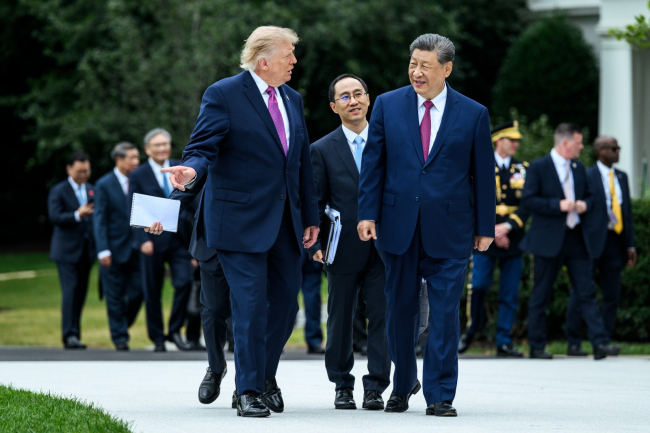
The United States, China and the Derisking Race in a Moment of “strategic stability”
For nearly a decade, relations between Washington and Beijing have been shaped by a contest over technology, supply chains, and the terms of economic interdependence. In The Derisking Race, Aaron Friedberg examines how this contest has moved well beyond tariffs and trade disputes toward a structural realignment of the global economy, in which both powers seek to reduce their exposure to one another even as the costs of doing so become harder to ignore.