






France
Although France's demographic and economic weight in the world is tending to decline, it nevertheless retains important attributes of power. Its diplomacy and defense policy bear witness to this.
Related Subjects

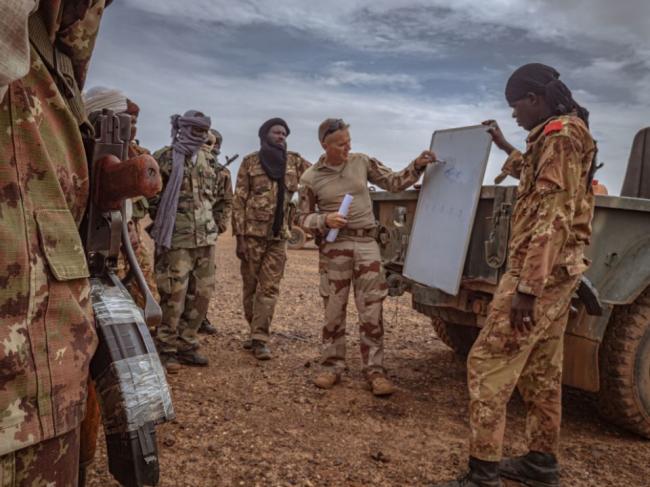
France Halts Joint Military Operations with Mali Over Coup
PARIS - France said Thursday it would suspend joint military operations with Malian forces after the West African country's second coup in nine months, adding to international pressure for the military junta to return civilians to positions of power.

La Guerre de vingt ans. Djihadisme et contre-terrorisme au XXIe siècle
La Guerre de vingt ans was awarded the Prize for the best book on geopolitics in 2021.

A Rough Year Ahead for the China-France Strategic Partnership
2020 has been a challenging year for the world economy. Although the magnitude of the shock triggered by the COVID-19 pandemic differed widely from one country to another, no economy was left unscathed.

Once a Jihadist, Always a Jihadist? A Deradicalization Program Seen from the Inside
France has traditionally taken a security-based approach to the fight against terror. It was a latecomer to the field of radicalization prevention and the establishment of disengagement programs aimed at jihadists. It only started to think seriously about the issue in 2013 and its first attempts involved certain irregularities.
Europe in the World: for a Modest and Effective Reform
This sad year ends with a pandemic that continues in full swing over a large part of the planet, especially in the United States and Europe, with no other reassuring prospect than that of one or more vaccines, which is already a lot. But that’s not the subject I want to focus on in this eighth letter, the last one for 2020. Internationally, two other facts have dominated the scene in recent months.
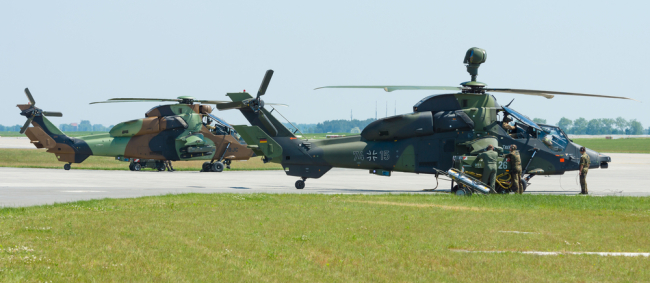
The Franco-German Armaments Cooperation. An Impossible Agreement?
In the Aachen Treaty in 2019, Germany and France agree to deepen their "common program in defense matters" and to pursue a common vision in terms of arms export. These are the preconditions that will help consolidate a culture of common armed forces, common interventions, and European defense industry.
Breakthrough for Decentralized Franco-German cooperation? Perspectives after the Aachen Treaty
The development of Franco-German cooperation can be described as an intergovernmental process. Depending on the perspective, the capacity for innovation of the relationship lies either with central decision-makers at the state level or with decentralized actors at the local level.
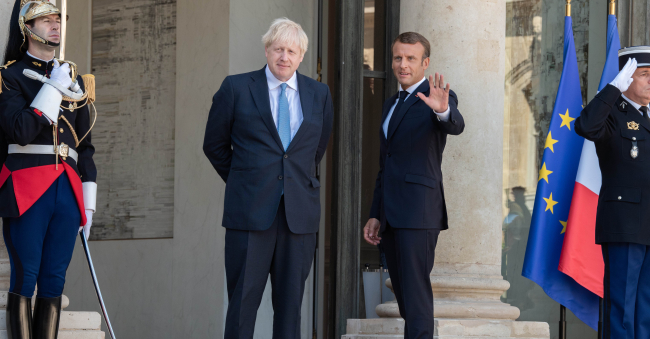
Complementarity or Competition? Franco-British Cooperation and the European Horizon of French Defense Policy
What does future hold for the Franco-British defense partnership after Brexit?
The Future of Europe in the Context of Sino-American Competition - Conclusions
In this special issue of Politique étrangère devoted to the proceedings of the conference organized by Ifri on April 10, 2019, at the Grand Amphitheater of the Sorbonne, on the occasion of its 40th anniversary, read the speech by Jean-Yves Le Drian, French Minister of Europe and Foreign Affairs.
The Crucial Challenge of Cyberthreats
In this special issue of Politique étrangère devoted to the proceedings of the conference organized by Ifri on April 10, 2019, in the Grand Amphitheater of the Sorbonne, on the occasion of its fortieth anniversary, discover the debate moderated by Marc Hecker between Thomas Gomart and Jean-Louis Gergorin.
The Future of Europe in the Context of Sino-American Competition - Foreword
In this special issue of Politique étrangère devoted to the proceedings of the conference organized by Ifri on April 10, 2019, in the Grand Amphitheater of the Sorbonne, on the occasion of its fortieth anniversary, discover the speech by Bruno Le Maire, Minister of Economy and Finance.
Industry Response to New Protectionism
In this special issue of Politique étrangère devoted to the proceedings of the conference organized by Ifri on April 10, 2019, in the Grand Amphitheater of the Sorbonne, on the occasion of its fortieth anniversary, discover the debate moderated by Thierry de Montbrial between Jean-Paul Agon and Patrick Pouyané.
Foreword
In this special issue of Politique étrangère devoted to the proceedings of the conference organized by Ifri on April 10, 2019, in the Grand Amphitheater of the Sorbonne, on the occasion of its fortieth anniversary, read the foreword by Thierry de Montbrial, founder and president of Ifri.
The Future of Europe in the Context of Sino-American Competition - Foreword
In this special issue of Politique étrangère devoted to the proceedings of the conference organized by Ifri on April 10, 2019, in the Grand Amphitheater of the Sorbonne, on the occasion of its fortieth anniversary, discover the speech by Bruno Le Maire, Minister of Economy and Finance.
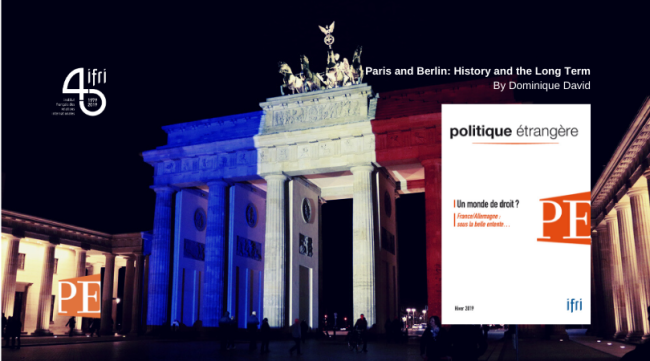
Paris and Berlin: History and the Long Term
Historically, the Franco-German “couple” provided a justification for the European project, and for the Europe that emerged from the collapse of the bipolar order.
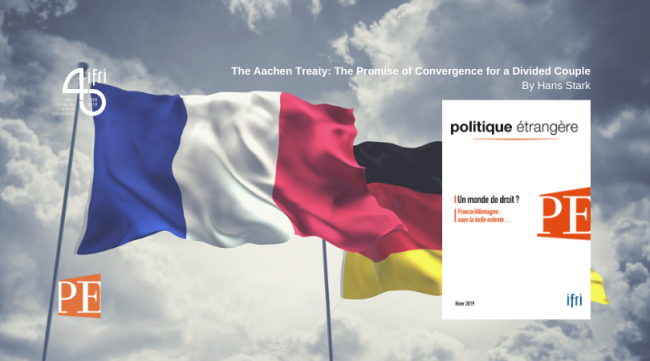
The Aachen Treaty: The Promise of Convergence for a Divided Couple
The numerous commitments made in the Aachen Treaty concealed a wide range of disagreements over defense, the future of the European Union, economic policies, relations with Russia, and so on.
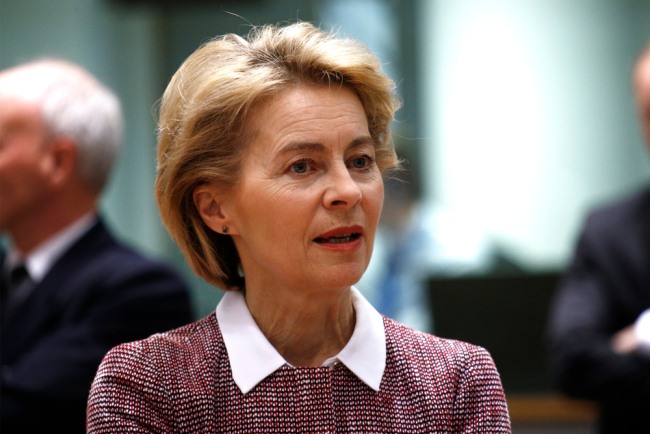
Ursula von der Leyen: betting on Franco-German unity in the European Commission
Germany's Ursula von der Leyen nominated to lead EU Commission.
The Franco-German Tandem: Bridging the Gap on Nuclear Issues
The Franco-German couple has long been characterized by divergent trajectories on nuclear matters, and antagonist historical decisions still frame the current relationship.
The Treaty of Aachen. New Impetus for Franco-German Defense Cooperation?
On 22 January 2019, French President Emmanuel Macron and German Chancellor Angela Merkel sign the Treaty of Aachen on “Franco-German Cooperation and Integration.” The document is set to complement the original Elysée Treaty from 1963, signed by President Charles de Gaulle and Chancellor Konrad Adenauer.
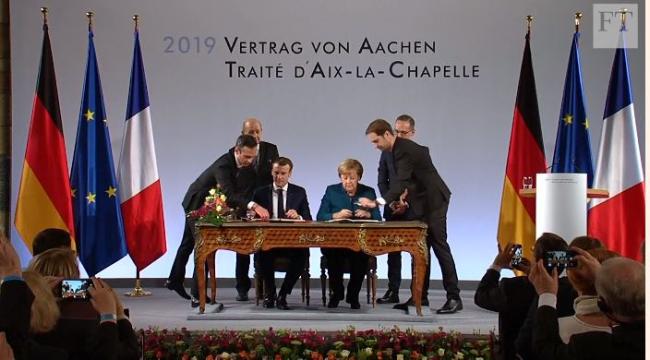
Merkel and Macron betray weakness with cautious Aachen treaty
When Angela Merkel and Emmanuel Macron sign a new Franco-German treaty in the historic city of Aachen on Tuesday, there will be much soaring rhetoric about the deepening ties between the two countries. To critics, though, the Treaty of Aachen is thin gruel. Anyone hoping for a new, tighter alliance between France and Germany, and for signs that the two countries might once again drive European integration, will be disappointed.
Ifri, a foundation recognized as being of public utility, relies largely on private donors – companies and individuals – to guarantee its sustainability and intellectual independence. Through their funding, donors help maintain the Institute's position among the world's leading think tanks. By benefiting from an internationally recognized network and expertise, donors refine their understanding of geopolitical risk and its consequences on global politics and the economy. In 2026, Ifri partners with over 90 French and international companies and organizations.
