




Energy Policies
How can the Green Deal be implemented at all levels and synchronized with global governance? How are power strategies evolving, and under what conditions can they converge?
Related Subjects

The European Energy Policy: Building New Perspectives
“After 17 years of supranationality, we are still seeking how to define a common energy policy and what it might be. [...] Could we have done more in one generation? Or were goals only established to achieve a political balance which it was explicitly agreed to ignore, once the machinery began to operate? Historians will have a hard task to distinguish between excessive ambitions and national hypocrisies”.
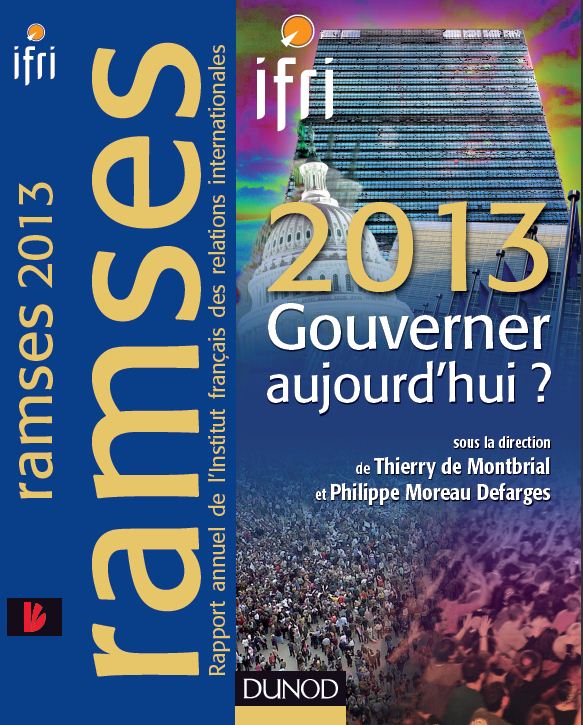
RAMSES 2013. Gouverner aujourd'hui ?
RAMSES (Le Rapport annuel mondial sur le système économique et les stratégies), is a yearly publication that provides in-depth reviews and prospective analysis on current events, providing readers with indispensable insights and perspectives for understanding contemporary geopolitics on the global scale. Edited by Thierry de Montbrial and Philippe Moreau Defarges, RAMSES relies on the expertise of Ifri’s research team and its network of associates.
Commission Communication of the EU Energy External Policy: Was There an Alternative?
EU is the world’s largest net energy importer and consumer, so why do its Members continue to negotiate individually with the rest of the world rather than as one big market with a big voice?
RAMSES 2012. Les États submergés ?
RAMSES (Le Rapport annuel mondial sur le système économique et les stratégies), is a yearly publication that provides in-depth reviews and prospective analysis on current events, providing readers with indispensable insights and perspectives for understanding contemporary geopolitics on the global scale.
European Energy Policy: Energy Savings Glass 2/3 Empty
Summing up Europe’s climate policies suggests we still haven’t grasped the full potential for energy savings. We act as if we were living in a system with infinite resources easily exploited by human innovation and ingenuity. We focus on the efficiencies we can gain from components of our system, but not on the system as a whole and we do not consider how the other billions of people on earth can achieve our level of comfort with a resource or carbon-constrained future and with aspirations that necessarily imply sharply growing energy consumption.
Energy Efficiency: The Commission's Complicated Calculations
Who hasn’t heard of the 3x20, those pillars of European energy policy? And yet who is able to give their exact definition?
Will there ever be a European Gas and Electricity Market ?
A year ago, I would have responded to this question rather positively. Nowadays, I am not so sure. My relative optimism before was based on the replacement of a group of monopoly-holding (at least regionally) national operators, by an oligopoly of operators with a sizeable proportion of their activity outside of their countries of origin. These included EON, EdF, RWE, ENEL, GDFSuez, IBERDROLA, VATTENFALL and others.
Energy Efficiency: Smart but not Sexy
Marie C. DONNELLY, DG Energy, reported that the EU is “unlikely to achieve a 20% reduction on the current set of policies” [1] by 2020. According to her, based on a modelling exercise, the estimate of energy savings “would be somewhere between 9 and 11% on current policies” in spite of the contribution of the economic crisis to decreasing the EU primary energy consumption.
Saving Wind from its Subsidies
European subsidies for wind energy are too high and unspecific. They risk frustrating their own objective.
Ifri, a foundation recognized as being of public utility, relies largely on private donors – companies and individuals – to guarantee its sustainability and intellectual independence. Through their funding, donors help maintain the Institute's position among the world's leading think tanks. By benefiting from an internationally recognized network and expertise, donors refine their understanding of geopolitical risk and its consequences on global politics and the economy. In 2026, Ifri partners with over 90 French and international companies and organizations.
