





The Year He Woke

Vikas Swarup, an Indian writer and former diplomat, is the author of four novels, including Q & A (New York: Doubleday, 2005), which has been translated into 47 languages and adapted for the screen under the title Slumdog Millionaire.
Text published in Politique étrangère, Vol. 91, No. 2, 2026.

2100. Ray Mehta opens his eyes in a room of absolute serenity, facing the snow-capped peaks of the Matterhorn. Seventy-four years earlier, shattered by an unspeakable tragedy in Florida, this influential businessman had chosen to leave his era behind, betting on a future he could not yet imagine. His only hope was oblivion, and the possibility of a world that had learned from the failures of his own.
When he wakes, that hope seems to have been realized. Mara, his enigmatic caregiver, describes a humanity that has healed itself: the climate stabilized, poverty eradicated, war relegated to history. Science appears to have fulfilled every promise once made in its name, offering Ray the world he had dared to hope for.
But beneath the minimalist calm of his recovery, something does not sit right. The silence is oppressive. The doors remain closed. As his strength returns, Ray begins to notice the fractures beneath the surface of this new century.
Has he truly reached a promised land, or simply exchanged one confinement for another?
In this novel, Vikas Swarup turns one man's search for the truth into a reflection of our own fears and hopes, a journey that reaches beyond cryogenics, into the place where grief no longer answers to reason.

Available in:
Themes and regions
Share
This page contains only a summary of our work. If you would like to have access to all the information from our research on the subject, you can download the full version in PDF format.
The Year He Woke
Iran: Anatomy of a Power at War
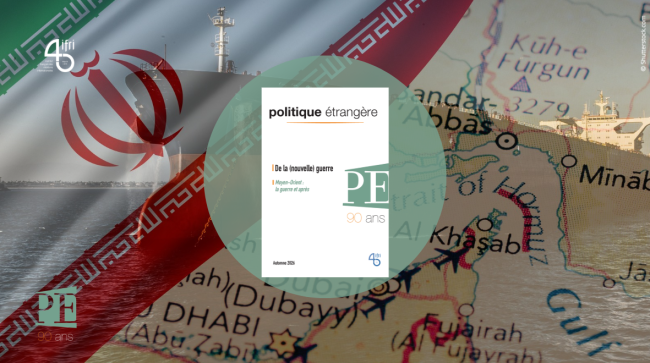
The elimination of Supreme Leader Ali Khamenei and several high-ranking officials at the outset of the 2026 American-Israeli operation did not succeed in bringing down the Iranian regime. The regime had prepared for such a scenario, notably by decentralizing its structures. Moreover, it continues to adapt to war. The power of the Islamic Revolutionary Guard Corps is growing at the expense of the Shiite clergy. The security apparatus defends the country’s sovereignty and justifies its actions in the name of raison d’état.
“Remodeling” the Middle East?
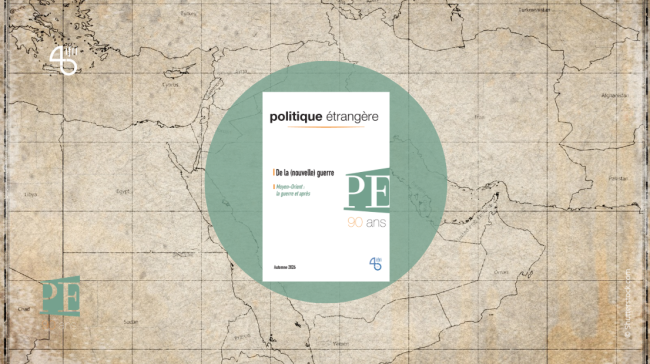
Chaos continues to spread, seemingly without end, across the Middle East. The Israeli-American attack on Iran has resulted in a clear military and diplomatic failure, but it is paving the way for a regional realignment, the consequences of which remain uncertain. New regional groupings are taking shape, either centered around Israel or built on the prospect of coexistence with Tehran, alongside a decline in American influence and the marginalization of Europe, while China maintains a low-key presence.
Silicon Valley and War: Lessons from Ukraine
Over the course of international conflicts, and particularly in Ukraine, major tech companies have emerged as central actors. Initially subject to wartime maneuvering, they have since become decisive actors in their own right, privatizing a significant share of wartime exchanges, shaping the information flows of societies, and presenting themselves as providers of security. This situation raises important questions about states’ autonomy in making decisions and taking action.
Does Artificial Intelligence Change the Nature of War?
From Gaza to Ukraine and Iran, current conflicts are being shaped by the arrival of artificial intelligence and robots on the battlefield. The changes under way are so profound that humans risk rapidly losing control over entire aspects of the conduct of military operations. While these technological developments are altering the character of war, their impact on the very nature of war itself remains a matter of debate.