



France’s incoherent China policy confuses partners

On 21 July 2020, French Minister of Economy and Finance Bruno Le Maire participated remotely in the High Level Economic and Financial Dialogue with Chinese Vice Premier Hu Chunhua.
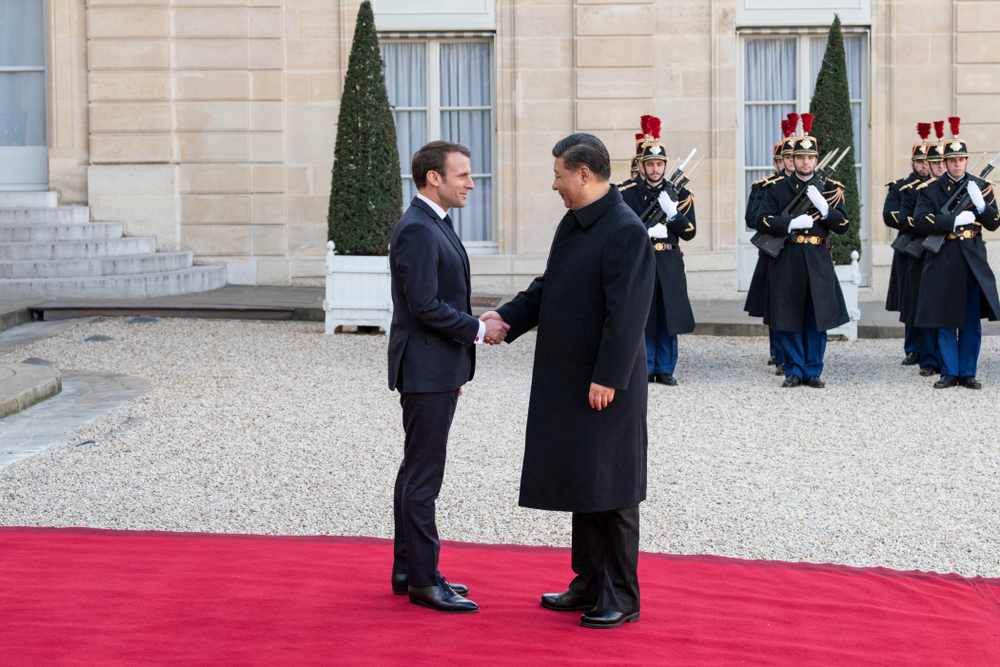
The two parties agreed to ‘encourage the businesses of each country to participate in the creation of 5G networks in line with market and security principles’.
It seems the French market plans to remain open to Huawei. The head of the French National Cybersecurity Agency Guillaume Poupard said as much when he confirmed the next day that there would be no blanket ban on Huawei equipment in the French 5G network.
But the devil is in the details. Authorisations for vendors to use Huawei equipment for 5G are granted for between three and eight years, without guarantee of renewal. As new mobile technology like 5G takes at least eight years to yield return on investment, no vendor would take the gamble. In other words, France is imposing a de facto ban on Huawei. National security considerations no doubt account for this choice — Poupard acknowledged the risk is not the same with European suppliers like Nokia and Ericsson.
This means French networks will be free of Huawei gear by 2028 at the latest. The French approach contrasts starkly with that of the United Kingdom, which outright banned new Huawei 5G equipment on 14 July with much fanfare, and ordered the removal of the existing Huawei 5G kit from operators’ networks by 2027.
The Huawei example can be seen as a testament of French President Emmanuel Macron’s conviction that actions speak louder than words. Earlier this year he declared that the time had come to behave less naively and to stop China from imposing its will, and he aims to talk softly and act tough.
The French government is fully aware that it cannot afford to antagonise bilateral relations. Cooperation is needed to effectively respond to key global issues of importance to France, such as the Paris Agreement, but it also wants to defend other interests and values. As a result, there has been a constant oscillation over the past two years between conciliatory tones and firm positions in defence of France’s national interest and economic security.
Despite few declarations, France firmly upholds the principle of freedom of navigation in the South China Sea, where the French Navy conducts regular exercises, and in the Taiwan Strait, through which a French warship passed in April 2019, much to Beijing’s ire. And while France reiterates adherence to the ‘one-China policy’, it did not hesitate to dismiss Chinese warnings about selling arms to Taiwan in July.
This ambivalence can be interpreted as another example of the en même temps (‘and at the same time’) doctrine that has become Macron’s trademark. During the 2017 presidential campaign, Macron was teased as the candidate of ‘en même temps’, his pet phrase in debates and interviews, suggesting that conflicting views could be carried simultaneously.
The full article is available online on the East Asia Forum website.

Available in:
Regions and themes
Share


Center for Asian Studies
Asia is a nerve center for multiple global economic, political and security challenges. The Center for Asian Studies provides documented expertise and a platform for discussion on Asian issues to accompany decision makers and explain and contextualize developments in the region for the sake of a larger public dialogue.
The Center's research is organized along two major axes: relations between Asia's major powers and the rest of the world; and internal economic and social dynamics of Asian countries. The Center's research focuses primarily on China, Japan, India, Taiwan and the Indo-Pacific, but also covers Southeast Asia, the Korean peninsula and the Pacific Islands.
The Centre for Asian Studies maintains close institutional links with counterpart research institutes in Europe and Asia, and its researchers regularly carry out fieldwork in the region.
The Center organizes closed-door roundtables, expert-level seminars and a number of public events, including an Annual Conference, that welcome experts from Asia, Europe and the United States. The work of Center’s researchers, as well as that of their partners, is regularly published in the Center’s electronic journal Asie.Visions.
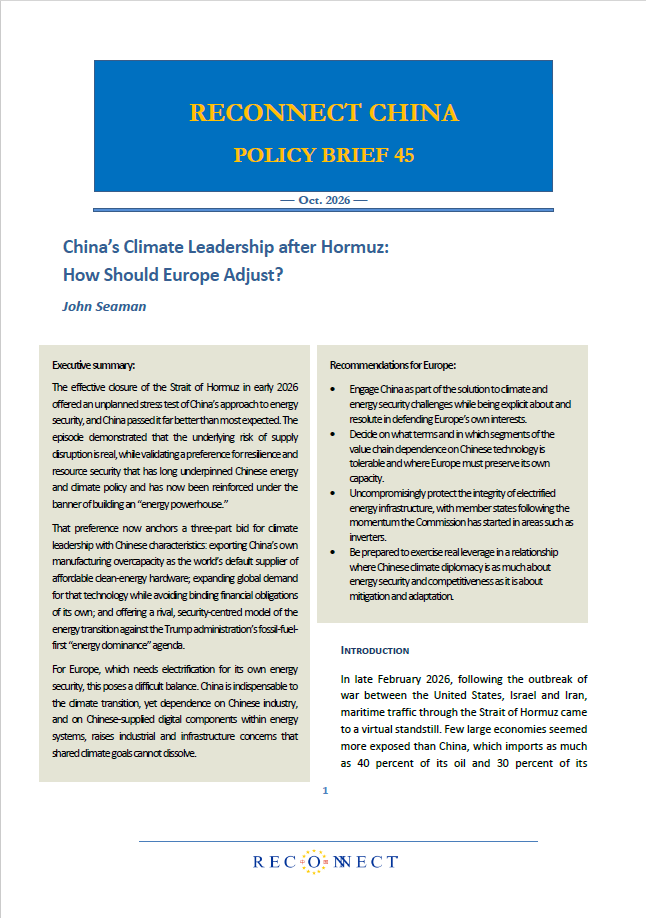
China’s Climate Leadership after Hormuz: How Should Europe Adjust?
The effective closure of the Strait of Hormuz in early 2026 offered an unplanned stress test of China’s approach to energy security, and China passed it far better than most expected. The episode demonstrated that the underlying risk of supply disruption is real, while validating a preference for resilience and resource security that has long underpinned Chinese energy and climate policy and has now been reinforced under the banner of building an “energy powerhouse.”

China as an ambivalent supporter of the WTO and the multilateral trading system
Amid rising trade tensions between Europe and China and broader uncertainty in the international rules-based trade regime, Beijing has worked to preserve and bolster the multilateral trading system while at the same time failing to reform the domestic policies that have served to undermine that same system.

Pakistan and the Israel-Palestine Conflict: Transformation in Pakistan’s Approach After the War in Gaza
Pakistan has long combined vocal support for the Palestinian cause with covert engagement with Israel. Since the war in Gaza, this balance has become untenable: public opinion is united against Israel, joining Trump’s Board of Peace has drawn rare cross-party criticism, and new regional alignments put normalization out of reach.
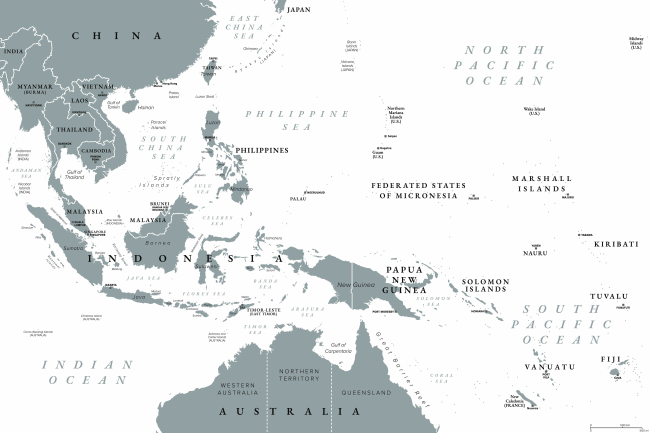
The Oceania Factor in France’s Evolving Indo-Pacific Strategy
This paper examines the two-way relationship between France’s Indo-Pacific strategy and developments in Oceania. Oceania was not a priority in the initial years of France’s Indo-Pacific strategy, as the region was largely treated as secondary to major strategic hotspots and key partnerships, while overseas territories were primarily handled as domestic issues and recipients of a top-down strategy.