

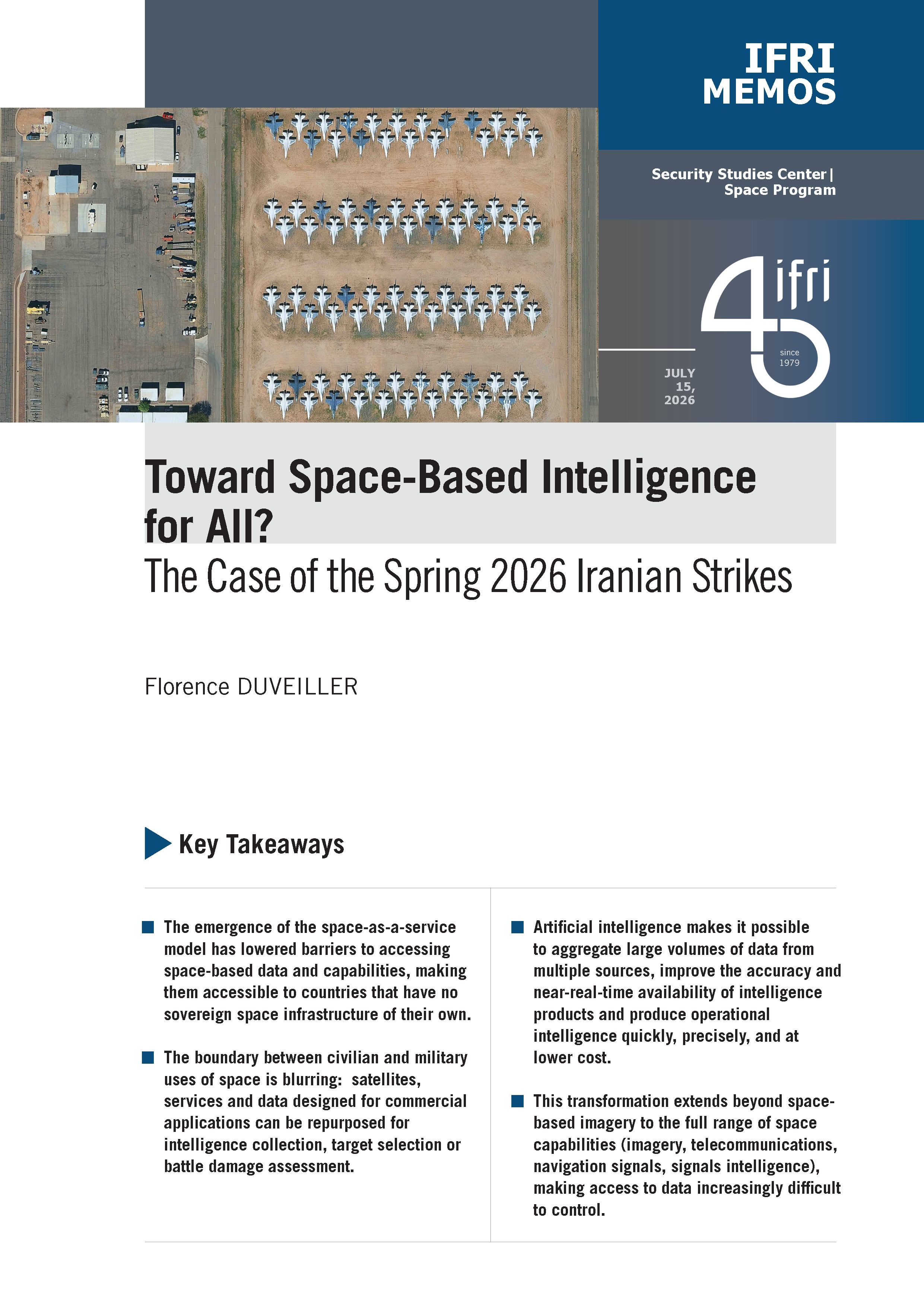



Space Security and Missile Defense : Japan's Quest for Autonomy and Indispensability
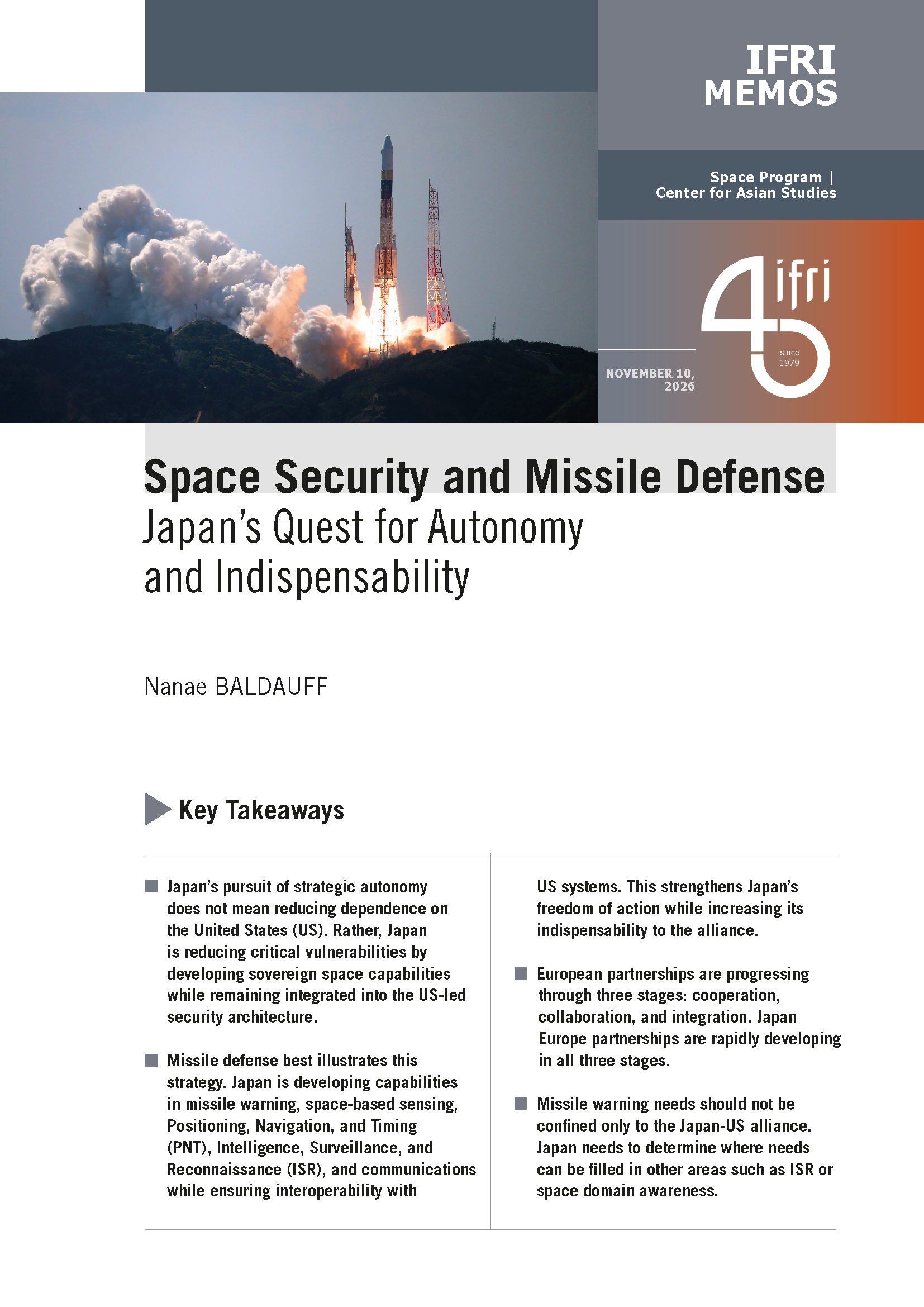
Seeking greater autonomy without loosening its alliance with the United States, Japan has steadily turned space into a pillar of its defense, building sovereign capabilities that also make it an indispensable partner, to Washington and beyond. This approach raises questions for Europe, whose ties with Japan are multiplying but which has yet to define what it can concretely bring to Tokyo, particularly in missile warning.
Titre
Key Takeaways
Japan’s pursuit of strategic autonomy does not mean reducing dependence on the United States (US). Rather, Japan is reducing critical vulnerabilities by developing sovereign space capabilities while remaining integrated into the US-led security architecture.
Missile defense best illustrates this strategy. Japan is developing capabilities in missile warning, space-based sensing, Positioning, Navigation, and Timing (PNT), Intelligence, Surveillance, and Reconnaissance (ISR), and communications while ensuring interoperability with US systems. This strengthens Japan’s freedom of action while increasing its indispensability to the alliance.
European partnerships are progressing through three stages: cooperation, collaboration, and integration. Japan Europe partnerships are rapidly developing in all three stages.
Missile warning needs should not be confined only to the Japan-US alliance. Japan needs to determine where needs can be filled in other areas such as ISR or space domain awareness.
Can a nation deepen its reliance on an ally while pursuing greater strategic autonomy? Japan is attempting to do precisely this, in the space domain and across its broader security posture.
For the past fifteen years or so, Japan has been pursuing a three-pronged strategy: strengthening its own defense capabilities, reinforcing the Japan–United States (US) alliance, and expanding strategic partnerships. First articulated in Japan’s inaugural National Security Strategy (NSS), published in 2013, these lines of effort were reaffirmed in the 2022 revision and continue to shape Japan’s strategic choices as the country prepares to update its NSS and Defense Buildup Program by the end of 2026. Originally developed in the context of economic security, the concepts of strategic autonomy and strategic indispensability can also illuminate Japan’s broader strategic posture, particularly in the space domain.
In the security realm, strategic autonomy refers to strengthening Japan’s own capabilities: by raising its defense spending to 2% of gross domestic product (GDP) and beyond, Japan both bolsters its own deterrent effect and provides insurance to the US to ensure its security commitment. At the same time, Japan is also diversifying its advancing security and defense cooperation with like-minded countries to hedge against the risk of a US retreat.
Strategic indispensability is originally about expanding capabilities where Japan is indispensable in the global value chain. It now extends across foreign and security policy, including the space domain, where Japan has developed cutting-edge technologies.
This dual pursuit of strategic autonomy and indispensability helps explain why Japan is deepening its alliance with the US while broadening its partnerships. In April 2024, Tokyo and Washington announced plans to collaborate on a Low Earth Orbit (LEO) constellation to detect and track missiles, including hypersonic glide vehicles (HGVs). The establishment of US Space Forces–Japan at Yokota Air Base in December 2024 further institutionalized space cooperation, underscoring the growing importance of space security to the bilateral alliance.
At the same time, Japan is expanding and deepening defense cooperation with European partners in the space domain. Such partnerships can help strengthen Japan’s domestic industrial capabilities, diversify its technological relationships, and enhance its ability to access and exploit space-based intelligence.
Japan’s autonomy–indispensability approach can therefore be understood as threefold: first, to reduce critical dependencies by developing sovereign capabilities and acquiring technologies not only from the US but also from other strategic partners where appropriate; second, to strengthen its value as an alliance partner to the US; and third, to become a more indispensable partner to other strategic partners. These three objectives are mutually reinforcing. Sovereign capabilities reduce Japan’s exposure to external dependencies, greater alliance value gives the US stronger incentives to sustain its engagement with Japan, and deeper interdependence with other partners broadens Japan’s strategic options and reduces its reliance on any single partner.
How does Japan seek to reconcile greater strategic autonomy with deeper integration with the US, and what does this mean for Japan–Europe space-security cooperation?

Available in:
Themes and regions
ISBN / ISSN
Share
This page contains only a summary of our work. If you would like to have access to all the information from our research on the subject, you can download the full version in PDF format.
Space Security and Missile Defense : Japan's Quest for Autonomy and Indispensability


Space Program
Space has become a crucial theme in the main international think tanks’ research activities as it entails important strategic, economic, and technological issues.
Since 2001, Ifri has integrated space in its research, notably by ensuring that the political dimension of scientific and human exploration programs is emphasized, and by supporting reflections on the Code of Conduct for Outter Space Activities.
Today, as part of its research agenda, Ifri mobilizes several of its centers and programs to transversally tackle the theme of space, through three main inputs:
- the competition of powers, driven by the Sino-American rivalry;
- critical points related to mastery of space, such as the issue of autonomous access to space or the mega-constellations necessary for the digital revolution;
- these developments’ challenges for Europe and its status as a space power.
Since the Summer 2020, Ifri has been coordinating a tripartite European Space Governance Initiative, together with two other renowned European think tanks: the Deutsche Gesellschaft für Auswärtige Politik (DGAP) in Germany and the Istituto Affari Internazionali (IAI) in Italy.

Center for Asian Studies
Asia is a nerve center for multiple global economic, political and security challenges. The Center for Asian Studies provides documented expertise and a platform for discussion on Asian issues to accompany decision makers and explain and contextualize developments in the region for the sake of a larger public dialogue.
The Center's research is organized along two major axes: relations between Asia's major powers and the rest of the world; and internal economic and social dynamics of Asian countries. The Center's research focuses primarily on China, Japan, India, Taiwan and the Indo-Pacific, but also covers Southeast Asia, the Korean peninsula and the Pacific Islands.
The Centre for Asian Studies maintains close institutional links with counterpart research institutes in Europe and Asia, and its researchers regularly carry out fieldwork in the region.
The Center organizes closed-door roundtables, expert-level seminars and a number of public events, including an Annual Conference, that welcome experts from Asia, Europe and the United States. The work of Center’s researchers, as well as that of their partners, is regularly published in the Center’s electronic journal Asie.Visions.

Center for Geopolitics of Technology
Artificial intelligence (AI), 5G, cybersecurity, robotics, semiconductors, space…Technologies—particularly digital technologies—now profoundly affect all human activities and, by extension, international relations. The political, strategic, economic, and social stakes that arise from them are expressed across multiple political levels, involving states, international organizations, and private companies alike. International dynamics of competition and cooperation are being reshaped as a result. To address these challenges, Ifri launched its Geopolitics of Technology Center in 2020, offering a distinctly European perspective on the international issues surrounding so-called critical technologies.

Toward Space-Based Intelligence for All? The Case of the Spring 2026 Iranian Strikes
The conflict in the Middle East has highlighted the effectiveness of Iranian strikes in identifying targets and conducting precision strikes. This raises the question: which capabilities enabled the Islamic Revolutionary Guard Corps (IRGC) to achieve these results?
Regulatory Dynamics and Tensions in the Space Sector: Towards and Americanization of Space Law?
The development of space law has gradually evolved from a top-down normative dynamic dominated by the founding impetus of the UN to a bottom-up normativity driven by national and industrial practices. This evolution is now accompanied by growing normative competition, raising the risk of an Americanization of space law and prompting the question of a European response.

The Sustainability of Space Operations: An Opportunity for European Leadership?
As space becomes a key arena for power projection strategies, while facing growth and diversification of orbital activities, the concept of “space sustainability” is emerging as a new framework of analysis for space governance.
The European Space Model: Renewing Ambition in a Changing Strategic Landscape
The European space model, based on science, cooperation and trade, is now being undermined by changes in international relations and the economic upheavals brought about by New Space. In light of the war in Ukraine and American disengagement, Europe needs to rethink its strategy by adding a fourth pillar dedicated to defense, in order to strengthen its sovereignty and deter possible aggression against the continent.