


China as an ambivalent supporter of the WTO and the multilateral trading system
Amid rising trade tensions between Europe and China and broader uncertainty in the international rules-based trade regime, Beijing has worked to preserve and bolster the multilateral trading system while at the same time failing to reform the domestic policies that have served to undermine that same system.
Since launching its reform and opening-up policy, China has viewed participation in international economic institutions such as the IMF and GATT/WTO as a means of advancing its own development objectives. Since joining the WTO in 2001, it has evolved from a discreet observer into an active member, contributing to both rulemaking and dispute settlement. Now, as the multilateral trading system faces attacks from one of its founders, China has officially positioned itself as an active defender.
Yet its stance is more nuanced. On one hand it has supported efforts to preserve the WTO’s arbitration function. In pursuing a proactive agenda through bilateral and minilateral agreements, including RCEP, China more broadly seeks to preserve the existing order and is strongly supporting various plurilateral agreements under the WTO. Yet, as Beijing formally advocates reforms to improve the organization’s effectiveness, it remains hesitant to adapt its own domestic policies that are not aligned with the liberal logic underlying WTO rules. In other words, China pays lip service to the need to reform the WTO but its actions are not fully in line with its declarations. In parallel, it pursues the creation of alternative governance frameworks such as the Global Governance Initiative (GGI) or the International Organization for Mediation.
Ultimately, China is best understood not as a straightforward status quo power, but as a selectively revisionist one — defending the parts of the system that serve it, while resisting reforms, such as disciplines on subsidies and state intervention, that would touch the core of its economic model.
This creates a mixed picture for the EU. The two sides converge on the priority of restoring the WTO's dispute settlement function but increasingly diverge substantially in a number of areas. Divergences touch on subsidies and the level playing field that include the very definitions of these terms, the unconditionality of most favored nation (MFN) rules, and more broadly on what "reform" itself should mean.
Dowload the Reconnect China Policy Brief via the project's website: China as an ambivalent supporter of the WTO and the multilateral trading system

Available in:
Themes and regions
Share
This page contains only a summary of our work. If you would like to have access to all the information from our research on the subject, you can download the full version in PDF format.
China as an ambivalent supporter of the WTO and the multilateral trading system


Françoise NICOLAS
Senior Advisor, Center for Asian Studies, Ifri

John SEAMAN
Research Fellow, Center for Asian Studies, Ifri


Center for Asian Studies
Asia is a nerve center for multiple global economic, political and security challenges. The Center for Asian Studies provides documented expertise and a platform for discussion on Asian issues to accompany decision makers and explain and contextualize developments in the region for the sake of a larger public dialogue.
The Center's research is organized along two major axes: relations between Asia's major powers and the rest of the world; and internal economic and social dynamics of Asian countries. The Center's research focuses primarily on China, Japan, India, Taiwan and the Indo-Pacific, but also covers Southeast Asia, the Korean peninsula and the Pacific Islands.
The Centre for Asian Studies maintains close institutional links with counterpart research institutes in Europe and Asia, and its researchers regularly carry out fieldwork in the region.
The Center organizes closed-door roundtables, expert-level seminars and a number of public events, including an Annual Conference, that welcome experts from Asia, Europe and the United States. The work of Center’s researchers, as well as that of their partners, is regularly published in the Center’s electronic journal Asie.Visions.

Space Security and Missile Defense : Japan's Quest for Autonomy and Indispensability
Seeking greater autonomy without loosening its alliance with the United States, Japan has steadily turned space into a pillar of its defense, building sovereign capabilities that also make it an indispensable partner, to Washington and beyond. This approach raises questions for Europe, whose ties with Japan are multiplying but which has yet to define what it can concretely bring to Tokyo, particularly in missile warning.
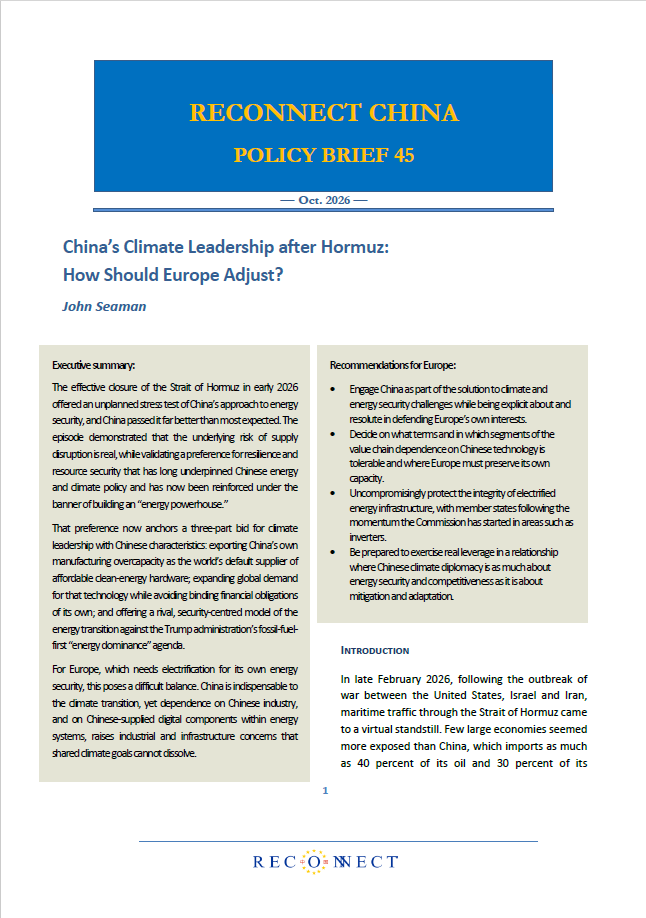
China’s Climate Leadership after Hormuz: How Should Europe Adjust?
The effective closure of the Strait of Hormuz in early 2026 offered an unplanned stress test of China’s approach to energy security, and China passed it far better than most expected. The episode demonstrated that the underlying risk of supply disruption is real, while validating a preference for resilience and resource security that has long underpinned Chinese energy and climate policy and has now been reinforced under the banner of building an “energy powerhouse.”

Canada in the Indo-Pacific: Sustaining the Pivot, Partnering with France
Since the launch of Canada’s inaugural Indo-Pacific Strategy (IPS) in November 2022, Ottawa has moved—with notable but uneven momentum—from the margins of regional engagement to a position of growing strategic visibility. The Strategy, backed by an initial $2.3 billion five-year investment, reflects a long-overdue recognition: Canada is a Pacific nation whose prosperity and security are inextricably linked to the stability of the world’s most economically and strategically consequential region.

Pakistan and the Israel-Palestine Conflict: Transformation in Pakistan’s Approach After the War in Gaza
Pakistan has long combined vocal support for the Palestinian cause with covert engagement with Israel. Since the war in Gaza, this balance has become untenable: public opinion is united against Israel, joining Trump’s Board of Peace has drawn rare cross-party criticism, and new regional alignments put normalization out of reach.