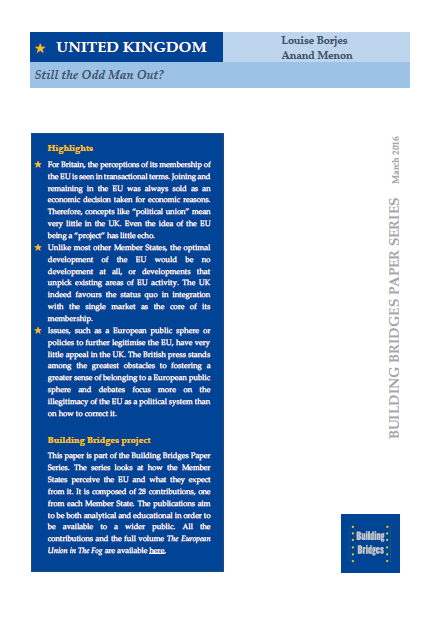
United Kingdom: Still the Odd Man Out?
For Britain, the perceptions of its membership of the EU is seen in transactional terms. Joining and remaining in the EU was always sold as an economic decision taken for economic reasons. Therefore, concepts like “political union” mean very little in the UK. Even the idea of the EU being a “project” has little echo.
Building Bridges Conversation Series - France & UK
This new episode of the Building Bridges Conversation Series is part of the "Building Bridges" project, which aims to foster debate on the future of the European Union and offer top quality analyses on how each member state perceives the EU. In this video, Vivien Pertusot, coordinator of the project, discusses with Dominique David from Ifri (France) and Anand Menon from King's College (UK).
Rushing to a deal on the UK could be ill-thought-out for the EU
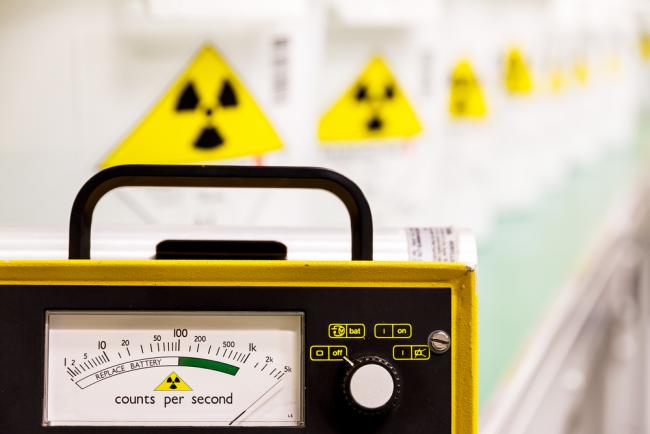
The Challenges of Maintaining Nuclear Cultures : US and UK perspectives
After the world entered the nuclear age, civilian and military organizations have witnessed the slow emergence of nuclear cultures, defined as the set of values and knowledge, shared among the national security community, about the relative importance of nuclear weapons in the country’s defense posture, the distinctive features of nuclear weapons in terms of security, safety and operational requirements, and the workings of deterrence.

De-radicalization and the Prevention of Radicalization in Germany, Great Britain and Denmark
To date, a few thousand Europeans have left Europe to join jihadi fighters in Syria and Iraq. Several hundreds of them have already returned. To deal with this phenomenon, some countries have developed radicalization prevention and de-radicalization programs.


European Defense Revisited / The United Kingdom and the EU: in or out?
Europe’s English Patient
Relations between London and the European construct are founded on a misunderstanding: for mainland Europeans, it represents a global political project, whereas for the British, the European Union is just one international institution among others.
Would Europe, Freed from the Perfidious Albion, Lose its Way?
The United Kingdom’s relationship with the European project could be nothing but complex given its long historical legacy and the implications of political, social and value systems that are often divergent.
Tough love between Britain and the European Union
Discussions of a potential “Brexit”, the United Kingdom leaving the European Union, have sparked debate in Britain, and also across Europe, intensified by the UK veto of the “fiscal compact” at the European Council in December 2011. What sounded like the absurd pipedream of a few hard-core eurosceptics a couple of years ago has now become a genuine possibility.
In Europe, not Ruled by Europe: Tough Love between Britain and the EU
Discussions of a potential “Brexit”, the United Kingdom leaving the European Union, have sparked debate in Britain, and also across Europe, intensified by the UK veto of the “fiscal compact” at the European Council in December 2011. What sounded like the absurd pipedream of a few hard-core eurosceptics a couple of years ago has now become a genuine possibility.
Defence Reform in the United Kingdom: A Twenty-First Century Paradox
The context of budgetary constraint offered a strong incentive for the 2010 Coalition Government to improve its management of defence equipment.
Migration Policy and Irregular Workers in the United Kingdom
While public opinion and European governments usually present migrants as an outside threat for European societies, in this article, Danièle Joly and Khursheed Wadia focus on the local level to analyze the issue of migrants, in particular irregular workers, living in the UK.

European Task Force on Irregular Migrations - Country Report: United Kingdom
Irregularity of status, or „illegal‟ migration, has become a significant issue of public interest over the last 10 years. It is argued that the numbers game and moral panic shifted from black communities in the early 1980s to „bogus‟ asylum seekers in the early 1990s, and to irregular migrants in the late 1990s (Clandestino 2008: 18). We argue that public concern over irregular migration results from the tension between the needs of the UK economy for labour migration and the attempts of successive governments to convince voters that they are in control of immigration, and that they only allow inflows beneficial to the country. This situation generates loud and tough discourses on asylum and irregular migration, which remain closely related issues in Britain today.
Ifri, a foundation recognized as being of public utility, relies largely on private donors – companies and individuals – to guarantee its sustainability and intellectual independence. Through their funding, donors help maintain the Institute's position among the world's leading think tanks. By benefiting from an internationally recognized network and expertise, donors refine their understanding of geopolitical risk and its consequences on global politics and the economy. In 2026, Ifri partners with over 90 French and international companies and organizations.