




Practical information
Accessibility
Themes and regions
Related centers and programs
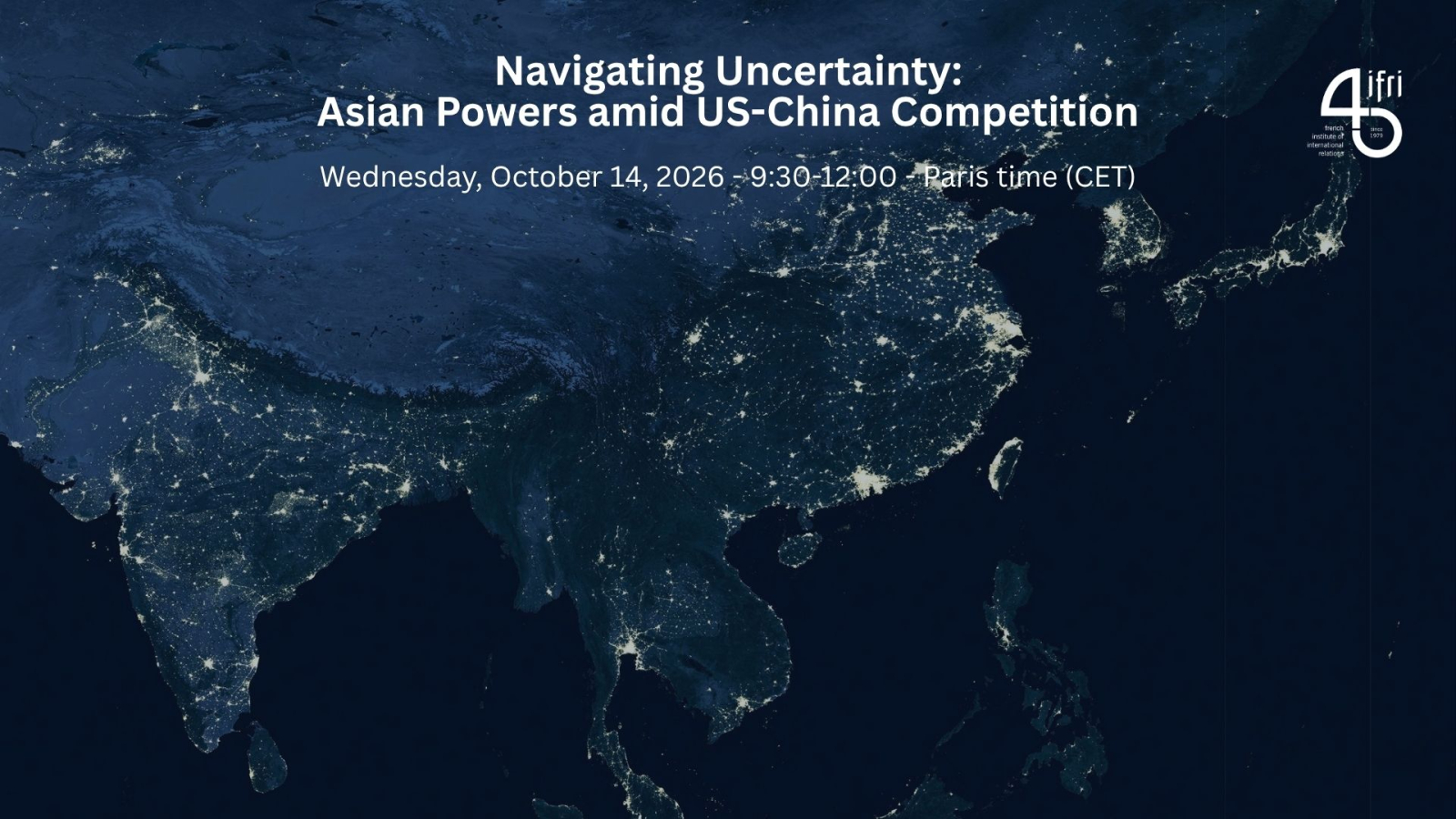
As relations between China and the United States oscillate between hardening competition and strategic stability, regional powers in Asia must adapt to greater uncertainty.
Replay
The increasing weaponization of trade and economic dependencies, the rise of disruptive technologies, and the ever-growing risk of armed conflict are among the destabilizing factors shaping the region’s trajectory. This conference will explore how regional powers are adapting to the various dimensions of US-China competition, what scenarios they envision for the future of the region and the globe, and how they might take matters into their own hands to shape that future.
09:30-09:45 | Opening Remarks
Marc Hecker, Executive Director, Ifri
Clémentine Pei-Chih Hao, Representative, Taipei Representative Office in France
09:45-12:00 | Panel discussion on Asia's future amid US-China competition
- Ken Jimbo, Executive Managing Director, International House of Japan
- Hyun-Wook Kim, Professor, Korean National Diplomatic Academy
- Uma Purushothaman, Professor, Centre for International Politics, Organization and Disarmament (CIPOD), School of International Studies, Jawaharlal Nehru University (in virtual)
- Hung-jen Wang, Director, Institute for National Policy Research (INPR)
- Charmaine M. Willoughby, Professor and Chair of the International Studies Department, De La Salle University
Chaired by Marc Julienne, Director, Center for Asian Studies, Ifri
Contact
Please contact Giorgia SGUEGLIA for any inquiry at [email protected]
Related Subjects
Other events
A New Moment for Central Europe? Regional Cooperation in a Time of European Strategic Choices
Recent political developments in Central Europe have revived the debate about the future of regional cooperation and the Visegrád Group. Changes in Hungary, Poland, the Czech Republic and Slovakia, together with Austria’s growing interest in closer cooperation with its neighbours, could create new opportunities for dialogue and coordination around shared priorities.
China’s Nuclear Buildup: Developments, Drivers, and Implications for Major-Power Relations and Arms Control
China has been steadily expanding its nuclear arsenal for several years amid levels of geopolitical tension unseen since the end of the Cold War, marked by a resurgence in nuclear proliferation and a broader, global arms race.

Reinventing Coordination in an Age of Fragmentation 3rd Paris Geoeconomic Dialogue
The world economy is being reordered. The certainties of the post-Cold War era, open trade, dollar centrality, predictable multilateral coordination, are giving way to a landscape shaped by rivalry between the United States and China, the weaponization of interdependence, and a scramble to secure supply chains, technologies and critical resources. What once looked like a stable architecture now appears fragile, contested, and in places actively being dismantled.