

New Cold War? What New Cold War? Confronting the Geoeconomic Fragmentation Narrative with the Data
It has become widely accepted that the world economy should be seen as increasingly shaped by forces of fragmentation, resulting from geopolitical tensions. This article takes another look at this narrative, using international trade data. While an aggregate analysis is consistent with a new Cold War narrative, whereby international trade is increasingly seen as split into two blocs, this is only a mix of very different outcomes. Far from being a widespread trend, geoeconomic fragmentation of trade flows is only significant in “hotspots”: Russia's foreign trade and China-US bilateral exchanges, and the impact is massive in these cases. Outside these “hotspots”, there is no tangible sign that geopolitical tensions have been shaping international trade patterns in terms of blocs, nor is there any hint of a trend toward nearshoring – to the contrary, in fact.
More Europe in the face of realpolitik’s return? French perspectives on 30 years of German reunification
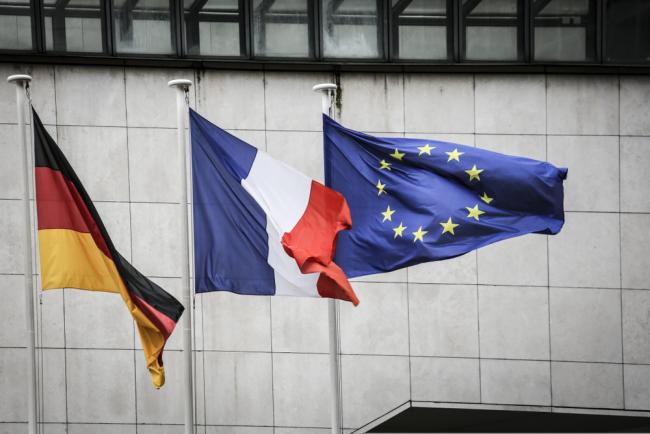
The current geopolitical situation has disrupted the European and global order, which were both consolidated in the 1990s and have been key factors in the modern German model. The Franco-German duo is currently facing new challenges and it will have to respond appropriately in a time when the EU’s global influence is shrinking in the face of what some analysts call a “new Cold War”.

Arctic: Toward the End of the Exception? Strategic, Nuclear and Maritime Issues in the Region
Through multiple international initiatives, including the creation of the Arctic Council at the end of the Cold War in 1996, the Arctic appears to be one of the last areas of peaceful cooperation in the world. This “Arctic exception” is also devoid of any serious territorial dispute between the neighboring countries, some of which are nevertheless great powers: Russia, the United States, Canada, but also Sweden, Norway, Denmark (via Greenland), Iceland and Finland.
The World of Yesterday and Tomorrow
In this special issue of Politique étrangère devoted to the proceedings of the conference organized by Ifri on April 10, 2019, in the Grand Amphitheater of the Sorbonne, on the occasion of its fortieth anniversary, discover the speech by Thierry de Montbrial, Founder and Executive Chairman of Ifri.
The Impact of the First World War on Strategy
The First World War helped redefine the notion of strategy, giving it a political dimension that it previously lacked.
Strategic Stability in the Cold War: Lessons for Continuing Challenges
During the Cold War, the phrase “strategic stability” gained currency both as a foreign policy objective and as an apt way of describing the fact that the United States and the Soviet Union never actually went to war.
A Vibrant and Flexible Alliance
NATO has proved its renewed usefulness and is today fully engaged, well beyond its former frontiers, wherever its interests and those of its members are threatened.
NATO: From Washington (1949) to Strasbourg/Kehl (2009)
The Alliance cannot avoid a strategic debate about its role, missions and resources. This may be painful, but it will ensure clarity and prepare the Alliance for future challenges.
New Cold War? What New Cold War? Confronting the Geoeconomic Fragmentation Narrative with the Data
It has become widely accepted that the world economy should be seen as increasingly shaped by forces of fragmentation, resulting from geopolitical tensions. This article takes another look at this narrative, using international trade data. While an aggregate analysis is consistent with a new Cold War narrative, whereby international trade is increasingly seen as split into two blocs, this is only a mix of very different outcomes. Far from being a widespread trend, geoeconomic fragmentation of trade flows is only significant in “hotspots”: Russia's foreign trade and China-US bilateral exchanges, and the impact is massive in these cases. Outside these “hotspots”, there is no tangible sign that geopolitical tensions have been shaping international trade patterns in terms of blocs, nor is there any hint of a trend toward nearshoring – to the contrary, in fact.
The World of Yesterday and Tomorrow
In this special issue of Politique étrangère devoted to the proceedings of the conference organized by Ifri on April 10, 2019, in the Grand Amphitheater of the Sorbonne, on the occasion of its fortieth anniversary, discover the speech by Thierry de Montbrial, Founder and Executive Chairman of Ifri.
Strategic Stability in the Cold War: Lessons for Continuing Challenges
During the Cold War, the phrase “strategic stability” gained currency both as a foreign policy objective and as an apt way of describing the fact that the United States and the Soviet Union never actually went to war.
NATO: From Washington (1949) to Strasbourg/Kehl (2009)
The Alliance cannot avoid a strategic debate about its role, missions and resources. This may be painful, but it will ensure clarity and prepare the Alliance for future challenges.
A Vibrant and Flexible Alliance
NATO has proved its renewed usefulness and is today fully engaged, well beyond its former frontiers, wherever its interests and those of its members are threatened.
Support independent French research
Ifri, a foundation recognized as being of public utility, relies largely on private donors – companies and individuals – to guarantee its sustainability and intellectual independence. Through their funding, donors help maintain the Institute's position among the world's leading think tanks. By benefiting from an internationally recognized network and expertise, donors refine their understanding of geopolitical risk and its consequences on global politics and the economy. In 2026, Ifri partners with over 90 French and international companies and organizations.