



Politique étrangère

International trade disagreements: Beyond Trump
The trade war between the United States and China is not only due to Donald Trump’s impulsiveness. Its roots are in fact profound and follow three structural changes in the multilateral trading system: the reversal of comparative advantages, the now central role of certain developing countries, and the re-balancing of power that makes coordination between states difficult. In this context, the future of world trade has yet to be written.
The Future of the International Monetary and Financial System
Following the collapse of the Bretton Woods system, the international community sought new stability in the financial system and the assurance of sustained growth. The crisis that began in 2007-2008 has revealed weaknesses that affected advanced economies first and foremost. Efforts have since been made to consolidate the international financial architecture, to coordinate macroeconomic policy, and to improve foreign exchange relations, even if this latter objective has proven complex.
The Waning of Universalism
During the 19th century, Westerners provided ideological justifications for their colonization, namely spreading the Enlightenment across the globe. This project was received favorably until the second half of the 20th century. Over the last 20 years, it has met new hostility. The “universal values” promoted by the West are viewed today as a form of imperialism to be opposed – especially by China, Russia and Turkey.

Brexit: Getting in a State
As Brexit fast approaches, what can be said about the key issues? Politique étrangère summarizes them with four questions.
Trump’s Trade Wars: The Outcry Against Multilateralism
The aim of multilateral trade as established after the Second World War was to prevent trade wars.

Will Artificial Intelligence Revolutionize the Art of War?
Despite the development of artificial intelligence (AI) only being in its early stages, it has already had an impact on armed forces.
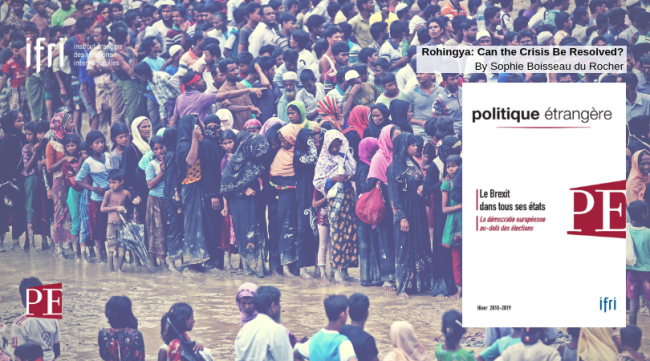
Rohingya: Can the Crisis be Resolved?
The Rohingya issue involves a complex national and regional history.
Support independent French research
Ifri, a foundation recognized as being of public utility, relies largely on private donors – companies and individuals – to guarantee its sustainability and intellectual independence. Through their funding, donors help maintain the Institute's position among the world's leading think tanks. By benefiting from an internationally recognized network and expertise, donors refine their understanding of geopolitical risk and its consequences on global politics and the economy. In 2026, Ifri partners with over 90 French and international companies and organizations.
