






The Future of the International Monetary and Financial System
Following the collapse of the Bretton Woods system, the international community sought new stability in the financial system and the assurance of sustained growth. The crisis that began in 2007-2008 has revealed weaknesses that affected advanced economies first and foremost. Efforts have since been made to consolidate the international financial architecture, to coordinate macroeconomic policy, and to improve foreign exchange relations, even if this latter objective has proven complex.
The “International Monetary and Financial System” (IMFS or IMS, broadly-speaking) covers four major components with regard to the commitments of International Monetary Fund (IMF) member countries: rules governing international current account transfers and payments; capital flows; foreign exchange reserves; and, finally, exchange rate relations and the exchange rates that make up the IMS in the narrower sense. The key motivation behind the agreements and rules laid down in these different areas is to facilitate the exchange of goods and services, as well as capital flows between countries.
Let us focus on the evolution of the IMS following the dismantling of the Bretton Woods system. Established after the Second World War, it was a system of fixed but adjustable exchange rates, based on the US dollar, which was itself convertible into gold. Since the system was dismantled in 1973, relations between the convertible currencies of advanced economies have been based on the concept of the free floating of the currencies concerned, and, progressively, the free movement of capital.
The international community has endeavored, following the end of the Bretton Woods system, to seek the optimal monetary and financial relations to ensure the stability of the international system, while trying to create the conditions for significant and smooth growth. After a difficult period in the 1970s and the first half of the 1980s, advanced economies gradually entered a period of steady real growth and price stability, characterized by a marked mitigation of economic cycles and low volatility with regard to growth and inflation. Two interpretations may be associated with this “Great Moderation” of a little over twenty years – from the mid-1980s to 2007.
The prevailing view was that advanced economies, and to a large extent the world economy as a whole, were characterized by a close-to-optimal situation in terms of growth, price stability, and relative financial stability.
The contrary assessment pointed out that this period was marked by a succession of serious financial crises: sovereign risk crises in developing and emerging countries in Latin America, Africa, and the Middle East in the 1980s and early 1990s; financial crises in eastern and central Europe, culminating in the Soviet Union’s collapse in 1991; the Mexican financial crisis of 1994; the sovereign risk crisis in Asia from 1997; the Russian financial crisis of 1998; and the bursting of the dot-com bubble in 2000. […]
OUTLINE
- Strengthening and deepening of the international financial architecture
- Possible ways to improve exchange rate relations
- The creation of a global currency
- Strengthening special drawing rights
- Improving the management of exchange rate relations between major convertible currencies
Jean-Claude Trichet is Chairman of the Trilateral Commission for Europe. Member of the Académie des sciences morales et politiques. Former Director of the French Treasury, Governor of the Banque de France and then President of the ECB.

Available in:
Share
This page contains only a summary of our work. If you would like to have access to all the information from our research on the subject, you can download the full version in PDF format.
The Future of the International Monetary and Financial System
Iran: Anatomy of a Power at War
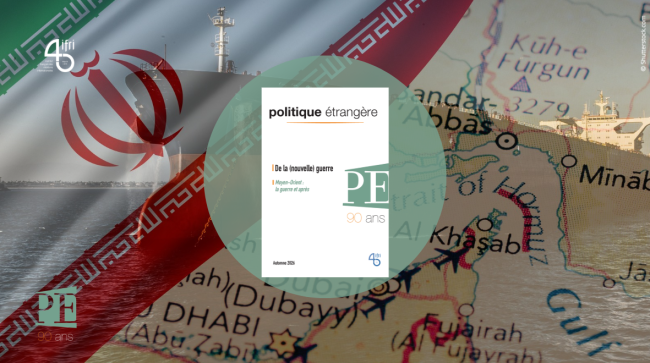
The elimination of Supreme Leader Ali Khamenei and several high-ranking officials at the outset of the 2026 American-Israeli operation did not succeed in bringing down the Iranian regime. The regime had prepared for such a scenario, notably by decentralizing its structures. Moreover, it continues to adapt to war. The power of the Islamic Revolutionary Guard Corps is growing at the expense of the Shiite clergy. The security apparatus defends the country’s sovereignty and justifies its actions in the name of raison d’état.
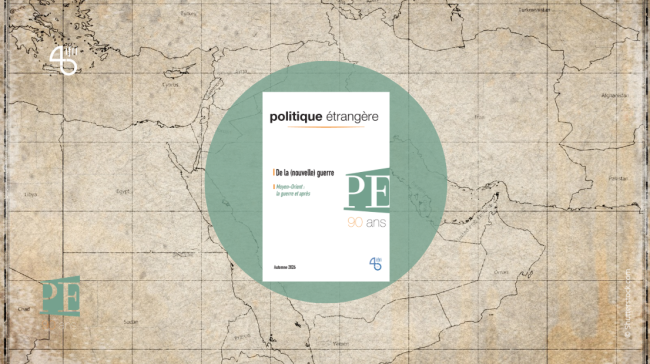
“Remodeling” the Middle East?
Chaos continues to spread, seemingly without end, across the Middle East. The Israeli-American attack on Iran has resulted in a clear military and diplomatic failure, but it is paving the way for a regional realignment, the consequences of which remain uncertain. New regional groupings are taking shape, either centered around Israel or built on the prospect of coexistence with Tehran, alongside a decline in American influence and the marginalization of Europe, while China maintains a low-key presence.

Silicon Valley and War: Lessons from Ukraine
Over the course of international conflicts, and particularly in Ukraine, major tech companies have emerged as central actors. Initially subject to wartime maneuvering, they have since become decisive actors in their own right, privatizing a significant share of wartime exchanges, shaping the information flows of societies, and presenting themselves as providers of security. This situation raises important questions about states’ autonomy in making decisions and taking action.

Does Artificial Intelligence Change the Nature of War?
From Gaza to Ukraine and Iran, current conflicts are being shaped by the arrival of artificial intelligence and robots on the battlefield. The changes under way are so profound that humans risk rapidly losing control over entire aspects of the conduct of military operations. While these technological developments are altering the character of war, their impact on the very nature of war itself remains a matter of debate.