







Practical information
The deepening strategic rivalry between the United States and China has repositioned geopolitics at the center of the international system today.
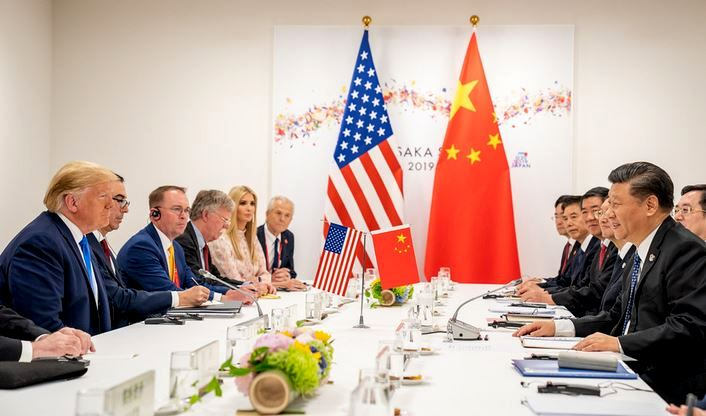
The ongoing “trade war” is only one dimension of growing frictions, which include a competition for technological leadership, a struggle for strategic and military preeminence and antagonism over opposing political systems and their underlying values. While Asia and Europe are confronted with major challenges beyond the Sino-US rivalry, actors in these regions are increasingly compelled to adjust to new geopolitical realities. What does this hold for regional stability in Asia? How can Europe navigate this structural change?
09:15 Opening Remarks
- Thierry de Montbrial, Founder and Executive Chairman, Ifri
- François Chih-chung Wu, Representative, Taipei Representative Office in France
The US-China rivalry: The contours of confrontation and entente
09:40-11:00
- David Rank, Senior Advisor, Cohen Group, former Deputy Chief of Mission, US Embassy in China
- Song Luzheng, Research Fellow, China Institute, Fudan University
- Discussant: John Seaman, Research Fellow, Center for Asian Studies, Ifri
- Moderated by Laurence Nardon, Head, North America Program, Ifri
Adjusting to the US-China rivalry in East Asia
11:15-13:00
- Chikako Ueki, Professor, Graduate School of Asia-Pacific Studies, Waseda University
- Malcolm Cook, Senior Fellow, Institute of Southeast Asian Studies (ISEAS) - Yusof Ishak Institute
- Yujen Kuo, Professor, Institute of China and Asia-Pacific Studies, National Sun Yat-sen University, and Executive Director, Institute for National Policy Research (INPR)
- Yul Sohn, Professor, Graduate School of International Studies (GSIS), Yonsei University, and President, East Asia Institute (EAI)
- Moderated by Françoise Nicolas, Director, Center for Asian Studies, Ifri
Lunch break - 13:00-14:30
Toward a European Way? Implications of the US-China rivalry for Europe
14:30-16:30
- Geopolitics and diplomacy: Monika Sie Dhian Ho, Director General, Netherlands Institute of International Relations, Clingendael
- Economics and trade: Aurélien Billot, Head of Trade and Development Policy, General Secretariat for European Affairs, Office of the Prime Minister of France
- Technology and industrial policy: André Loesekrug-Pietri, Speaker for Joint European Disruptive Initiative (JEDI)
- Moderated by Eric-André Martin, Senior Advisor to the Director, Ifri
Related Subjects
Other events
One Month Ahead of the Midterms: Where Is Trump’s America Headed?
The 24th edition of the Ifri Americas Programme Annual Conference will examine the dynamics at play in the United States and their implications for Europe and the transatlantic relationship. will examine the dynamics at play in the United States and their implications for Europe and the transatlantic relationship.
France-Ukraine Forum 2026
More than four and a half years after the start of the full-scale war launched by Russia against Ukraine, the 2026 France-Ukraine Forum will bring together policymakers, experts, academics, and civil society representatives from both countries to discuss three main topics: the formats and conditions for a lasting diplomatic settlement; Ukraine’s Euro-Atlantic integration, encompassing both the EU accession process and closer ties with NATO; and the societal transformations of postwar Ukraine, as well as its prospects for reconstruction.
The EU in a World of Economic Warfare: Trade, Geopolitics, and the Battle for Economic Sovereignty
The international trading system has become a primary theatre of geopolitical competition. Tariffs, sanctions, and technology controls have replaced dialogue as the default instruments of economic relations.