






How the war in Ukraine affects strategic foresight? Visions from France and Japan

Practical information
The Russian aggression in Ukraine took most experts and policymakers by surprise and raised questions about the methodology of strategic planning and foresight.

This webinar offers the opportunity to present how foresight is conducted in France and in Japan strategic communities, as well as in a big French company. We will see if the failure to predict the war in Ukraine is having any impact on anticipation practices. In particular, we will focus on two cases studies: the prospect for a more aggressive Russian foreign policy in Europe and Northeast Asia; and the prospect for a more aggressive Chinese foreign policy in East Asia vis à vis Taiwan and Japan.
This webinar will be held on Zoom, in English.
PROGRAMME
Chair and discussion leader: Céline PAJON, Head of Japan Research, Center for Asian Studies, Ifri
- Tomonori YOSHIZAKI, Vice-President for Academic Affairs, National Institute for Defense Studies, Tokyo
- Tristan DUFES, Deputy Assistant Director, Defence Strategy, Directorate General for International Relations and Strategy (DGRIS), French Ministry of Armed Forces
Replay
Related Subjects
Other events
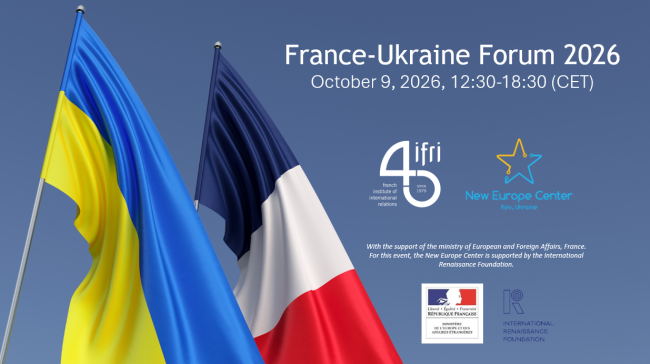
France-Ukraine Forum 2026
More than four and a half years after the start of the full-scale war launched by Russia against Ukraine, the 2026 France-Ukraine Forum will bring together policymakers, experts, academics, and civil society representatives from both countries to discuss three main topics: the formats and conditions for a lasting diplomatic settlement; Ukraine’s Euro-Atlantic integration, encompassing both the EU accession process and closer ties with NATO; and the societal transformations of postwar Ukraine, as well as its prospects for reconstruction.

The EU in a World of Economic Warfare: Trade, Geopolitics, and the Battle for Economic Sovereignty
The international trading system has become a primary theatre of geopolitical competition. Tariffs, sanctions, and technology controls have replaced dialogue as the default instruments of economic relations.

The Road to 27 Electrification Action Plans: Planning and Investing in Europe’s Electric Future
The European Commission’s Electrification Action Plan places the continent on an electric path to structurally reduce dependence on fossil fuel imports and boost the energy transition in industry, transport and buildings.