

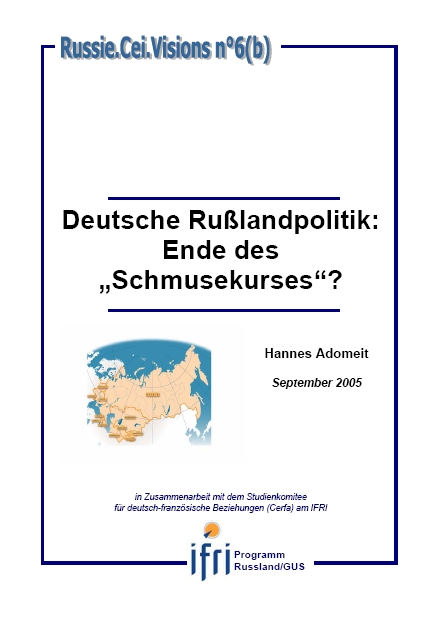
Deutsche Rußlandpolitik: Ende des „Schmusekurses
Doppelte Note du Cerfa, 26 (a) und 26 (b), September 2005, in Kooperation mit dem Programm Russland/GUS
Note du Cerfa, n° 26 (a), septembre 2005 Hannes Adomeit, "Deutsche Rußlandpolitik: Ende des „Schmusekurses?"
Note du Cerfa, n° 26 (b), septembre 2005 Andreï Zagorski, "Russland und Deutschland: Kontinuität und Wandel"
Die Entwicklungen in Putins Russland weg von Democratie und Rechtsstaat haben auch die deutsche Russlandpolitik auf den Prüfstand gestellt. So haben Repräsentanten der Oppositionsparteien CDU/SCU und FDP im Vorfelf der Wahl zum Deutschen Bundestag am 18. September zu arkennen gegeben, dass sie die von Bundeskanzler Schröder gegenüber Russland eingenommene Haltung für verfehlt halten. In den neuen EU-Mitgliedstaaten Ostmitteleuropas wird Deutschland vorgeworfen, es schlage abweichend von der EU einen Sonderweg ein, es strebe ein Sonderverhältnis zu Russlan an. Der vorliegende Artikel geht der Frage nach, ob diese Kritik zutreffend ist und was hinter der von Bundeskanzler Schröder und Präsident Putin immer wieder beschworenen "strategischen Partnerschaft" steckt.
Hannes Adomeit is seit 1997 wissenschaftlicher Mitarbeiter und Fachmann für Russlandfragen am Forschungsinstutut für Internationale Politik und Sicherheit der SWP in Berlin.
This page contains only a summary of our work. If you would like to have access to all the information from our research on the subject, you can download the full version in PDF format.
Deutsche Rußlandpolitik: Ende des „Schmusekurses


The Study Committee on Franco-German Relations (Cerfa)
The Study Committee on Franco-German Relations (Cerfa) was created in 1954 by an inter-governmental agreement between the Federal Republic of Germany and France, in order to raise awareness of Germany in France and analyze Franco-German relations, including in their European and international dimensions. In its conferences and seminars, which bring together experts, political leaders, senior decision-makers and representatives of civil society from both countries, Cerfa develops the Franco-German debate and stimulates political proposals. It regularly publishes studies through two collections: Cerfa notes and studies as well as Franco-German visions.
Cerfa maintains close relations with the network of German foundations and think tanks. In addition to its research and debate activities, Cerfa promotes the emergence of a new Franco-German generation through original cooperation programs. This is how in 2021-2022, Cerfa led a program on multilateralism with the Konrad Adenauer Foundation in Paris. This program is aimed at young professionals from both countries interested in the issues of multilateralism in the context of their activities. It covered a wide range of themes relating to multilateralism, such as international trade, health, human rights and migration, non-proliferation and disarmament. Previously, Cerfa had participated in the Franco-German future dialogue, co-led with the DGAP from 2007 to 2020, and supported by the Robert Bosch Foundation and the Daniel Vernet group (formerly the Franco-German Reflection Group) which was founded in 2014 upon the initiative of the Genshagen Foundation.
France-Germany: Overcoming Differences to Strengthen European Sovereignty
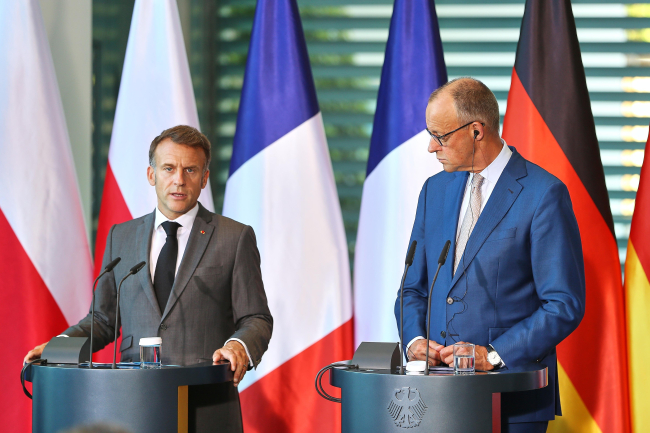
The Franco-German “reset” launched with Friedrich Merz’s appointment as Chancellor in May 2025 and given concrete form at the Franco-German Council of Ministers (FGCM) in Toulon in August 2025 was intended to address the structural challenges affecting the bilateral relationship. Yet it is clear that these ambitions have only been partially translated into concrete action. Since the beginning of 2026, Franco-German relations have entered a phase in which short-term challenges have combined with deeper divergences over priorities, policy approaches, and strategic culture.
Under construction: Europe’s economic repositioning in a fragmented international order
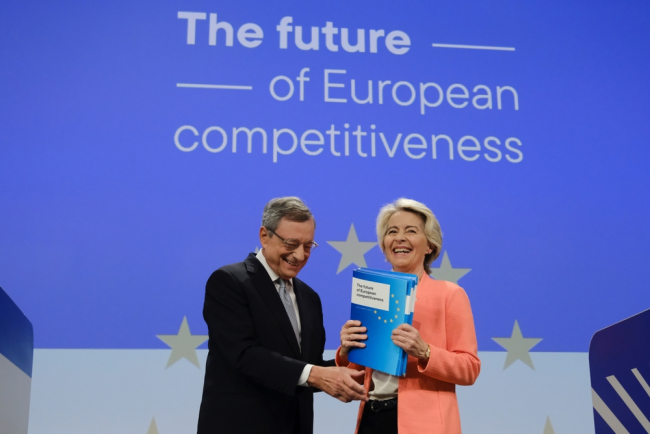
„Under Destruction“– this was this year’s motto at the Munich Security Conference. A motto that applies both to security and economy in an increasingly fragile international system. In 2024, Mario Draghi’s report on the EU’s competitiveness rang the alarm bell: Europe is slipping behind the US and China, European companies struggle with Brussels' bureaucracy, and the internal market is too fragmented. However, two years later only about 15 % of his recommendations were implemented: the wake-up call was not heard.
Germany in the Shadow of the United States, Russia, and China – Systemic Paradigm Shifts
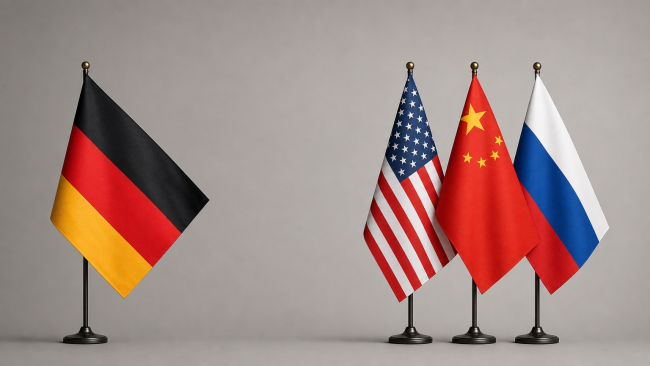
Since reunification, Germany has built its prosperity on an international order based on free trade, multilateralism, and geopolitical stability. This model relied on three relationships considered complementary: U.S. military protection, Russian energy supplies, and economic integration with China. For several decades, Berlin viewed these interdependencies as factors contributing to peace, growth, and security.
France and EU Enlargement: From Strategic Hesitation to a Geopolitical Shift
Paris has come a long way in its approach to enlarging the European Union. However, French support remains fragile, due in part to a lack of public support.