




Economy
The economy is an essential attribute of power and a major component of international relations. While geopolitical tensions are on the rise, economic interdependence remains strong.
Related Subjects

Country Risk Analysis: More than a Postmodern Discipline
Methodological debates about the stages of growth and the way in which a country goes through political modernization are long-established and manifold.
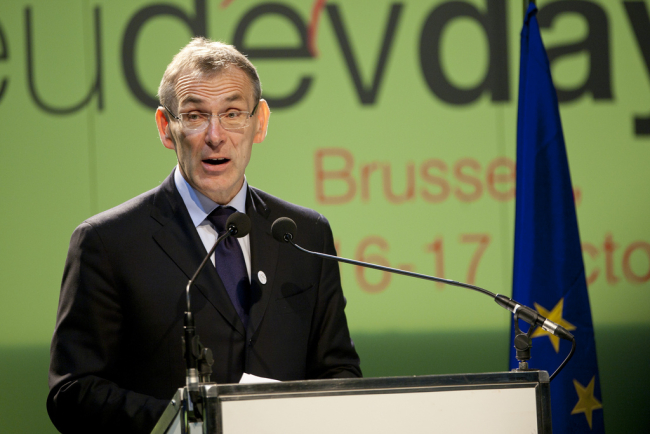
The European Union's Development Aid : from Development to Security, the Example of the European Development Fund
In the course of its institutional development and the expansion of its activities, the European Union (EU) has tended to pile up rather than to rationalize its policies, creating a financial tool per objective. As a result, the European funds have become a labyrinth, for which management costs are high.
The Distinctive Features of China's Middle Classes
This study seeks to lay the foundations for a better understanding of the Chinese middle classes. It goes beyond the traditional classification by revenue and identifies the distinctive features of China’s middle classes by taking into account relevant historical events, current sociopolitical and economic contexts, and key expectations of the population.
Quelles perspectives pour l'industrie européenne des armements terrestres ?
Over the last decade, the European land armament industry developed into a thriving market driven by growing demand from the BRICS, a new wave of emerging countries and the wars in Iraq and Afghanistan.
Europe's Place in the World: from 1914 to 2014
The first wave of globalization in the 20th century triggered deep upheaval of the organization of power and an overall depreciation of European nations.
Will Europe’s Past be East Asia’s Future?
There are some disturbing similarities between present-day Asia and pre-1914 Europe.
The Impact of the First World War on Strategy
The First World War helped redefine the notion of strategy, giving it a political dimension that it previously lacked.
The Influence of the State on Expanding Russian MNEs: Advantage or Handicap?
Government influence is crucial for the international operations of firms in emerging economies. However, these firms have varied experience of government interventions: some benefit more, some less, while the government roles vary among countries and industries.
Beyond the Arab awakening: Policies and Investments for Poverty Reduction and Food Security
This report aims to inform and stimulate the debate on key policy priorities for poverty reduction and food security in light of the Arab Awakening.
Crisis and Decline in Southern Europe: Implications for Turkey
The twists and turns of the economic and political crisis in southern Europe are now an important parameter for relations between Europe and Turkey.
Youth Unemployment in Europe
On an initiative of the IP-Journal of the German Council of Foreign Relations (DGAP), the Study Committee for Franco-German Relations (Cerfa) of the French Institute of International Relations (IFRI) and the Polish Institute of International Affairs (PISM) are regularly publishing short contributions on a common subject, written by three experts of these institutes. The purpose of these “Weimar Triangle Analyses” is to give the French, Polish and German views on central questions of European politics and European integration.
États-Unis : Le rôle de l'État dans le soutien à l'innovation
Even though the private sector brings more funding to innovation programs, the role government plays by hosting and/or funding research projects remains key. Only the public sector can pursue the long term projects with no foreseeable profitability that will enable the next industrial revolution.
A Transatlantic Free Trade Agreement? Weimar Triangle Analyses: French, Polish and German viewpoints on European questions
On an initiative of the German Council of Foreign Relations (DGAP), the Study Committee for Franco-German Relations (Cerfa) of the French Institute of International Relations (IFRI) and the Polish Institute of International Affairs (PISM) are regularly publishing short contributions on a common subject, written by three experts of these institutes. The purpose of these “Weimar Triangle Analyses” is to give the French, Polish, and German views on central questions of European politics and European integration.
Trading Freely with East Asia: Challenges and Opportunities for EU FTAs in the Region
As the fastest growing region in the world, East Asia is an important partner for the European Union, particularly at a time of economic difficulty. Asian countries have weathered the recent financial and economic crisis much better than Europe and much better than initially anticipated, with China and several members of the Association of Southeast Asian Nations (ASEAN) recording relatively impressive growth rates. As a result, self-confidence has been growing in Asia while European economies feel increasingly challenged.
Kazakhstan and Eurasian Economic Integration: Quick Start, Mixed Results and Uncertain Future
Kazakhstan's economic integration with Russia and Belarus has been advancing at break-neck speed.
Negotiating for a Malaysia-EU FTA: Contesting Interests from Malaysia's Perspective
Malaysia has shifted its focus from multilateral and regional to bilateral trade agreements due to the current doldrums in the Doha Round and the bandwagon effect from similar shifts in other countries.
Challenges and Opportunities of a EU-Taiwan ECA: A Review of Political-Economic Perspectives
Concerns over becoming marginalized in the course of East Asian economic integration are driving a proactive regional trade agreement (RTA) strategy on the part of Taiwan. Three factors explain this concern: Competing visions of economic integration in the region from both the United States and China, the success of Korea in concluding a large number of important RTAs, and the increasing number of overlapping agreements that crowd out countries and economies such as Taiwan that do not have proactive RTA strategies.
A EU-Japan Free Trade Agreement: Toward More Solid Economic Relations
Russia's diplomacy is more active than it was ten years ago
Since December 2011 there is a real convergence between the perception of President Vladimir Putin and the perception of Russia, especially, in the Western media.
That leads to several comments. The first is the feeling that there is now a new, much more concentrated power in the Kremlin, and that to some extent leads to the question about the very difficult challenge for Russia to build balanced institutions. And there is the perception that, on this particular point, Russia has not made progress. And this is the main area of concern as seen from outside.
The WTO and the Customs Union: What Consequences for the Russian Banking Sector?
Russia is now a member of World Trade Organization (WTO) and of the Eurasian Customs Union between Russia, Belarus and Kazakhstan. Questions remain over how this new global and regional integration will affect the competitive environment of the Russian banking services industry.
Ifri, a foundation recognized as being of public utility, relies largely on private donors – companies and individuals – to guarantee its sustainability and intellectual independence. Through their funding, donors help maintain the Institute's position among the world's leading think tanks. By benefiting from an internationally recognized network and expertise, donors refine their understanding of geopolitical risk and its consequences on global politics and the economy. In 2026, Ifri partners with over 90 French and international companies and organizations.

To analyze the impact of power rivalries and tensions on globalization, this initiative combines economic and political expertise. In the face of growing geopolitical risk, the goal is to decipher the dynamics of reconfiguration: protectionist pressures, sanctions, restrictions, industrial policies, and economic security concerns are redefining the rules of international trade. These tensions are also transforming international financial relations by undermining the foundations of trust and reshaping the global monetary system. They raise questions about the role of several key players: sovereign wealth funds, central banks, digital platforms, multilateral institutions, and financial infrastructure operators. In a context of profound disruption, simply refining existing approaches is no longer sufficient. The initiative is designed as a flexible model, drawing on diverse expertise to offer both broad overviews and targeted analyses. It also provides a platform for stakeholders and experts from various backgrounds to debate these issues freely.