





Economy
The economy is an essential attribute of power and a major component of international relations. While geopolitical tensions are on the rise, economic interdependence remains strong.
Related Subjects
Is Africa's Recent Economic Growth Sustainable?
Hardly a week goes by without an African investors’ conference or growth summit.
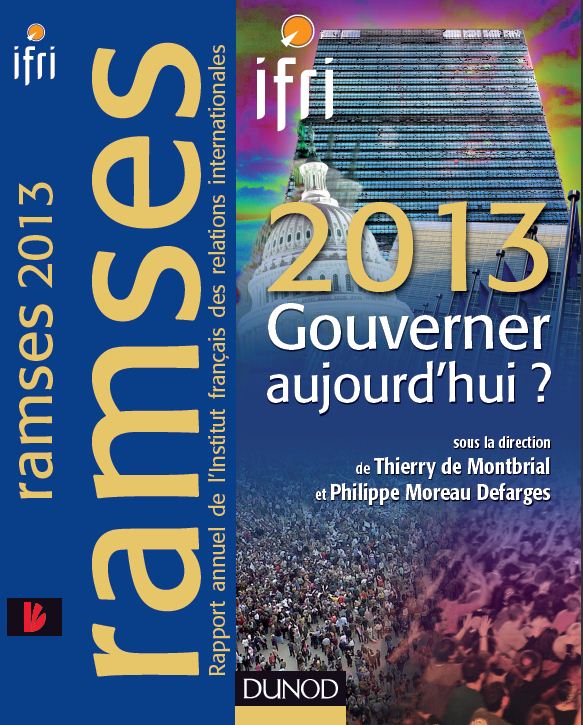
RAMSES 2013. Gouverner aujourd'hui ?
RAMSES (Le Rapport annuel mondial sur le système économique et les stratégies), is a yearly publication that provides in-depth reviews and prospective analysis on current events, providing readers with indispensable insights and perspectives for understanding contemporary geopolitics on the global scale. Edited by Thierry de Montbrial and Philippe Moreau Defarges, RAMSES relies on the expertise of Ifri’s research team and its network of associates.
The Ongoing Economic Crisis-Series 5. What Precipitated the Economic Bubble in Europe, and How Did It Collapse?
This series of policy papers, published by Ifri and the Canon Institute for Global Studies, provides a Japanese perspective on the causes, the mechanisms and the consequences of the global economic crisis, as well as the measures implemented by the States to cope with it.
Russia: Will the Web Reinvent Policy?
The Web has seen a spectacular development in Russia, opening an intermediary political space through which protesters against the regime have been able to coalesce, as shown by the events in late 2011 and early 2012.
The Ongoing Economic Crisis - 3 & 4: The US Authorities and the Financial Crisis / Fiscal Austerity as a Mistake
This series of policy papers, published by Ifri and the Canon Institute for Global Studies, provides a Japanese perspective on the causes, the mechanisms and the consequences of the global economic crisis, as well as the measures implemented by the States to cope with it.
The Ongoing Economic Crisis - 1 & 2: Comments on the EU Strategy / The Causes of the Crisis
This series of policy papers, published by Ifri and the Canon Institute for Global Studies, provides a Japanese perspective on the causes, the mechanisms and the consequences of the global economic crisis, as well as the measures implemented by the States to cope with it.
Ukraine at the Crossroads: Between the EU DCFTA and Customs Union
After serious decline in the 1990s, Ukraine's economy finally started its recovery and systemic reform in early 2000. While the economy rapidly grew by 2008, its transformation remained unfinished. Ukraine has three possible roads to development.
Rare Earths and the WTO: Tougher case than it looks
Deepening their partnership, Ifri and the Canon Institute for Global Studies (CIGS) are launching a series of op-eds, written both by Ifri and CIGS experts. This new series aims at providing the European and Asian public with original and different visions on the rapidly evolving international affairs.
The Economic Opportunities and Constraints of Green Growth: The Case of South Korea
Decoding Russia's WTO Accession
As Moscow and the WTO Member States have finally established terms on which Russia will accede to the organization, thoughts turn to the impact of this historic event and the potential for it to play a role in the modernization of the country’s economy. The process has been long, with Russia having to negotiate bilateral accession protocols with the more than fifty WTO member states.
Doors Wide Shut? An Update on FDI Regulations in China
The fears of a rise in economic nationalism in China have been fueled by a number of recent moves, such as changes in the law on indigenous innovation or the enactment of a national security review (NSR) regulation for M&As by foreign enterprises. The objective of the current paper is twofold: First is to provide an update on the investment environment in China in order to determine whether or not these provisions reflect a move in the direction of more protectionism, and second is to suggest ways for European countries to level the playing field for their firms wishing to invest in China.
The European Power System - Decarbonization and Cost Reduction: Lost in Transmissions?
Europe’s energy policy is commonly defined by three axes of equal importance: security of supplies, competitiveness and sustainable development. The European Commission is mandated to develop the policy tools that allow the implementation of this common policy. Early on, challenges arose from the trade-offs to be made not only between these three pillars but also between a common European policy and national approaches. The European Commission has always had to struggle in attempting to keep a balanced line.
The Architect and Fragile States: Development Assistance's Contribution to Global Security
Up to Europe’s threshold in the middle of Sahara and Sahel region, a growing insecurity led beyond mere reconsideration of field practice to a whole change of paradigm for multilateral and bilateral aid institutions.
Political Europe: Is Hope Reasonable?
The European crisis is primarily the result of economic difficulties and their social effects.
Is Turkey an Economic Exception?
This roundtable dealt with the specificities of Turkey"s economy, which is completing major economic achievements in particularly difficult times. François Faure analyzed the risks of an economic backlash following the European crisis; Turkey appears indeed in a weaker position than in 2008 and difficult times could lie ahead. Esen Çağlar pointed out how Turkey progressed from a low-technology to medium-technology economy, thus ensuring considerable levels of growth. Yet, a renewed reform agenda is needed if Turkey wants to maintain its economic performance. Deniz Ünal addressed the issue of economic governance under the AKP and the consistency of their economic policy agenda. In any case, Europe will most certainly play a role in the country"s economic future. According to Rémi Bourgeot, the Middle East cannot provide an alternative to European markets even if it offers interesting opportunities for the Turkish South East. Turkey"s future growth will also depend on its capacity to impose itself as a corridor between Europe and its neighbours energy resources.
Innovation Policy Challenges for Japan: An Open and Global Strategy
Productivity is increasingly important in the Japanese economy as an aging and shrinking population is expected to constrain labor input. Thus, the creation of innovation is critical for realizing economic growth and maintaining Japan's international competitiveness. Specifically, emerging countries such as China and South Korea are quickly catching up on Japan's level of technological prowess in electronics and other high-tech industries. For that reason, continual investment in R&D and provision of products and services that are competitive in the global market are crucial for Japan's international competitiveness.
Japan: How Should Funds Be Raised for Rebuilding After the Disaster?
Ifri and the Canon Institute for Global Studies are launching a series of policy papers presenting the analyses of senior Japanese researchers on how the triple disasters that hit the archipelago last March have impacted Japan's economic, environmental and energy policies as well as country's crisis management system.
East Asian Regional Economic Integration: A Post-Crisis Update
To the surprise of many analysts, the outbreak of the global financial crisis (GFC) in 2008 did not leave East Asian economies unscathed. The objective of the paper is to examine the implications of the GFC for the regional economic integration process in East Asia, taking into account both the de facto and the de jure dimensions.
RAMSES 2012. Les États submergés ?
RAMSES (Le Rapport annuel mondial sur le système économique et les stratégies), is a yearly publication that provides in-depth reviews and prospective analysis on current events, providing readers with indispensable insights and perspectives for understanding contemporary geopolitics on the global scale.
Ifri, a foundation recognized as being of public utility, relies largely on private donors – companies and individuals – to guarantee its sustainability and intellectual independence. Through their funding, donors help maintain the Institute's position among the world's leading think tanks. By benefiting from an internationally recognized network and expertise, donors refine their understanding of geopolitical risk and its consequences on global politics and the economy. In 2026, Ifri partners with over 90 French and international companies and organizations.
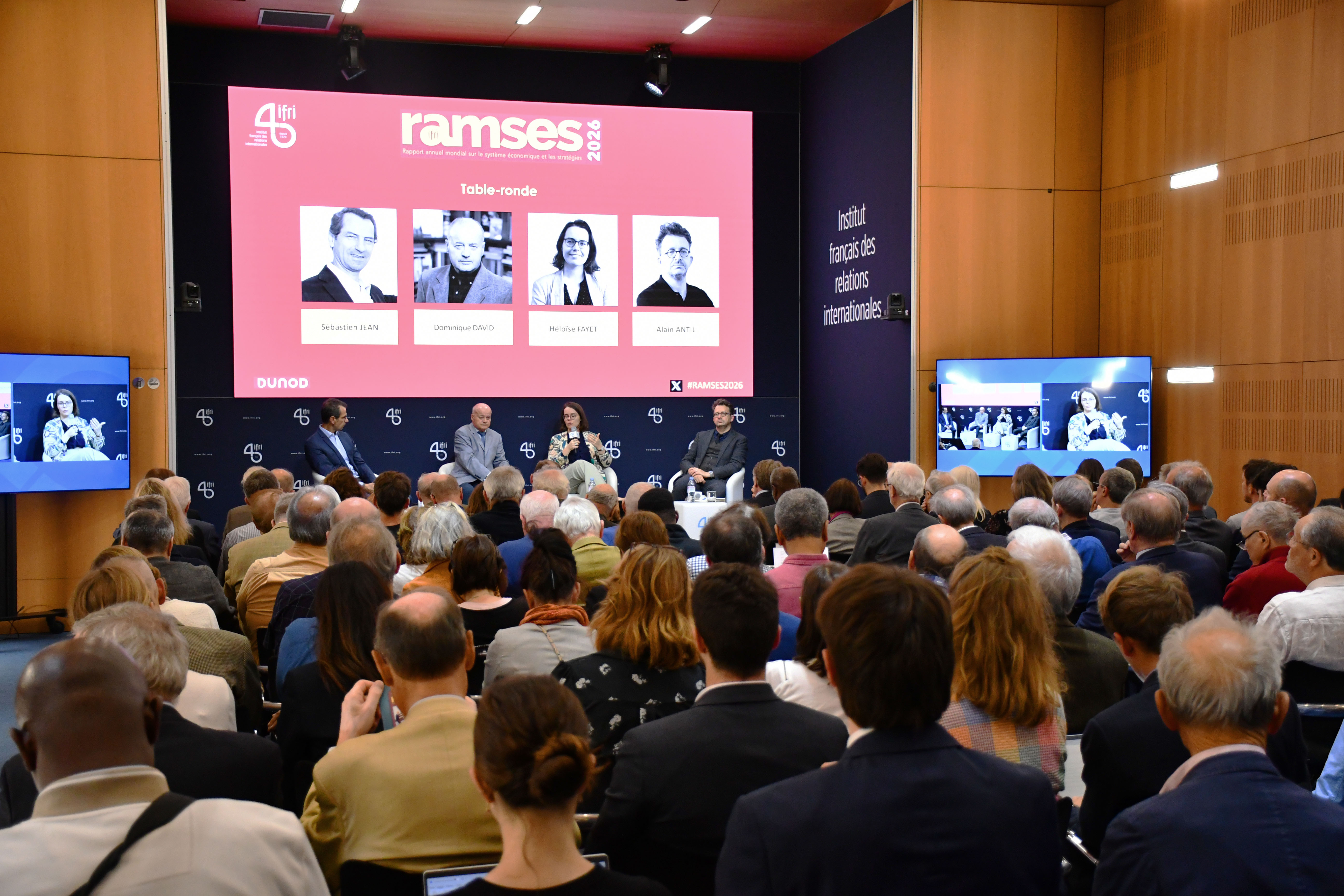

To analyze the impact of power rivalries and tensions on globalization, this initiative combines economic and political expertise. In the face of growing geopolitical risk, the goal is to decipher the dynamics of reconfiguration: protectionist pressures, sanctions, restrictions, industrial policies, and economic security concerns are redefining the rules of international trade. These tensions are also transforming international financial relations by undermining the foundations of trust and reshaping the global monetary system. They raise questions about the role of several key players: sovereign wealth funds, central banks, digital platforms, multilateral institutions, and financial infrastructure operators. In a context of profound disruption, simply refining existing approaches is no longer sufficient. The initiative is designed as a flexible model, drawing on diverse expertise to offer both broad overviews and targeted analyses. It also provides a platform for stakeholders and experts from various backgrounds to debate these issues freely.