Search on Ifri.org

About Ifri

Frequent searches

Suggestions

Prénom de l'expert
Thomas
Nom de l'expert
GOMART

Intitulé du poste

Director of Ifri

Domaine d'expertises En

Research Areas:

  • International Relations
  • Geopolitical Risk
  • Post-Soviet Space
  • French Diplomacy
  • Energy Issues
  • Digital Governance
  • Geopolitics and Security
Biographie En

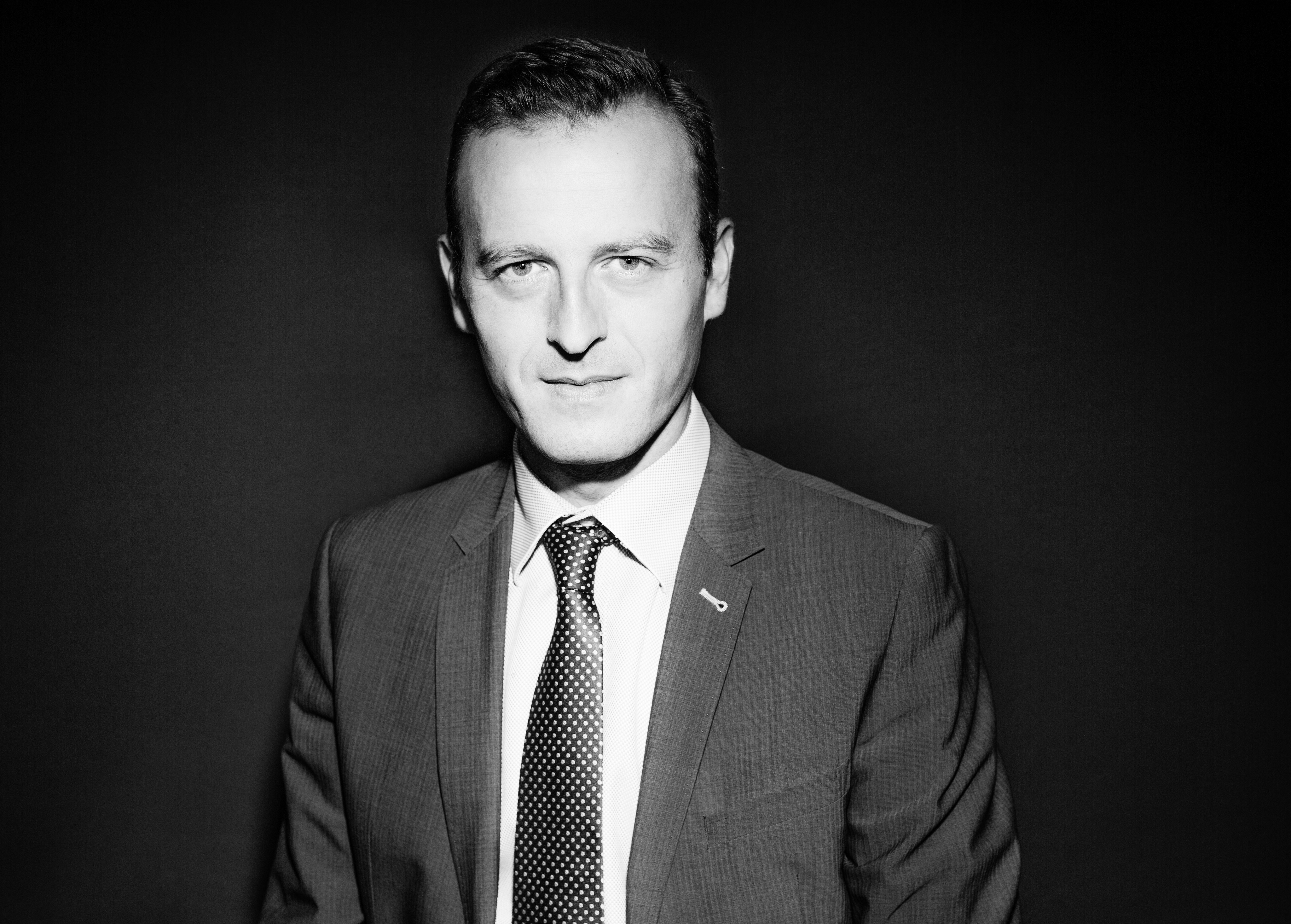
Thomas Gomart has been director of Ifri since 2015. He was a member of the editorial committee of the 2017 National Defence and Security Strategic Review, placed under the authority of the Minister for Armed Forces. Thomas Gomart is a member of the scientific council of Institut des hautes études de défense nationale (IHEDN) and of the editorial board of the journals: Politique étrangère, Revue des deux mondes and Études.

His current work focuses on Russia, digital governance, French foreign policy, geopolitical risk and think tanks.

He recently published L'Affolement du monde (Tallandier, 2019), Guerres invisibles (Tallandier, 2021) and Les Ambitions inavouées. Ce que préparent les grandes puissances (Tallandier, 2023). His latest book, "L’Accélération de l’histoire. Les nœuds géostratégiques d’un monde hors de contrôle", Editions Tallandier, was published in January 2024.

Thomas Gomart has a doctorate in the history of international relations (Paris 1 Panthéon-Sorbonne) and is an EMBA graduate (HEC). He is knight of the National Order of Merit.

See more

Eléments a la une
Decoration

Support independent French research

Ifri, a foundation recognized as being of public utility, relies largely on private donors – companies and individuals – to guarantee its sustainability and intellectual independence. Through their funding, donors help maintain the Institute's position among the world's leading think tanks. By benefiting from an internationally recognized network and expertise, donors refine their understanding of geopolitical risk and its consequences on global politics and the economy. In 2025, Ifri supports more than 80 French and foreign companies and organizations.

Ramses Conference, 2024
Analysis from Thomas GOMART
Publications
Image de couverture de la publication
logo_coc.jpg

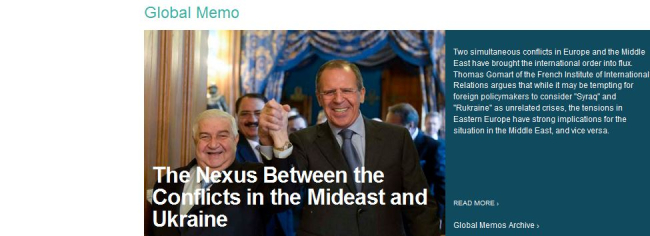
The Nexus Between the Conflicts in the Mideast and Ukraine

Date de publication
05 June 2015
Accroche

Two simultaneous conflicts in Europe and the Middle East have brought the international order into flux. Russia’s annexation of Crimea and destabilization of eastern Ukraine have deeply undermined European security. Meanwhile, the self-declared Islamic State’s proclamation of a caliphate in western Iraq and eastern Syria has unsettled the Middle East. While it may be tempting for foreign policymakers to consider "Syraq" and "Rukraine" as unrelated crises, the tensions in Eastern Europe have strong implications for the situation in the Middle East, and vice versa. Indeed one of the greatest challenges to global governance is the combination of an assertive and declining Russia, and a disintegrating Middle East.

To read this Global Memo

All Global Memos


Global Memos are briefs by the Council of Councils that gather opinions from global experts on major international developments.

The Council of Councils is a Council on Foreign Relations initiative connecting leading foreign policy institutes from around the world in a common conversation on issues of global governance and multilateral cooperation. The Council of Councils draws on the best thinking from around the world to find common ground on shared threats, build support for innovative ideas, and introduce remedies into the public debate and policymaking processes of member countries. The membership of the Council of Councils includes leading institutions from twenty-five countries, roughly tracking the composition of the Group of Twenty (G20). The network facilitates candid, not-for-attribution dialogue and consensus building among influential opinion leaders from established and emerging nations.

FOUNDING COUNCIL OF COUNCILS MEMBER THINK TANKS


From Russia’s Grand Strategy to Limited War

Date de publication
01 June 2015
Accroche

To implement the “grand strategy”, Moscow’s strongest card is the energy weapon. However, the fall in oil prices and the conflict in Ukraine have brought things sharply into perspective. The traditional military dimension of the army is currently resigned to waging “limited wars” in localized areas.

Russian Energy Security and Foreign Policy

Date de publication
10 May 2011
Thomas GOMART Adrian DELLECKER

Europe in Russian Foreign Policy: Important but no Longer Pivotal

Date de publication
17 May 2010
Accroche

It is now necessary to ask ourselves what place Europe holds in Russian foreign policy, given the recent developments in the latter. Indeed, Europe is by far Russia's most important partner. Nevertheless, Russia is developing a discourse of emerging state, in order to highlight the rapid loss of influence of Europeans in global affairs.

Image principale

NATO-Russia: Is the ‘Russian Question’ European?

Date de publication
01 December 2009
Accroche

The proliferation of theaters (in Europe, the Caucasus, Central Asia, the Far East, the Middle East and the Arctic) and cross-cutting issues (proliferation, disarmament, energy, arms sales) demonstrate the overall importance of the NATO/Russia relationship.