Replay - Navigating Uncertainty: Asian Powers amid US-China Competition
On 14 October 2026, Ifri’s Center for Asian Studies brought together experts from Taiwan, South Korea, Japan, the Philippines and India to discuss how Asian countries are adapting to the competition between Washington and Beijing. They share a common concern: being caught out either by a sudden military escalation or by a deal struck between the two superpowers at their expense.
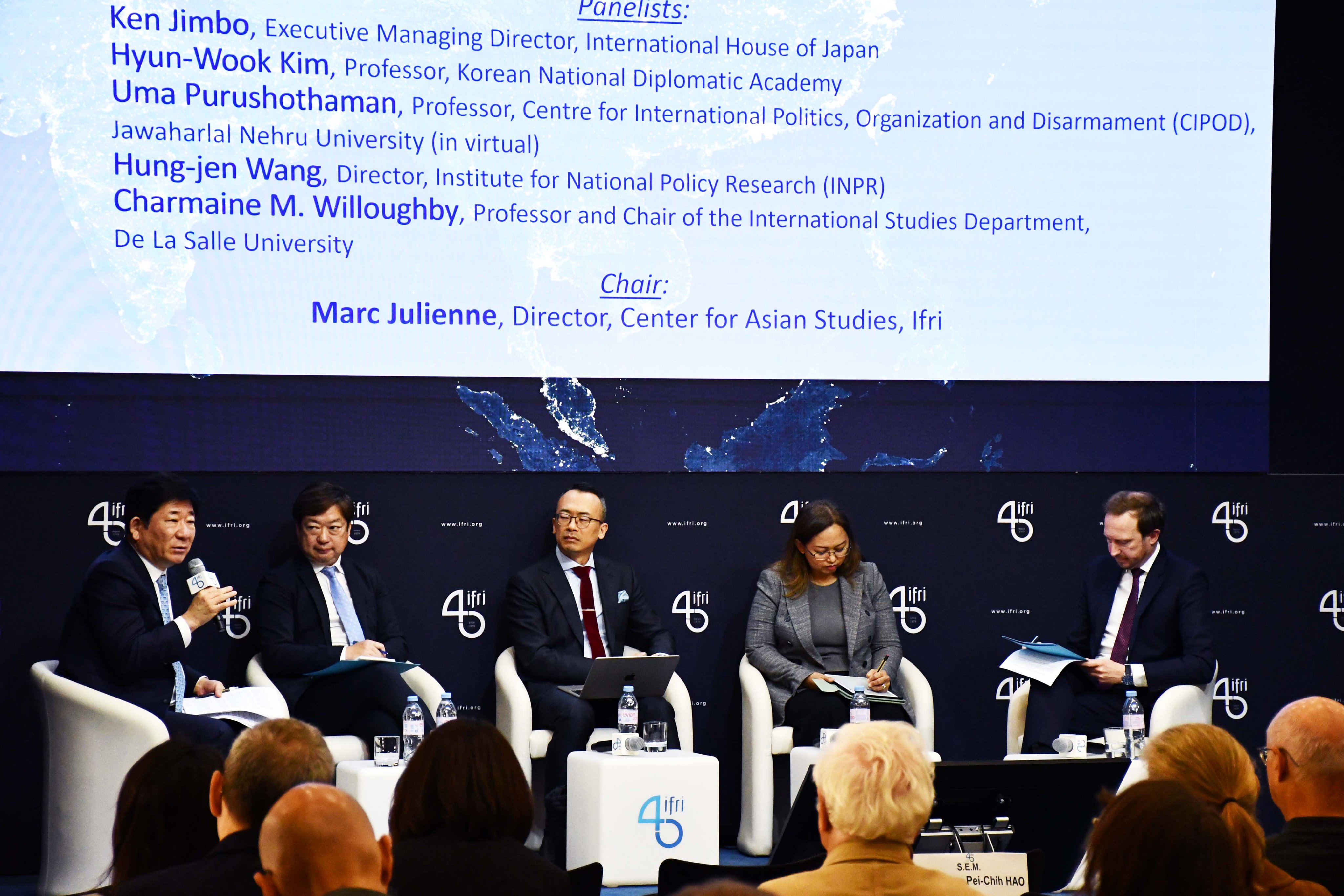
Opening Remarks
Marc Hecker, Executive Director, Ifri
Clémentine Pei-Chih Hao, Representative, Taipei Representative Office in France
Panel discussion on Asia's future amid US-China competition
Ken Jimbo, Executive Managing Director, International House of Japan
Hyun-Wook Kim, Professor, Korean National Diplomatic Academy
Uma Purushothaman, Professor, Centre for International Politics, Organization and Disarmament (CIPOD), School of International Studies, Jawaharlal Nehru University (in virtual)
Hung-jen Wang, Director, Institute for National Policy Research (INPR)
Charmaine M. Willoughby, Professor and Chair of the International Studies Department, De La Salle University
Chaired by Marc Julienne, Director, Center for Asian Studies, Ifri
Taiwan remains committed to preserving the status quo and peace across the Strait, while facing daily military pressure, cyberattacks and disinformation campaigns. Its central role in producing the world’s most advanced semiconductors, continued high levels of US military support and efforts to strengthen societal resilience are its main assets.
South Korea is seeing Washington reshape its military presence on the peninsula so that US forces can respond more quickly elsewhere in the region, at a time when the North Korean threat is growing as Pyongyang moves closer to Moscow. Economically, Seoul is squeezed between China’s technological rise and American demands.
Japan, aware that its regional allies together account for only a fraction of China’s defense budget, practices what speakers called an “alliance by subscription”: it is raising defense spending and investing heavily in the United States to keep the American security guarantee in place. At the same time, it is working to reduce its exposure to Chinese economic coercion, in particular by diversifying its supply of critical minerals.
The Philippines, facing repeated incidents with Chinese vessels in the South China Sea, has chosen to publicize Beijing’s actions in order to rally public opinion and international partners. Manila draws on its 2026 ASEAN chairmanship, its alliance with the United States and new partnerships in Europe, including with France.
Finally, India sees China as its main long-term threat but refuses any alliance that would make it a junior partner of the United States. Instead, it is building up its own strength and expanding its partnerships to preserve its strategic autonomy.

Share