




Worldwide
Related Subjects
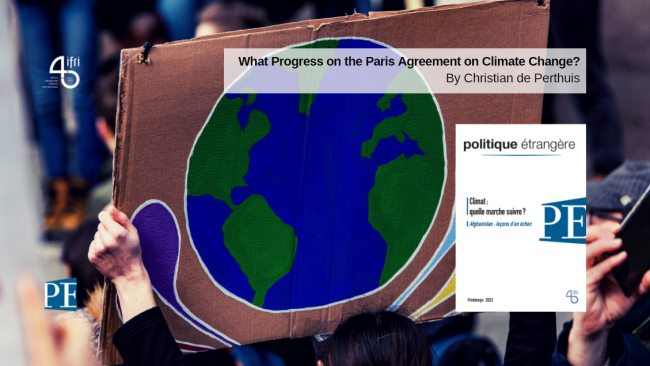
What Progress on the Paris Agreement on Climate Change?
At COP26, a long-term target to keep global warming below 1.5°C was set. This goal is inconsistent with the commitments that the signatory countries have made in terms of reducing their greenhouse gas emissions by 2030.

COVID-19: The Geopolitics of Herd Immunity
Mass vaccination against COVID-19 identifies several groups of countries: rich countries with rapid vaccination; countries that develop and produce vaccines, but do not prioritize vaccination of their own population; and poorer countries that will only achieve herd immunity by 2022 or 2023.

COVID-19 and the End of Technological Innocence
COVID-19 acts as a catalyst in international relations.
The Post-Coronavirus World Is Already Here
The unforeseeable COVID-19 crisis raises fundamental questions on a number of levels.
Foreword
In this special issue of Politique étrangère devoted to the proceedings of the conference organized by Ifri on April 10, 2019, in the Grand Amphitheater of the Sorbonne, on the occasion of its fortieth anniversary, read the foreword by Thierry de Montbrial, founder and president of Ifri.
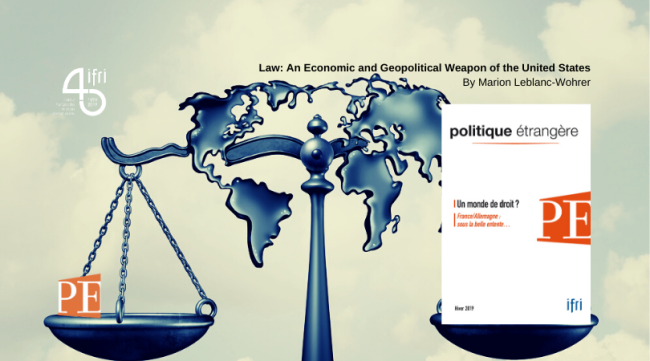
Law: An Economic and Geopolitical Weapon of the United States
From the 2000s, the United States has developed an extraterritorial legal policy that began with fighting corruption but has since broadened considerably.
Between Concentration and Dispersion: A Promising Future for Power Relations
The notion of power has long been a topic of study in international relations. In the coming decade, the evolution of power will be characterized by the dynamics of concentration and dispersion. On the one hand, the global system will be marked by the clash of two superpowers, the United States and China. On the other hand, capacity for individual action will proliferate through information and communication technologies.
International trade disagreements: Beyond Trump
The trade war between the United States and China is not only due to Donald Trump’s impulsiveness. Its roots are in fact profound and follow three structural changes in the multilateral trading system: the reversal of comparative advantages, the now central role of certain developing countries, and the re-balancing of power that makes coordination between states difficult. In this context, the future of world trade has yet to be written.
Possible Energy Transitions through 2029
Renewable energies are experiencing rapid growth, due not only to their limited impact on the environment but also to shrinking costs. To fight climate change, new investments in low carbon technologies are necessary. Apart from its positive aspects, the energy transition carries risks, notably geopolitical. The notion of energy security will be profoundly modified. These risks can be anticipated and managed.
After the Demographic Explosion
Demographic forecasting is not an exact science. UN projections, which suggest that the world population may rise to 11.2 billion in 2100, could be overestimates. Indeed, fertility could fall more rapidly and life expectancy may rise less than expected. The Sahel is set to experience the most spectacular demographic explosion, but this will not necessarily lead to massive migration to Europe.
The Future of the International Monetary and Financial System
Following the collapse of the Bretton Woods system, the international community sought new stability in the financial system and the assurance of sustained growth. The crisis that began in 2007-2008 has revealed weaknesses that affected advanced economies first and foremost. Efforts have since been made to consolidate the international financial architecture, to coordinate macroeconomic policy, and to improve foreign exchange relations, even if this latter objective has proven complex.
Poverty and Inequality through 2030
Thanks to strong economic growth, poverty has tended to fall worldwide. But the trend is not sufficient to eradicate poverty by 2030. For this, growth would have to rise further and inequalities fall. Non-economic dimensions of well-being, such as education and health, also need to be taken into account. This assumes that governments in particular have the capacity to invest in public infrastructures.
Wars in the Next Decade
Forecasting in areas of strategy is particularly delicate as predictions may impact the course of events. While several major trends in the evolution of conflicts during the next decade can be identified, precise forecasts are impossible. Yet one thing is certain: in the next 10 years, decision-makers face unknown risks of significant consequence.
Trump’s Trade Wars: The Outcry Against Multilateralism
The aim of multilateral trade as established after the Second World War was to prevent trade wars.
The Geopolitics of Artificial Intelligence: The Return of Empires?
Artificial intelligence (AI) is swiftly moving forward and becoming a real tool of power.

The Legacy of the Great War: Sovereign States, Globalization and Regionalism
The Great War has shaped many 20th century practices and norms.
Does International Commerce Help Foster Peace?
Montesquieu’s theory of “doux commerce” has never ceased to be debated.
World War I, in Theory
The First World War gave rise to the emergence of the discipline of international relations, but it was the Second World War and the Cold War that fostered its development.
Foreword
In this special issue of Politique étrangère devoted to the proceedings of the conference organized by Ifri on April 10, 2019, in the Grand Amphitheater of the Sorbonne, on the occasion of its fortieth anniversary, read the foreword by Thierry de Montbrial, founder and president of Ifri.
The Future of the International Monetary and Financial System
Following the collapse of the Bretton Woods system, the international community sought new stability in the financial system and the assurance of sustained growth. The crisis that began in 2007-2008 has revealed weaknesses that affected advanced economies first and foremost. Efforts have since been made to consolidate the international financial architecture, to coordinate macroeconomic policy, and to improve foreign exchange relations, even if this latter objective has proven complex.
International trade disagreements: Beyond Trump
The trade war between the United States and China is not only due to Donald Trump’s impulsiveness. Its roots are in fact profound and follow three structural changes in the multilateral trading system: the reversal of comparative advantages, the now central role of certain developing countries, and the re-balancing of power that makes coordination between states difficult. In this context, the future of world trade has yet to be written.
Poverty and Inequality through 2030
Thanks to strong economic growth, poverty has tended to fall worldwide. But the trend is not sufficient to eradicate poverty by 2030. For this, growth would have to rise further and inequalities fall. Non-economic dimensions of well-being, such as education and health, also need to be taken into account. This assumes that governments in particular have the capacity to invest in public infrastructures.
Possible Energy Transitions through 2029
Renewable energies are experiencing rapid growth, due not only to their limited impact on the environment but also to shrinking costs. To fight climate change, new investments in low carbon technologies are necessary. Apart from its positive aspects, the energy transition carries risks, notably geopolitical. The notion of energy security will be profoundly modified. These risks can be anticipated and managed.
Wars in the Next Decade
Forecasting in areas of strategy is particularly delicate as predictions may impact the course of events. While several major trends in the evolution of conflicts during the next decade can be identified, precise forecasts are impossible. Yet one thing is certain: in the next 10 years, decision-makers face unknown risks of significant consequence.
After the Demographic Explosion
Demographic forecasting is not an exact science. UN projections, which suggest that the world population may rise to 11.2 billion in 2100, could be overestimates. Indeed, fertility could fall more rapidly and life expectancy may rise less than expected. The Sahel is set to experience the most spectacular demographic explosion, but this will not necessarily lead to massive migration to Europe.
Between Concentration and Dispersion: A Promising Future for Power Relations
The notion of power has long been a topic of study in international relations. In the coming decade, the evolution of power will be characterized by the dynamics of concentration and dispersion. On the one hand, the global system will be marked by the clash of two superpowers, the United States and China. On the other hand, capacity for individual action will proliferate through information and communication technologies.
Ifri, a foundation recognized as being of public utility, relies largely on private donors – companies and individuals – to guarantee its sustainability and intellectual independence. Through their funding, donors help maintain the Institute's position among the world's leading think tanks. By benefiting from an internationally recognized network and expertise, donors refine their understanding of geopolitical risk and its consequences on global politics and the economy. In 2026, Ifri partners with over 90 French and international companies and organizations.
