



NATO and Nuclear Weapons
The changes in the way that NATO operates raise the question of whether the nuclear weapons stationed in Europe would, in a time of crisis, be an instrument of solidarity, or lead instead to divisiveness.
The 1999 Strategic Concept has been described as a core mission statement for NATO. The Secretary General of the Alliance, Anders Fogh Rasmussen, has established a Group of Experts to lay the groundwork for a new NATO Strategic Concept. The results of the Group of Experts work will be the subject of open consultation among and within the allies before inter-governmental discussions to elaborate a new document. This process is expected to lead to a new Strategic Concept being adopted by the end of 2010.
Among other things, the Strategic Concept lays out the main parameters of current NATO nuclear policy. There appears to be an emerging pattern of reviewing the Strategic Concept of NATO roughly every ten years, so the task facing the experts is to establish guiding principles for Alliance nuclear policy over the next ten years.
At the time of writing, the United States Department of Defense is reviewing its nuclear posture, a process that should be complete by the end of 2009. Aside from the work of the Group of Experts, NATO is also undertaking an internal review of nuclear deterrence requirements for the 21st century. The role, size and configuration of nuclear forces is therefore being evaluated in key NATO countries and collectively within the Alliance.
The United States has tried to create a positive environment for new steps in arms control through a number of political initiatives. In a speech in Prague in April 2009, President Obama reconnected the issues of nuclear non-proliferation and disarmament and emphasized the urgent need to reduce the role of nuclear weapons in international security. The Obama administration has also re-energized the bilateral nuclear arms-control negotiations with Russia and proposed convening a high-level summit in 2010 to discuss the security of nuclear materials worldwide. At the end of September 2009, President Obama chaired a meeting of the UN Security Council discussion of nuclear arms control. This meeting culminated in unanimous support for a Security Council resolution that called for existing nuclear arms-control law to be strengthened. The US administration has also shown a willingness to engage in dialogue with states that are currently considered to pose particular problems for nuclear arms control.
In Europe the leaders of France and the United Kingdom have also developed their thinking on what the next steps should be in creating the conditions not only for additional reductions, but for nuclear disarmament. […]
OUTLINE
- The changing threat picture and NATO’s nuclear response
- Short-range nuclear weapons in NATO strategy
- Engagement with Russia and the future of short-range nuclear weapons in NATO
Dr. Ian Anthony is Research Coordinator at the Stockholm International Peace Research Institute (SIPRI). He is Leader of the Arms Control and Non-Proliferation Programme. His recent publications include: Reforming Nuclear Export Controls: The Future of the Nuclear Suppliers Group (Stockholm, SIPRI, Research Report, No. 22, 2007).

Available in:
Themes and regions
Share
This page contains only a summary of our work. If you would like to have access to all the information from our research on the subject, you can download the full version in PDF format.
NATO and Nuclear Weapons

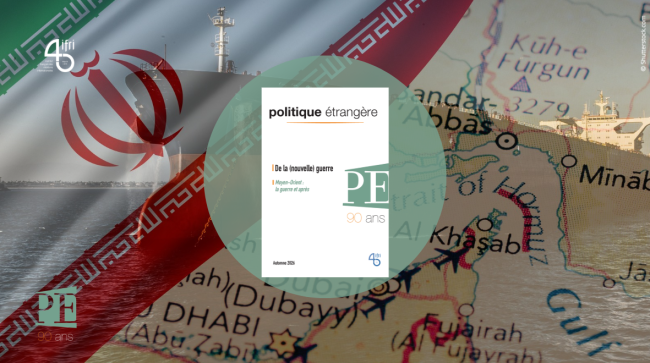
Iran: Anatomy of a Power at War
The elimination of Supreme Leader Ali Khamenei and several high-ranking officials at the outset of the 2026 American-Israeli operation did not succeed in bringing down the Iranian regime. The regime had prepared for such a scenario, notably by decentralizing its structures. Moreover, it continues to adapt to war. The power of the Islamic Revolutionary Guard Corps is growing at the expense of the Shiite clergy. The security apparatus defends the country’s sovereignty and justifies its actions in the name of raison d’état.
“Remodeling” the Middle East?
Chaos continues to spread, seemingly without end, across the Middle East. The Israeli-American attack on Iran has resulted in a clear military and diplomatic failure, but it is paving the way for a regional realignment, the consequences of which remain uncertain. New regional groupings are taking shape, either centered around Israel or built on the prospect of coexistence with Tehran, alongside a decline in American influence and the marginalization of Europe, while China maintains a low-key presence.
Silicon Valley and War: Lessons from Ukraine
Over the course of international conflicts, and particularly in Ukraine, major tech companies have emerged as central actors. Initially subject to wartime maneuvering, they have since become decisive actors in their own right, privatizing a significant share of wartime exchanges, shaping the information flows of societies, and presenting themselves as providers of security. This situation raises important questions about states’ autonomy in making decisions and taking action.
Does Artificial Intelligence Change the Nature of War?
From Gaza to Ukraine and Iran, current conflicts are being shaped by the arrival of artificial intelligence and robots on the battlefield. The changes under way are so profound that humans risk rapidly losing control over entire aspects of the conduct of military operations. While these technological developments are altering the character of war, their impact on the very nature of war itself remains a matter of debate.